1. Joseph Smith’s preparation to receive and translate the Book of Mormon
JS-H 1:27 I continued to pursue my common vocations in life until the twenty-first of September
‘When Joseph warned the Saints against mortal imperfections, he did not raise himself above them, and they loved him for it. He cautioned a group of Saints newly arrived in Nauvoo against the tendency to be dissatisfied if everything was not done perfectly right. “He said he was but a man and they must not expect him to be perfect,” an associate recorded. “If they expected perfection from him, he should expect it from them, but if they would bear with his infirmities and the infirmities of the brethren, he would likewise bear with their infirmities” (The Papers of Joseph Smith, Volume 2, Journal, 1832–1842, ed. Dean C. Jessee [1992], 489).
Joseph had a “native cheery temperament” JS—H 1:28 He delighted in the society of his friends. “He would play with the people,” one acquaintance recalled, “and he was always cheerful and happy” (Rachel Ridgeway Grant, “Joseph Smith, the Prophet,” Young Woman’s Journal 16 [Dec. 1905]: 551). He loved little children and often frolicked with them in a manner shocking to some accustomed to the exaggerated sobriety of other ministers. These warm, human qualities caused some to deny Joseph’s prophetic role, but they endeared him to many who knew him. Our records contain numerous adoring tributes like that of an acquaintance who said, “The love the saints had for him was inexpressible” (Mary Alice Cannon Lambert, Young Woman’s Journal, 16:554).
Despite his familiar and friendly style, the Prophet Joseph Smith was resolute in doing his duty. During a meeting to consider disciplining a man who had rejected the counsel of the Presidency and the Twelve, he declared: “The Saints need not think because I am familiar with them and am playful and cheerful, that I am ignorant of what is going on. Iniquity of any kind cannot be sustained in the Church, and it will not fare well where I am; for I am determined while I do lead the Church, to lead it right” (History of the Church,5:411). On another occasion he wrote, “I am a lover of the cause of Christ and of virtue chastity and an upright steady course of conduct & a holy walk, I despise a hypocrite or a covenant breaker” (The Personal Writings of Joseph Smith, ed. Dean C. Jessee [1984], 246).’ (Dallin H Oaks, General Conference, April 1996)
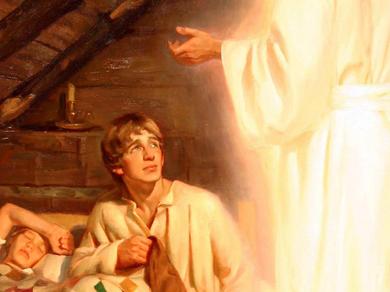
JS-H 1:33-35 First appearance of Moroni
‘In 1822, Joseph began helping his older brother Alvin build a new frame house for the family. By September of 1823, it was two stories high but without a roof. The family continued to live in their small log house.
Here late in the evening on Sunday, 21 September 1823, seventeen-year-old Joseph retired for the night. Concerned about his standing before the Lord, he earnestly prayed for forgiveness of his sins. He was confident that he would again receive a divine manifestation. Suddenly his room filled with light and a heavenly messenger stood by his bedside in partial fulfillment of the great prophecy of John the Apostle (see Revelation 14:6–7).’ (Church History in the Fulness of Time Institute Manual)
2. The miracle of the Book of Mormon’s preservation
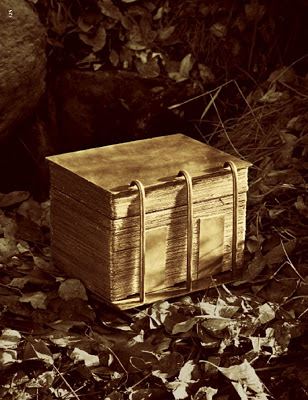
JS-H 1:60 Persecution became more bitter and severe than before, and multitudes were on the alert continually to get them from me
3. Witnesses of the Book of Mormon
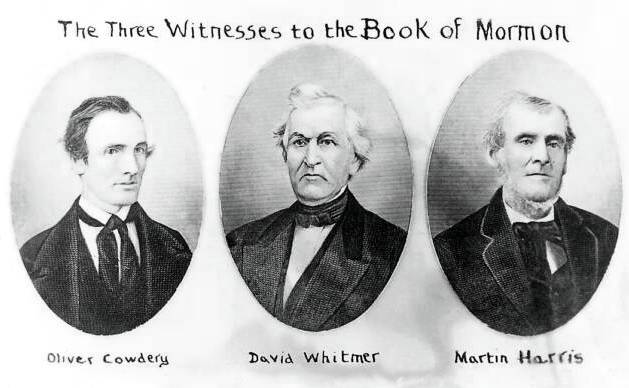
‘The three men chosen as witnesses of the Book of Mormon were Oliver Cowdery, David Whitmer, and Martin Harris. Their written ‘Testimony of Three Witnesses’ has been included in all of the almost 100 million copies of the Book of Mormon the Church has published since 1830. These witnesses solemnly testify that they “have seen the plates which contain this record” and “the engravings which are upon the plates.” They witness that these writings “have been translated by the gift and power of God, for his voice hath declared it unto us.”
…People who deny the possibility of supernatural beings may reject this remarkable testimony, but people who are open to believe in miraculous experiences should find it compelling. The solemn written testimony of three witnesses to what they saw and heard-two of them simultaneously and the third almost immediately thereafter-is entitled to great weight.
…Measured against all…possible objections, the testimony of the Three Witnesses to the Book of Mormon stands forth in great strength. Each of the three had ample reason and opportunity to renounce his testimony if it had been false, or to equivocate on details if any had been inaccurate. As is well known, because of disagreements or jealousies involving other leaders of the Church, each one of these three witnesses was excommunicated from The Church of Jesus Christ of Latter-day Saints by about eight years after the publication of their testimony. All three went their separate ways, with no common interest to support a collusive effort. Yet to the end of their lives-periods ranging from 12 to 50 years after their excommunications-not one of these witnesses deviated from his published testimony or said anything that cast any shadow on its truthfulness.’ (Dallin H Oaks, “The Witness: Martin Harris,” Ensign, May 1999, 35-36)
4. Our duty to “remember the new covenant, even the Book of Mormon”
D&C 84:55 The whole church under condemnation
“Some of the early missionaries, on returning home, were reproved by the Lord in section 84 of the Doctrine and Covenants because they had treated lightly the Book of Mormon. As a result, their minds had been darkened. The Lord said that this kind of treatment of the Book of Mormon brought the whole Church under condemnation, even all of the children of Zion. And then the Lord said, ‘And they shall remain under this condemnation until they repent and remember the new covenant, even the Book of Mormon.’ (See D&C 84:54–57.) Are we still under that condemnation? …
“… Grave consequences hang on our response to the Book of Mormon. ‘Those who receive it,’ said the Lord, ‘in faith, and work righteousness, shall receive a crown of eternal life;
“‘But those who harden their hearts in unbelief, and reject it, it shall turn to their own condemnation—
“‘For the Lord God has spoken it.’ (D&C 20:14–16.)
“Is the Book of Mormon true? Yes.
“Who is it for? Us.
“What is its purpose? To bring men to Christ.
“How does it do this? By testifying of Christ and revealing his enemies.
“How are we to use it? We are to get a testimony of it, we are to teach from it, we are to hold it up as a standard and ‘hiss it forth.’
“Have we been doing this? Not as we should, nor as we must.
“Do eternal consequences rest upon our response to this book? Yes, either to our blessing or our condemnation.
“Every Latter-day Saint should make the study of this book a lifetime pursuit. Otherwise he is placing his soul in jeopardy and neglecting that which could give spiritual and intellectual unity to his whole life.” (Ezra Taft Benson, In Conference Report, Apr. 1975, pp. 96–97; or Ensign,May 1975, p. 65.)
 Latter-day Bloke