1. The Prophet Joseph Smith sealed his testimony with his blood.
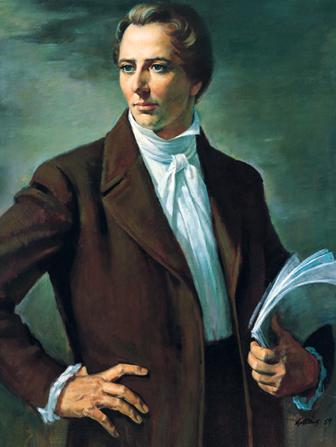
D&C 135:4-5 I am calm as a summer’s morning
‘Joseph Smith sealed his testimony with his blood. He could have saved his life…. He loved life. He loved his wife and family and friends. He wasn’t anxious to go over into eternity. He wanted to live a normal and natural life. He either had to give up his testimony-to recant-or he had to give up his life. He wasn’t willing to give up his testimony. He said, “Who am I to deny that I have had heavenly manifestations-that the Lord has appeared before me?”
And so he went calmly, knowing that his life would be taken. He said, “I go as a lamb to the slaughter”; and he went up to Carthage, knowing that the mob was gathering there and knowing they had bullets in their guns. He went calmly and passed on. He said, as he passed on, “Lord, forgive them, for they know not what they do.” ‘(The Teachings of Spencer W. Kimball, edited by Edward L. Kimball [Salt Lake City: Bookcraft, 1982], 143)
‘President Brigham Young and Elder Wilford Woodruff spent a portion of the day together in the city of Boston, and were sitting together in the railway depot at the time of the massacre of the Prophets; they felt very sorrowful, and depressed in spirits, without knowing the cause.
Elders Heber C. Kimball and Lyman Wight traveled from Philadelphia to New York by railway and steamboat. Elder Kimball felt very mournful as though he had lost some friend, and knew not the cause.
Elder Orson Hyde was in the hall occupied by the saints in Boston, examining maps, and designating or pointing out each man’s district or field of labor, in company with Elders Brigham Young, Wilford Woodruff and others, a part of the day. He felt very heavy and sorrowful in spirit, and knew not the cause, but felt no heart to look on the maps. He retired to the further end of the hall alone, and walked the floor; tears ran down his face…. He never felt so before, and knew no reason why he should feel so then.
Elder Parley P. Pratt was on the canal boat between Utica and Buffalo, N. Y., on his return to Nauvoo, and was much depressed in spirit; his brother William Pratt came on board of the same boat, and Parley asked him if he had any books or pamphlets containing the gospel of Christ, or the words of life; if so, to put them under lock and key, for the people are not worthy of them for, said Parley, “I feel that the spirit of murder is in the hearts of the people through the land.”
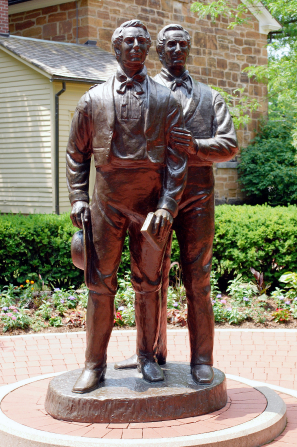
Elders Willard Richards and John Taylor were the only two of the Quorum of the Twelve who were not on missions, and the only two men who were with the martyrs when they fell and sealed their testimony with their blood.
Elder George A. Smith rode with Elder Crandall Dunn, from Napoleon, to Elder Noah Willis Bartholemew’s, near Jacksonburg, Jackson county, Michigan, and felt unusually cast down and depressed in spirits. About five o’clock he repaired to an oak grove, and called upon the Lord, endeavoring to break the spell of horror which had dominion over his mind. He remained there a long time without finding any relief, and then went back to Brother Bartholomew’s, and went to bed with Elder Crandall Dunn; he could not sleep, but spent the night in a series of miserable thoughts and reflections. Once it seemed to him that some fiend whispered in his ear, “Joseph and Hyrum are dead; ain’t you glad of it?”
Elder Amasa Lyman was in the city of Cincinnati, and felt that depression of spirit mentioned by his brethren.’ (History of the Church, 7:132-133)
2. The Prophet Joseph Smith did more for the salvation of men in this world than anyone except Jesus.
Watch: Joseph Smith – Prophet of the Restoration (D&C 135) This review of the Prophet Joseph Smith’s ministry shows that he “has done more, save Jesus only, for the salvation of men in this world.” (13:09)
Watch: Those Who Knew Joseph Best Elder Oaks teaches about those who knew Joseph best (D&C 135). (0:50)
Watch: Testimony of the Book of Mormon A modern-day Apostle describes the unwavering faith the Church’s founders showed, even in the face of death, to remain true to their testimonies of the Book of Mormon.(4:39)
D&C 135:3 ..has sealed his mission
‘If it be the will of the Lord for the people to live, they will live. If it had been the will of the Lord that Joseph and Hyrum should have lived, they would have lived. It was necessary for Joseph to seal his testimony with his blood. Had he been destined to live he would have lived. The Lord suffered his death to bring justice on the nation. The debt is contracted and they have it to pay.’ (Discourses of Brigham Young, selected and arranged by John A. Widtsoe [Salt Lake City: Deseret Book Co., 1954], 467)
Eye witness accounts of Joseph Smith
Jane James, an Afro-American convert :
I could not begin to tell you what he was, only this way, he was tall, over six feet; he was a fine, big, noble, beautiful man! He had blue eyes and light hair, and very fine white skin.
Rachel Ridgeway Grant (mother of Heber J Grant)
I guess you have seen the picture where Brother Joseph was preaching to the Indians. I was there at that time. The Indians were all kneeling down on the grass in front of the Mansion, and if you have seen that picture, that just describes the way everything was, though it is a miserable picture of the Prophet. He was a fine, noble-looking man, always so neat. There are some of the pictures that do not look a particle like him. When he was preaching you could feel the power and influence.
Jacob Jones
The Prophet weighed about 150 pounds, had nice brown hair, was always jovial and could crack a joke. He could sing well and loved music, loved to dance and would leave a meal at any time to wrestle with anyone. He was nimble as a cat and he was fond of us boys and would often play with us.
Anyone could not help but love him and he loved everybody. He always shook hands with all, even the babes. He had a very fine gray horse that he always rode whenever there was a parade.
Matthew S. Davis, member of Congress:
Washington 6th February 1840. My Dear Mary- I went last evening to hear Joe Smith, the celebrated Mormon, expound his doctrine. I with several others, had a desire to understand his tenets as explained by himself. He is not an educated man: but he is a plain, sensible strong minded man. Everything he says, is said in a manner to leave an impression that he is sincere. There is no levity, no fanaticism, no want of dignity in his deportment. He is apparently from forty to forty five years of age, rather above the middle stature, and what you ladies would call a very good looking man. ln his garb there are no peculiarities, his dress being that of a plain unpretending citizen. He is by profession a Farmer; but is evidently well read.
Josiah Quincy III, Mayor of Boston and President of Harvard University:
Pre-eminent among the stragglers by the door stood a man of commanding appearance, clad in the costume of a journeyman carpenter when about his work. He was a hearty, athletic fellow, with blue eyes standing prominently out upon his light complexion, a long nose, and a retreating forehead. He wore striped pantaloons, a linen jacket which had not lately seen the wash tub, and a beard of some three days’ growth. This was the founder of the religion which had been preached in every quarter of the earth.
A fine looking man is what the passerby would instinctively have murmured upon meeting this remarkable individual who had fashioned the mould which was to shape the feelings of so many thousands of his fellow-mortals.
George Q Cannon, Liverpool born member of the Quorum of the Twelve:
He was more than six feet in height, with expansive chest and clean cut limbs ” a staunch and graceful figure. His head, crowned with a mass of soft, wavy hair, was grandly poised. His face possessed a complexion of such clearness and transparency that the soul appeared to shine through. He wore no beard, and the full strength and beauty of his countenance impressed all beholders at a glance. He had eyes which seemed to read the hearts of men. His mouth was one of mingled power and sweetness. His majesty of air was natural, not studied. Though full of personal and prophetic dignity whenever occasion demanded, he could at other times unbend and be as happy and unconventional as a boy. This was one of his most striking characteristics; and it was sometimes held up to scorn by his traducers, that the chosen *’man of God” should at times mingle as a man of earth with his earthly brethren.
Louisa Young Littlefield, met the Prophet as a 12 year old girl in 1834:
I will speak of a prominent trait of his character which was perhaps more marked in his early career than was the case after public cares and responsibilities multiplied upon him from so many sources. I mean his natural fondness for children. In Kirtland, when wagon loads of grown people and children came in from the country to meeting, Joseph would make his way to as many of the wagons as he well could and cordially shake the hand of each person. Every child and young babe in the company were especially noticed by him and tenderly taken by the hand, with his kind words and blessings. He loved innocence and purity, and he seemed to find it in the greatest perfection with the prattling child.
James Worthington Phippen:
I was favorably impressed with his noble mien, his stately form and his pleasant, smiling face and cheerful conversation. Before I ever saw Joseph Smith I was satisfied that he was a man inspired of God, and when I beheld him if anything further could have increased my knowledge of him being a Prophet of the Lord, I was confirmed. During my acquaintance with him from 1839 until 1844, his teachings and examples were strong proof to me of his divine calling, without the inspiration of the Lord. I was an attentive listener and observer of the teachings, sayings and example of the Prophet Joseph Smith from the first time I saw him till the month of May, 1844, at which time I left Nauvoo for the state of New York on a mission. And being quite familiar with the history of his life as written, I remember many sayings recorded that I heard him utter. In common with those who were acquainted with his public life and doings in the midst of the Saints in Nauvoo, I had great joy and satisfaction in listening to his teachings.
Emmeline B Wells, 5th Relief Society General President:
In his manner he was gentle and kindly, and he was always affectionate to his friends, and at times demonstrative. He was strong and ardent in his nature and valued highly the quality of sincerity in friendship. He was manly to an unusual degree, yet tender-hearted as a woman on occasions. In his tastes he was literary as well as spiritual, fond of the drama, of music and of poetry. A very dear friend of mine who knew the Prophet intimately . . .[said] that she had known him to shed tears when hearing some specially fine vocal music, particularly old-fashioned songs and ballads. With such noble characteristics it is not strange that he was so intensely beloved.
John S. Reed, lawyer who helped Joseph Smith in some of his early law suits:
… The first acquaintance I had with General Smith was about the year 1823. He came into my neighborhood, being then about eighteen years of age, and resided there two years, during which time I became intimately acquainted with him. I do know that his character was irreproachable, and that he was well known for truth and uprightness; that he moved in the first circles of the community, and he was often spoken of as a young man of intelligence and good morals, and possessing a mind susceptible of the highest intellectual attainments. I early discovered that his mind was constantly in search of truth, expressing an anxious desire to know the will of God.
Peter H. Burnett, a former Governor of California:
You could see at a glance that his education was very limited. He was an awkward and vehement speaker. In conversation he was slow, and used too many words to express his ideas, and would not generally go directly to a point. But, with all these drawbacks, he was much more than an ordinary man. He possessed the most indomitable perseverance, was a good judge of men, and deemed himself born to command, and he did command. His views were so strange and striking, and his manner was so earnest, and apparently so candid, that you could not but be interested. There was a kind, familiar look about him, that pleased you. He was very courteous in discussion, readily admitting what he did not intend to controvert, and would not oppose you abruptly, but had due deference to your feelings. He had the capacity for discussing a subject in different aspects, and for proposing many original views, even of ordinary matters. His illustrations were his own. He had great influence over others. As an evidence of this I will state that on Thursday, just before I left to return to Liberty [Missouri], I saw him out among the crowd, conversing freely with every one, and seeming to be perfectly at ease. In the short space of five days he had managed so to mollify his enemies that he could go unprotected among them without the slightest danger.
Dr. John M. Bernhisel, close friend of Joseph Smith:
Having been a boarder in General Smith’s family for more than nine months, and having therefore had abundant opportunities of contemplating his character and observing his conduct, I have concluded to give you a few of my “impressions” of him.
General Joseph Smith is naturally a man of strong mental powers, and is possessed of much energy and decision of character, great penetration, and a profound knowledge of human nature. He is a man of calm judgment, enlarged views, and is eminently distinguished by his love of justice. He is kind and obliging, generous and benevolent, sociable and cheerful, and is possessed of a mind of a contemplative and reactive character. He is honest, frank, fearless and independent, and as free from dissimulation as any man to be found.
But it is in the gentle charities of domestic life, as the tender and affectionate husband and parent, the warm and sympathizing friend, that the prominent traits of his character are revealed, and his heart is felt to be keenly alive to the kindest and softest emotions of which human nature is susceptible; and I feel assured that his family and friends formed one of the greatest consolations to him while the vials of wrath were poured upon his head, while his footsteps were pursued by malice and envy, and reproach and slander were strewn in his path, as well as during numerous and cruel persecutions, and severe and protracted sufferings in chains and loathsome prisons, for worshiping God according to the dictates of his own conscience.
He is a true lover of his country, and a bright and shining example of integrity and moral excellence in all the relations of life. As a religious teacher, as well as a man, he is greatly beloved by this people. It is almost superfluous to add that the numerous ridiculous and scandalous reports in circulation respecting him have not the least foundation in truth.
Lorenzo Snow
I shall never forget the first time I saw Joseph Smith. It was in Father Johnson’s house, in the township of Hiram, in the State of Ohio, about twenty-five miles from Kirtland. It was near Father Johnson’s where the mob tarred and feathered him. When I saw him he was standing in the doorway. Before him was a small bowery occupied by about a hundred and fifty or two hundred men and women. There for the first time I heard his voice. When I heard his testimony in regard to what the Lord had revealed to him, it seemed to me that he must be an honest man. He talked and looked like an honest man. He was an honest man.
Margarette McIntire Burgess, convert who lived in Nauvoo as a child:
Another time my older brother and I were going to school, near to the building which was known as Joseph’s brick store. It had been raining the previous day, causing the ground to be very muddy, especially along that street. My brother Wallace and I both got fast in the mud, and could not get out, and of course childlike, we began to cry, for we thought we would have to stay there. But looking up, I beheld the loving friend of children, the Prophet Joseph, coming to us. He soon had us on higher and drier ground. Then he stooped down and cleaned the mud from our little, heavyladen shoes, took his handkerchief from his pocket and wiped our tear-stained faces. He spoke kind and cheering words to us, and sent us on our way to school rejoicing.
Brigham Young:
When I first heard him preach, he brought heaven and earth together; and all the priests of the day could not tell me anything correct about heaven, hell, God, angels, or devils; they were as blind as Egyptian darkness. When I saw Joseph Smith, he took heaven, figuratively speaking, and brought it down to earth; and he took the earth, brought it up, and opened up in plainness and simplicity, the things of God; and that is the beauty of his mission.
 Latter-day Bloke