1. The Lord instructed the Saints regarding their physical preparations for their journey.
Section 136, … Brigham Young’s only canonized revelation, was proclaimed on 14 January 1847 in the depths of a very cold winter and at a most trying moment in Church history. Having been driven from their comfortable homes and their glorious temple in Nauvoo, some twelve thousand Latter-day Saints huddled in various makeshift settlements, including Winter Quarters in Nebraska Territory on Indian lands just west of the Missouri River; Council Bluffs (Kingsville), Iowa Territory; other communities stretching along the Missouri River as far south as St. Louis; and temporary settlements such as Mt. Pisgah and Garden Grove, along the trail from Winter Quarters to the Salt Lake Valley. Some five hundred of the Saints’ most able men had been called into service by the United States Army of the West and were then marching to the Pacific coast as the Mormon Battalion. Church members were largely uprooted and spread out on their way west in a full-scale exodus of man and beast to a new Zion in some valley of the Rocky Mountains.
During the winter of 1847, the Quorum of the Twelve and others counseled together on how best to move the large body of Saints to the Great Basin. While they were discussing how they should travel in companies with presidencies over each company and captains of hundreds, fifties, and tens (as did the ancient Israelites under Moses; Deuteronomy 1:15), Brigham Young received this revelation. (Largey, Doctrine and Covenants Reference Companion, (2012), p.856)
Read: Revelations in Context: This Shall Be Our Covenant
This article shows how difficulties crossing Iowa helped lead to the Lord revealing what is now known as Doctrine and Covenants 136.
‘[D&C 136] was read to each quorum in the area and sustained as the word of the Lord to them. Copies were made and members of the Twelve and the local high councils traveled to all the other camps, read the revelation, and obtained sustaining votes. Thus, the revelation was canonized by the Saints within days of its reception and is evidence that these people were committed to the leadership of Brigham Young and the other members of the Quorum of the Twelve.
Furthermore, the revelation transformed their travels and travails from a mere westward departure into an exodus of modern Israel with divine design and purpose. Spelling out the revised organization by which they would begin to travel west of the Missouri through hostile Indian country, the revelation was at once a resolution and an explanation, a vindication and a promise.’ (Largey, Doctrine and Covenants Reference Companion, (2012), p.856)
D&C 136:1–3. How Was the Camp of Israel Organized?
D&C 136:6 When the companies are organized let them… prepare for those who are to tarry
“In accord with a 14 January 1847 revelation (see D&C 136), President Young organized the Saints carefully into companies of 100, 50, and 10 (meaning people in this case, not wagons). He served as company president and main captain, aided by 2 captains of 100, 5 captains of 50, and 14 captains of 10. Their story is one of ‘organization, foresight, and discipline,’ wrote one historian, saying that they stopped more days for Sabbath worship than for delays caused by travel hazards.
“For half their journey, this advance, exploratory company followed the north side of the Platte River. Later travelers joked that the lazy Platte was ‘a mile wide and an inch deep, too thin to plow, too thick to drink.’ As much as possible, they followed somewhat established trails, smoothing and improving the way for following pioneer companies and only occasionally blazing new trail segments.” (William G. Hartley, “Gathering the Dispersed Nauvoo Saints, 1847-1852,” Ensign, July 1997, 19)
2. The Lord instructed the Saints regarding their conduct.
D&C 136:18–27. Zion Will Be Redeemed
Smith and Sjodahl wrote that “the members of the Church had been disappointed, if not discouraged, because Zion had not been redeemed. No doubt it was trying to the faith of some to be on the way to the unknown region of the Rocky Mountains. All that they had heard of this territory was discouraging and the redemption of Zion seemed farther away than ever from fulfillment. Now they were to take courage, for the Lord had not forgotten Zion, and it should be redeemed in the due time of the Lord. It was well, therefore, for the members to obey counsel and not seek to build themselves at the expense of others; should this be done they would lose the reward. The Lord would lead them as he led the children of Israel, and he was just as mindful of the Saints today as he was then. Every man should respect the rights and property of the rest, and all should be wise stewards.” (Commentary, p. 860.)
D&C 136:21 Keep yourselves from evil to take the name of the Lord in vain
‘In the revelation given to President Brigham Young on January 14, 1847, while the Saints were preparing to leave Winter Quarters for these valleys in the West, the Lord said to them, “Keep yourselves from evil to take the name of the Lord in vain, for I am the Lord your God, even the God of your fathers, the God of Abraham and of Isaac and of Jacob” (D&C 136:21).
In a general epistle to the entire Church issued by the First Presidency on April 8, 1887, a hundred years ago, they said concerning this problem, which evidently was serious then as it is now, “The habit … , which some young people fall into, of using vulgarity and profanity … is not only offensive to well-bred persons, but it is a gross sin in the sight of God, and should not exist among the children of the Latter-day Saints” (in Messages of the First Presidency, comp. James R. Clark, 6 vols., Salt Lake City: Bookcraft, 1965-75, 3:112-13).
I once worked with a group of railroad men who seemed to pride themselves on the use of profanity. They tried to make an art of it. I recall handing a written instruction to a switchman. It was his job to take care of the matter as instructed, but he thought it inconvenient that he should have to do so at that time. On reading the order, he flew into a tantrum. He was a fifty-year-old man, but he acted like a spoiled child. He threw his cap on the ground and jumped on it and let forth such a string of expletives as to seem to cause the air to turn blue around him. Every third or fourth word was the name of Deity spoken in vain.
I thought, how childish can a grown man be? The very idea of a man acting and speaking like that was totally repugnant. I could never again give him my full respect.
When I was a small boy in the first grade, I experienced what I thought was a rather tough day at school. I came home, walked in the house, threw my book on the kitchen table, and let forth an expletive that included the name of the Lord.
My mother was shocked. She told me quietly, but firmly, how wrong I was. She told me that I could not have words of that kind coming out of my mouth. She led me by the hand into the bathroom, where she took from the shelf a clean washcloth, put it under the faucet, and then generously coated it with soap. She said, “We’ll have to wash out your mouth.” She told me to open it, and I did so reluctantly. Then she rubbed the soapy washcloth around my tongue and teeth. I sputtered and fumed and felt like swearing again, but I didn’t. I rinsed and rinsed my mouth, but it was a long while before the soapy taste was gone. In fact, whenever I think of that experience, I can still taste the soap. The lesson was worthwhile. I think I can say that I have tried to avoid using the name of the Lord in vain since that day. I am grateful for that lesson.
On one occasion, Jesus said to the multitude, “Not that which goeth into the mouth defileth a man; but that which cometh out of the mouth, this defileth a man” (Matt. 15:11).’ (Gordon B Hinckley, “Take Not the Name of God in Vain,” Ensign, Nov. 1987, 45-46)
D&C 136:23 cease to speak evil one of another
‘Faultfinding, evil speaking, and backbiting are obviously unchristian. The Bible commands us to avoid “evil speakings.” (See 1 Pet. 2:1.) It tells us to “Let all bitterness, and wrath, and anger, and clamour, and evil speaking, be put away from you.” (Eph. 4:31.) Modern revelations direct us to avoid “backbiting,” “evil speaking,” and “find[ing] fault one with another.” (See D&C 20:53-54; D&C 42:27; D&C 88:124; and D&C 136:23.)
We are given these commandments for a reason. The Apostle Paul advised the Saints to “grieve not the holy Spirit of God” (Eph. 4:30) by evil speaking. Of faultfinders, President Brigham Young said, “The Spirit of God has no place in [such] persons.” (Journal of Discourses, 8:13.) The primary reason we are commanded to avoid criticism is to preserve our own spiritual well-being, not to protect the person whom we would criticize.
Elder George Albert Smith said this about criticism: “Aren’t we rather prone to see the limitations and the weaknesses of our neighbors? Yet that is contrary to the teachings of the gospel of Jesus Christ. There is a class of people who find fault and criticize always in a destructive way. There is a difference in criticism. If we can criticize constructively under the influence of the Spirit of the Lord, we may change beneficially and properly some of the things that are being done. But if we have the spirit of faultfinding, of pointing out the weaknesses and failings of others in a destructive manner, that never comes as the result of the companionship of the Spirit of our Heavenly Father and is always harmful.”‘ (Dallin H Oaks, “Criticism,” Ensign, Feb. 1987, 68)
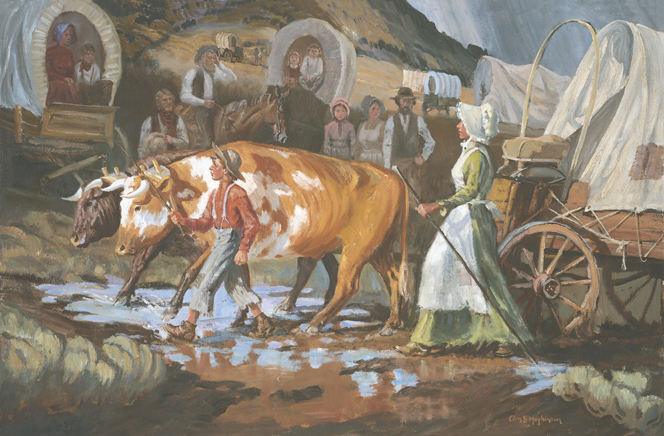
3. Under the direction of President Brigham Young, the Saints journeyed to the Salt Lake Valley.
Watch: Learning Through Trials Elder Robert D Hales
Watch: Ministry of Brigham Young – A Visionary Leader

‘On 21 July 1847, Orson Pratt and Erastus Snow of the first pioneer company preceded the emigrants into the Salt Lake Valley. They saw grass so deep that a person could wade through it, promising land for farming, and several creeks that wandered through the valley. Three days later, President Brigham Young, who was ill with mountain fever, was driven in his carriage to the mouth of a canyon that opened onto the valley. As President Young looked over the scene, he gave his prophetic benediction to their travels: “It is enough. This is the right place.”
As the Saints who followed emerged from the mountains, they, too, gazed at their promised land! This valley with its salty lake gleaming in the western sun was the object of vision and prophecy, the land of which they and thousands after them dreamed. This was their land of refuge, where they would become a mighty people in the midst of the Rocky Mountains.
Several years later, a convert from England, Jean Rio Griffiths Baker, recorded her feelings as she viewed Salt Lake City for the first time. “The city … is laid out in squares or blocks as they call them here; each containing ten acres and divided into eight lots, each lot having one house. I stood and looked, I can hardly analyze my feelings, but I think my prevailing ones were joy and gratitude for the protecting care had over me and mine during our long and perilous journey.”’ (This is the Right Place in Our Heritage)

 Latter-day Bloke