
1. President Brigham Young guided the rescue of the Martin and Willie handcart companies.
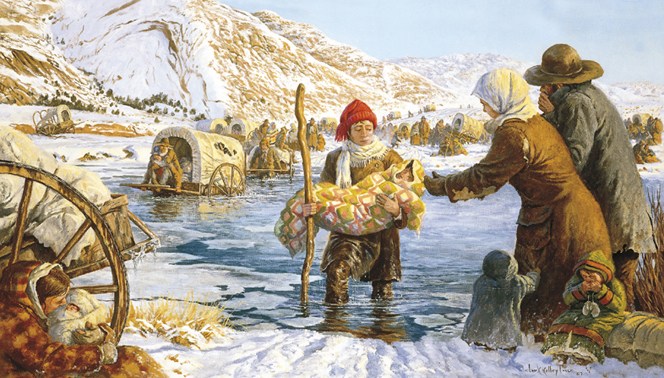
See: Five Things You May Not Know About the Handcart Rescue
Read: How the Rescue of Handcart Pioneers Helped Revive the Relief Society
‘In the 1850s Church leaders decided to form handcart companies as a way to reduce expenses so that financial aid could be extended to the greatest number of emigrants. Saints who traveled this way put only 100 pounds of flour and a limited quantity of provisions and belongings into a cart and then pulled the cart across the plains. Between 1856 and 1860, ten handcart companies traveled to Utah. Eight of the companies reached the Salt Lake Valley successfully, but two of them, the Martin and Willie handcart companies, were caught in an early winter and many Saints among them perished.
Nellie Pucell, a pioneer in one of these ill-fated companies, turned ten years old on the plains. Both her parents died during the journey. As the group neared the mountains, the weather was bitter cold, the rations were depleted, and the Saints were too weak from hunger to continue on. Nellie and her sister collapsed. When they had almost given up hope, the leader of the company came to them in a wagon. He placed Nellie in the wagon and told Maggie to walk along beside it, holding on to steady herself. Maggie was fortunate because the forced movement saved her from frostbite.
When they reached Salt Lake City and Nellie’s shoes and stockings, which she had worn across the plains, were removed, the skin came off with them as a result of frostbite. This brave girl’s feet were painfully amputated and she walked on her knees the rest of her life. She later married and gave birth to six children, keeping up her own house and raising a fine posterity.10 Her determination in spite of her situation and the kindness of those who cared for her exemplify the faith and willingness to sacrifice of these early Church members. Their example is a legacy of faith to all Saints who follow them.
A man who crossed the plains in the Martin handcart company lived in Utah for many years. One day he was in a group of people who began sharply criticizing the Church leaders for ever allowing the Saints to cross the plains with no more supplies or protection than a handcart company provided. The old man listened until he could stand no more; then he arose and said with great emotion:
“I was in that company and my wife was in it. … We suffered beyond anything you can imagine and many died of exposure and starvation, but did you ever hear a survivor of that company utter a word of criticism? … [We] came through with the absolute knowledge that God lives for we became acquainted with him in our extremities.
“I have pulled my handcart when I was so weak and weary from illness and lack of food that I could hardly put one foot ahead of the other. I have looked ahead and seen a patch of sand or a hill slope and I have said, I can go only that far and there I must give up, for I cannot pull the load through it. … I have gone on to that sand and when I reached it, the cart began pushing me. I have looked back many times to see who was pushing my cart, but my eyes saw no one. I knew then that the angels of God were there.
“Was I sorry that I chose to come by handcart? No. Neither then nor any minute of my life since. The price we paid to become acquainted with God was a privilege to pay, and I am thankful that I was privileged to come in the Martin Handcart Company.”’ (Handcart Pioneers in Our Heritage)
2. The Savior rescues us through His atoning sacrifice.
“I remember reading about a fire fighter in the eastern United States who ran into a burning house to rescue several children from an arson-induced fire. While his colleagues battled the blaze to keep it from spreading to other structures in the neighbor-hood, this man dashed into the building again and again, each time emerging with a child in his arms. After rescuing the fifth child, he started back into the inferno once more. Neighbors shouted that there were no more children in the family. But he insisted that he had seen a baby in a cradle, and he dove into the intensifying heat.
“Moments after he disappeared into the fire and smoke, a horrifying explosion shook the building and the entire structure collapsed. It was several hours before fire fighters were able to locate their colleague’s body. They found him in the nursery near the crib, huddled protectively over a life sized—and practically unscratched—doll.
“As I think about such heroism, however, I’m reminded that the most heroic act of all time ever was performed in behalf of all mankind by the Son of God. In a very real sense, all of humanity—past, present, and future—was trapped behind a wall of flame that was fueled and fanned by our own faithlessness. Sin separated mortals from God (see Romans 6:23), and would do so forever unless a way was found to put out the fires of sin and rescue us from ourselves” (Cited in Our Search for Happiness: M. Russell Ballard, p. 11).
D&C 18:11-12 He suffered the pain of all men
“The results of childhood abuse, whether sexual, physical, or emotional, can be devastating…Truly the Atonement plays the crucial role in the healing process as people with broken hearts and scarred spirits realize they are not alone in their pain and that the Savior has provided a way for them to find peace.
“‘In October 1995 I was sitting in a chapel listening to general conference,’ remembers one woman. ‘Elder Jeffrey Holland spoke on remembering the Lord during the passing of the sacrament…he said, `To those who stagger or stumble, he is there to steady and strengthen us. In the end he is there to save us, and for all this he gave his life` (“This Do in Remembrance of Me,” Ensign, Nov. 1995, 69).
“‘I was amazed. I knew Jesus Christ had given his life to pay for the sins of the world. But I did not know the Savior had given his life for the pains, abuse, and tearful suffering we all have to endure in this life, oftentimes as innocent victims of terrible circumstances far beyond our own control.
“‘I raced home after conference in order to look up scriptures about this aspect of the Savior’s Crucifixion. I found a wonderful scripture: Remember the worth of souls is great in the sight of God;
“‘For, behold, the Lord your Redeemer suffered death in the flesh; wherefore he suffered the pain of all men, that all men might repent and come unto him (D&C 18:10-11). He did not suffer just for people’s sins; he also suffered their pains. What a powerful message that was to my heart to learn he had suffered for those of us who had been abused. I can honestly say that my healing began on that day.'” (“The Journey to Healing,” Ensign, Sept. 1997, 19-20)
3. As Latter-day Saints, we are to rescue those in need.
Watch: Tried in All Things (D&C 136:29-33) Elder Maxwell explains how the Saints will be tried in all things. (1:47)
Watch: Ministering (2014/15 Auxiliary Training)
D&C 4:3 If Ye Have Desires
‘Actually, everything depends-initially and finally-on our desires. These shape our thought patterns. Our desires thus precede our deeds and lie at the very cores of our souls, tilting us toward or away from God (see D&C 4:3).’ (Neal A Maxwell, “Swallowed Up in the Will of the Father,” Ensign, Nov. 1995, 23)
D&C 18:10-16 The Worth of Souls is Great
“And how are we to determine the value of souls? This matter has been determined for us also by revelation. The souls of men are so precious in the sight of God that He gave to the world His Only Begotten Son, that by the shedding of His blood He might draw all men unto Him. That is why the great Prophet of this dispensation, Joseph Smith, and these others, John Whitmer, Oliver Cowdery, David Whitmer, and the rest, were called to bring souls unto Christ. And if one of these men should labor all his days, and bring save it be but one soul unto Christ, and that one should be his wife, what great joy he would have with his wife in heaven. Then if he should labor all his days and bring unto Christ the souls of his wife and his children, and none else perchance, how great would be his joy in heaven with his wife and children.” (Rudger Clawson In Conference Report, Apr. 1901, pp. 7–8.)
D&C 52:40 Remember in All Things the Poor and Needy
‘That one cannot be a true disciple of Christ without significant giving is dramatically emphasized in the revelation received by the Prophet Joseph Smith in Kirtland, on June 7, 1831. In this revelation, the Lord directed twenty-eight of the elders to travel two by two from Kirtland to Jackson County, Missouri. They were to go by different routes, preaching the gospel as they went. You will recall that they were destitute in those days and had to travel through primitive country. Joseph Smith and his immediate companions “journeyed by wagon and stage and occasionally by canal boat to Cincinnati, Ohio,” then to Louisville, Kentucky, and on to St. Louis by steamer. “From this city on the Mississippi, the Prophet of God walked across the entire state of Missouri to Independence, Jackson County, a distance of nearly three hundred miles as traveled.” (George Q. Cannon, Life of Joseph Smith the Prophet, Salt Lake City: Deseret Book Company, 1958, p. 117.) I call these facts to your attention that you may have in mind the background against which the Lord said to these men as they started, “Remember in all things the poor and the needy, the sick and the afflicted, for he that doeth not these things, the same is not my disciple.” (D&C 52:40.) Imagine that! These elders were nearly destitute and the Lord said, “Remember … the poor and the needy.”‘ (Marion G Romney, “Living Welfare Principles,” Ensign, Nov. 1981, 92)
 Latter-day Bloke