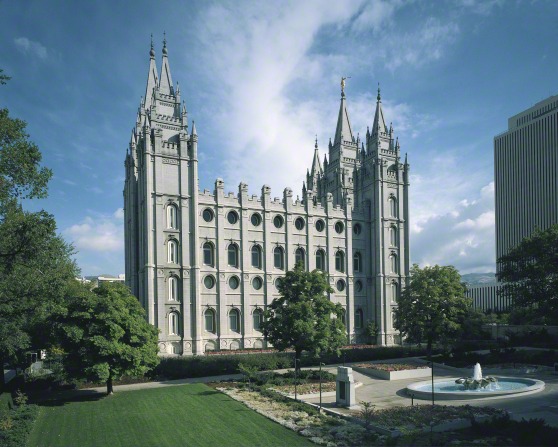
1. “Right here will stand the temple of our God.”
Watch: Ministry of Brigham Young – The Master Builder
Watch: Ministry of Gordon B Hinckley – Temple Building
The construction of temples across the globe allows the blessings of the temple to attend LDS families wherever they reside. (1:57)
‘Two days after the first company’s arrival, Brigham Young and several of the Twelve climbed a round bluff on the mountainside that President Young had seen in vision before leaving Nauvoo. They looked out over the valley’s vast expanse and prophesied that all nations of the world would be welcome in this place and that here the Saints would enjoy prosperity and peace. They named the hill Ensign Peak after the scripture in Isaiah that promised, “He shall set up an ensign for the nations, and shall assemble the outcasts of Israel” (Isaiah 11:12).
President Young’s first public act, on 28 July 1847, was to select a central site for a temple and put men to work planning its design and construction. Placing his cane on the chosen spot he said, “Here we shall build a temple to our God.” This declaration must have comforted the Saints, who only a short time before had been forced to discontinue temple worship when they left Nauvoo.’ (Our Heritage)
“The next morning he and the Twelve who came with him took a walk. He had been quite feeble, but he was then able to walk with the assistance of his staff. We walked along until we came to this Temple Block. It was covered with sagebrush. There was no mark to indicate that God ever intended to place anything there. But while walking along Brother Brigham stopped very suddenly. He stuck his cane in the ground and said, ‘Right here will stand the great Temple of our God.’ We drove a stake in the place indicated by him, and that particular spot is situated in the middle of the Temple site” (Wilford Woodruff, Collected Discourses, Vol. 5, delivered on April 6, 1992).
“The pioneers were hungry and weary; they needed food and rest; a hostile desert looked them in the face; yet in the midst of such physical requirements they turned first to the building of temples and to the spiritual food and strength that the temples provide.” (Elder John A Widtsoe, Conf. Rpt., Apr. 1943, 38).
2. The Saints were obedient as they settled and colonized the Salt Lake Valley and the surrounding areas.

D&C 58:2-4 Faithful in tribulation
“If the Saints could realize things as they are when they are called to pass through trials, and to suffer what they call sacrifices, they would acknowledge them to be the greatest blessings that could be bestowed upon them” (Discourses of Brigham Young, p. 345).
D&C 64:33 Be not weary in well-doing
‘A major reason this church has grown from its humble beginnings to its current strength is the faithfulness and devotion of millions of humble and devoted [members]… He encourages us to “be not weary in well-doing, for [we] are laying the foundation of a great work. And out of small things proceedeth that which is great.” May we be faithful in fulfilling the duties of whatever calling we have in the kingdom. Let us pay heed to the “small things” that make all the difference. Let us be faithful in keeping the commandments as we have made sacred covenants to do. As our heritage and our growth clearly show, we are, indeed, “laying the foundation of a great work.”
Let us dedicate ourselves to doing the Lord’s work to the best of our abilities. May we honor the faith of our fathers by giving our own faithful service to this great cause.’ (Joseph B Wirthlin, “Faith of Our Fathers,” Ensign, May 1996, 34)
3. Missionaries made sacrifices to teach the gospel throughout the world.
‘With the hum of labor and domestic life filling the air, President Brigham Young turned to the concerns of the Church. At the general conference held on 6 October 1849, he assigned several members of the Twelve, along with newly called missionaries, to serve foreign missions. They accepted these calls even though they would leave behind their families, their new homes, and many unfinished tasks. Erastus Snow and several elders opened missionary work in Scandinavia, while Lorenzo Snow and Joseph Toronto traveled to Italy. Addison and Louisa Barnes Pratt returned to Addison’s former field of labor in the Society Islands. John Taylor was called to France and Germany. As the missionaries traveled east, they passed Saints headed to the new Zion in the Rocky Mountains.
In their fields of labor, the missionaries witnessed miracles and baptized many people into the Church. When Lorenzo Snow, who later became President of the Church, was preaching in Italy, he saw a three-year-old boy on the verge of death. He recognized an opportunity to heal the child and open the hearts of the people in the area. That night he prayed long and earnestly for God’s direction, and the following day he and his companion fasted and prayed for the boy. That afternoon they administered to him and offered a silent prayer for help in their labors. The boy slept peacefully all night and was miraculously healed. Word of this healing spread across the valleys of the Piedmont in Italy. The doors were opened to the missionaries, and the first baptisms in the area took place.5
In August 1852, at a special conference held in Salt Lake City, 106 elders were called to go on missions to countries throughout the world. These missionaries, as well as those who were called later, preached the gospel in South America, China, India, Spain, Australia, Hawaii, and the South Pacific. In most of these areas, the missionaries had little initial success. However, they sowed seeds that resulted in many coming into the Church in later missionary efforts.
Elder Edward Stevenson was called to the Gibraltar Mission in Spain. This call meant a return to the place of his birth, where he boldly proclaimed the restored gospel to his countrymen. He was arrested for preaching and spent some time in jail until authorities found he was teaching the guards, almost converting one of them. After his release he baptized two people into the Church and by January 1854 a branch of ten members had been organized. In July, even though six members had left to serve with the British army in Asia, the branch had eighteen members, including one seventy, one elder, one priest, and one teacher, giving the branch the leadership it needed to continue to grow.6
Local governments in French Polynesia drove the missionaries out in 1852. But the converted Saints kept the Church alive until further proselyting efforts in 1892. Elders Tihoni and Maihea were especially valiant as they endured imprisonment and other ordeals rather than deny their faith. Each of them tried to keep the Saints active and faithful to the gospel.7
For those who joined the Church outside the United States, this was a time for gathering to Zion, which meant traveling by boat to America. Elizabeth and Charles Wood sailed in 1860 from South Africa, where they had labored several years to acquire money for their travel. Elizabeth kept house for a wealthy man, and her husband made bricks until they obtained the needed funds. Elizabeth was carried aboard the ship on a bed 24 hours after delivering a son and was given the captain’s berth so she could be more comfortable. She was very ill during the journey, almost dying twice, but lived to settle in Fillmore, Utah.
Missionaries became very dear to the Saints in the countries where they served. Joseph F. Smith, near the end of his mission to Hawaii in 1857, became ill with a high fever that prevented him from working for three months. He was blessed to come under the care of Ma Mahuhii, a faithful Hawaiian Saint. She nursed Joseph as if he were her own son, and a strong bond of love developed between the two. Years later, when he was President of the Church, Joseph F. Smith visited Honolulu and just after his arrival saw an old blind woman being led in with a few choice bananas in her hand as an offering. He heard her call, “Iosepa, Iosepa” (Joseph, Joseph). Immediately he ran to her and hugged and kissed her many times, patting her on the head and saying, “Mama, Mama, my dear old Mama.”’ (Our Heritage)
Read: Sacrifice – Missionary Style Elder Adney Y Komatsu
 Latter-day Bloke