1. Abraham and his family settle in Hebron, and Lot and his family settle near Sodom.
Although Abraham had to flee from his home as a young man to escape the danger of being offered as a human sacrifice to a heathen god, he had benefited from the experience. It enabled him to get the priesthood, to learn greater principles of righteousness from Melchizedek and to mature in his judgement. The text doesn’t make clear why he returned home but chapter 2 begins with Abraham having rejoined his family and having his own life affected by the famine.
Genesis 13:7 There was a strife
‘Contentions frequently arise to so alienating a degree that brethren have no faith in each other’s honesty and integrity, when, perhaps, both parties have stumbled over a little, selfish, ignorant, personal misunderstanding, are carrying it to the extent of wishing to cut each other off from the Church. Very frequently such cases are presented before me. Unravel the difficulty, and it is found to have started in a trifling misunderstanding in relation to some small matter; all the trouble has arisen from a most frivolous cause. Avoid nursing misunderstandings into difficulties.’ (Discourses of Brigham Young, selected and arranged by John A. Widtsoe [Salt Lake City: Deseret Book Co., 1954], 277)
Genesis 13:8-12 Let there be no strife
‘It is so easy for some to become obsessed with what they possess and to lose eternal perspective. When Abraham went out of Egypt, his nephew Lot went with him to Bethel. Both Abraham and Lot had flocks and herds and tents, “and the land was not able to bear them, that they might dwell together: for their substance was great, so that they could not dwell together.” Gen. 13:6 After some friction between the herdmen of Abraham and Lot, Abraham made a proposal to Lot: “Let there be no strife, I pray thee, between me and thee, and between my herdmen and thy herdmen; for we be brethren.
“… If thou wilt take the left hand, then I will go to the right; or if thou depart to the right hand, then I will go to the left.” Gen. 13:8–9
Lot saw “what was in it for him” as he looked over the fruitful plain of Jordan and chose to take the land which was close to the worldly place of Sodom. [See Gen. 13:10–11] Abraham was content to take his flocks to live in the more barren land of Canaan, yet he accumulated even more wealth there.’ (James E Faust, General Conference, October 2002)
‘Abraham provides an example of one who had great wealth (see Genesis 13:2) and yet was a man of great faith and righteousness. The incident between him and Lot provides an excellent insight into Abraham’s Christlike nature. By all rights Lot should have insisted that Abraham choose first. Lot had been nurtured and protected by Abraham, and Abraham was the patriarch of the clan. Abraham could have taken his rights and given Lot what was left. Instead, his concern was only that “there be no strife” between them, so he gave Lot first choice (v. 8; see also vv. 9–10). Lot seems to have chosen the best land—the well-watered plains of Jordan—and yet there is not a trace of resentment in Abraham. In fact, in the next few chapters is recorded Abraham’s intervention to save Lot’s life. Here was a man for whom principles came first and material things second. It is not surprising that the Lord should renew the ancient covenant with him and make him father of the faithful.’ (Institute Old Testament Manual)

2. Abraham rescues Lot, pays tithes to Melchizedek, and refuses to accept the spoils of war from the king of Sodom.
Genesis 14:1-2 City states
‘In ancient Jewish traditions Melchizedek is often thought to be Shem, the son of Noah. Melchizedek is a title meaning “king of righteousness,” even though it is also used as a proper name. A modern writer examined the question of whether Shem and Melchizedek could be the same person and concluded that, while we cannot say for sure, the possibility is clearly there. He said:
“Let us examine first what we know about Shem. Although the Bible names Shem as the eldest son of Noah (Gen. 5:32), modern-day revelation places Japheth as the eldest (Moses 8:12). Both reports, however, are harmonious in naming Shem as the progenitor of Israel and in the fact that the priesthood descended through Shem to all the great patriarchs after Noah. (1 Chron. 1:24–27.) In this patriarchal order of priesthood, Shem stands next to Noah. He held the keys to the priesthood and was the great high priest of his day.
“Living contemporary with Shem was a man known as Melchizedek, who was also known as the great high priest. The scriptures give us the details of Shem’s birth and ancestry but are silent as to his ministry and later life. Of Melchizedek, however, the opposite is true. Nothing is recorded about his birth or ancestry, even though the Book of Mormon states that he did have a father. (Al. 13:17–18.) Concerning his ministry and life we have several interesting and important facts. (Gen. 14:18–20; Heb. 7:1–4; Al. 13:17–18.)
“All of this provokes some questions and calls for answers. Were there two high priests presiding at the same time? Why is the record silent concerning Shem’s ministry? Why is nothing known concerning Melchizedek’s ancestry?
“Because of this state of knowledge on our part, many Saints and gospel scholars have wondered if these men were the same person. The truth is, we do not know the answer. But an examination of the scriptures is fascinating, because it seems to indicate that these men may have been one and the same. For example, here is the case for their oneness:
-
The inheritance given to Shem included the land of Salem. Melchizedek appears in scripture as the king of Salem, who reigns over this area.
-
Shem, according to later revelation, reigned in righteousness and the priesthood came through him. Melchizedek appears on the scene with a title that means ‘king of righteousness.’
-
Shem was the great high priest of his day. Abraham honored the high priest Melchizedek by seeking a blessing at his hands and paying him tithes.
-
Abraham stands next to Shem in the patriarchal order of the priesthood and would surely have received the priesthood from Shem; but D&C 84:5–17 says Abraham received the priesthood from Melchizedek.
-
Jewish tradition identifies Shem as Melchizedek.
-
President Joseph F. Smith’s remarkable vision names Shem among the great patriarchs, but no mention is made of Melchizedek.
-
Times and Seasons [15 Dec. 1844, p. 746] speaks of ‘Shem, who was Melchizedek. … ’
“On the other hand, there is a case for their being two distinct personalities. Many persons believe D&C 84:14is proof that there are perhaps several generations between Melchizedek and Noah. The scripture says, ‘Which Abraham received the priesthood from Melchizedek, who received it through the lineage of his fathers, even till Noah.’
“If it does turn out that Shem and Melchizedek are the same person, this scripture should prove no stumbling block, because it could be interpreted to mean that priesthood authority commenced with Adam and came through the fathers, even till Noah, and then to Shem.” (Alma E. Gygi, “Is It Possible That Shem and Melchizedek Are the Same Person?”Ensign, Nov. 1973, pp. 15–16.)’ (Institute Old Testament Manual)
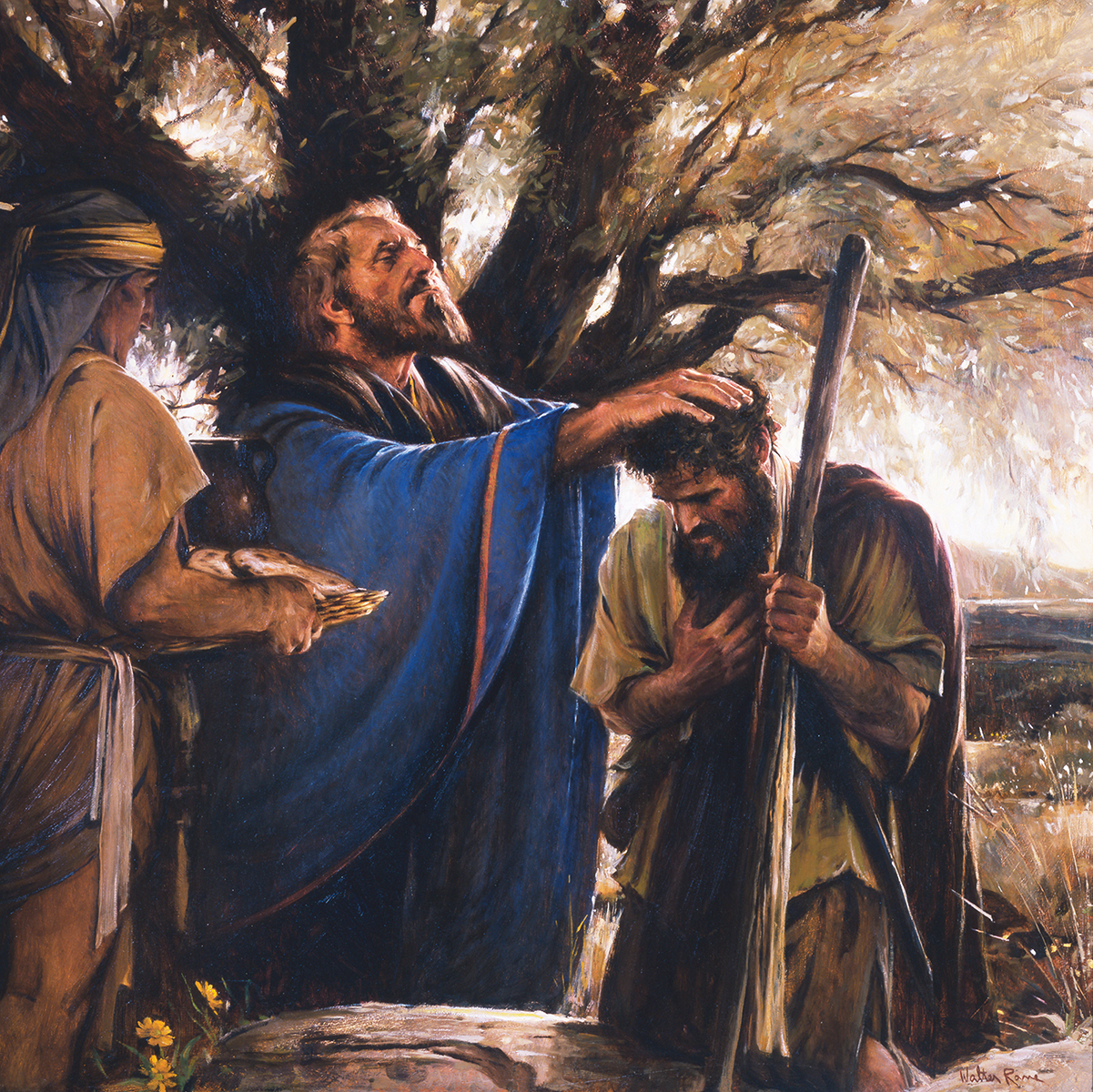
Genesis 14:20 Tithes
‘There are some who take the position that the law of the tithe was only a Levitical institution, but history confirms the fact that it has been and is a universal law. It was basic in the Mosaic law. It had existed from the beginning and is found in the ancient Egyptian law, in Babylonia, and can be traced throughout biblical history… The words of Malachi close the Old Testament with a reiteration of the law of tithing, indicating there had been no abrogation of this law which had existed from the beginning.’ (Howard W Hunter, Conference Report, April 1964, Afternoon Meeting 35)
Genesis 14:21-24 I will not take from a thread even to a shoe latchet
‘According to the war customs still existing among the Arab tribes, Abram might have retained the recovered goods, and his right was acknowledged by the king of Sodom. But with honest pride, and a generosity unknown in that part of the world, he replied with strong phraseology common to the East, “I have lifted up mine hand” [that is, I have sworn] unto the Lord that I will not take from a thread even to a sandal-thong, and that that I will not take any thing that [is] thine, lest thou shouldst say, I have made Abram rich”‘ (Jameson, Faussett, Brown, Commentary Critical and Explanatory on the Whole Bible)
3. The Lord destroys Sodom and Gomorrah.
Genesis 19:26 Lot’s wife
“Lot’s wife was not only accustomed to Sodom; apparently she liked it and did not want to leave. In that she was representative of all those in every time who are caught in the consequences of the evil they cannot quite let go.” (The Interpreter’s Bible, 630)
 Latter-day Bloke