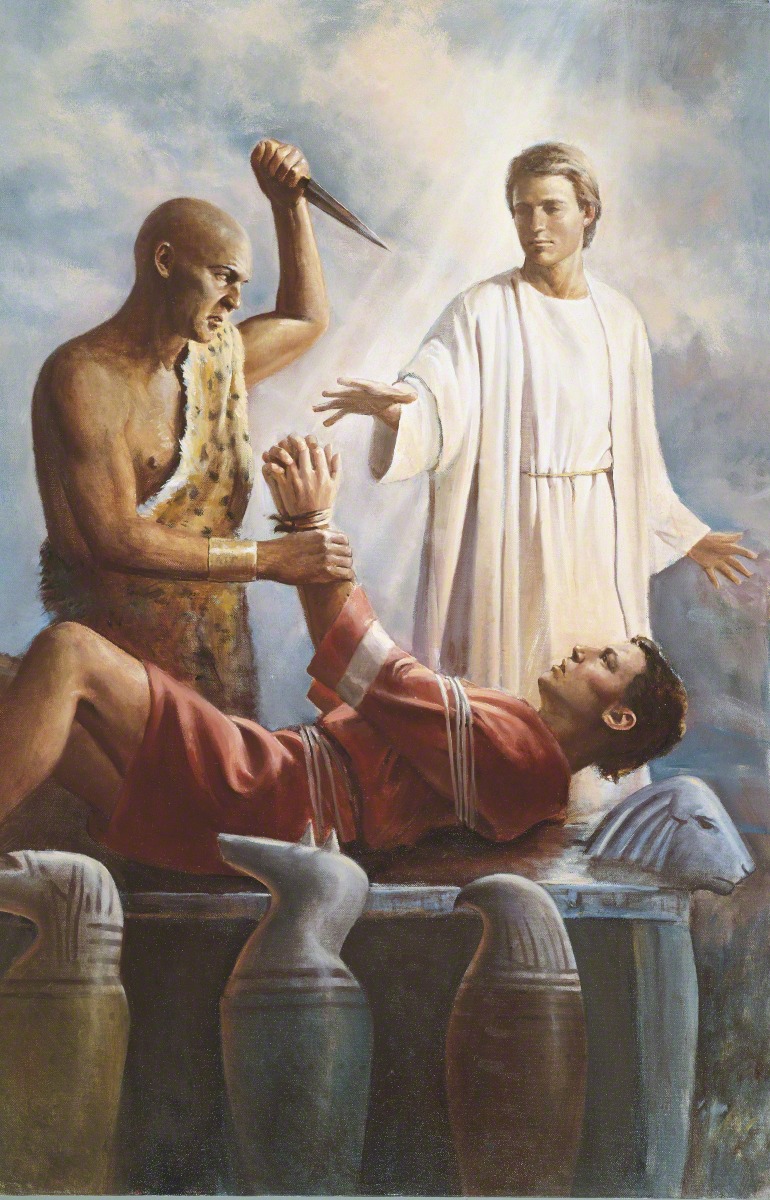
1. Abraham is nearly sacrificed by the false priests of Pharaoh.
Abraham 1:1, 5-8 Idolatry of Abraham’s father
‘[Abraham] understood that there was a God in heaven, a living and true God, and that no man should worship any other God but Him. These were the feelings of Abraham, and he taught his father’s house, and all around him, as far as he had the privilege. The consequence was, his father and the idolatrous priests of that day sought to take his life. In the book of Abraham, translated in our day and generation, we are informed that Abraham was bound, and those priests sought to take his life, but the Lord delivered him from them. One reason why they did so was, that he had gone into those places which his father considered sacred, and among the wooden gods which were there, and, being filled with anger that his father should bow down and worship gods of wood and stone, he broke them. When his father saw that his son Abraham had broken his gods he was very angry with him. But Abraham, trying to reason with his father, said that probably the gods had got to fighting among themselves and had killed one another. He tried to bring him to reason, but his father did not believe they had life enough to kill one another. If he had possessed the spirit which his son had, he would have said there is no power with these gods; but he did not, and Abraham had to flee from his father’s house, confiding in the Lord, who gave many promises to him and concerning his posterity.’ (Wilford Woodruff, Journal of Discourses, 11:244b)
Abraham 1:6–7 Why Did the Fathers Seek to Sacrifice Abraham?
‘Abraham 1 reveals that Abraham’s father, Terah, had given himself to the worship of false gods and was willing to offer his own son as a sacrifice (see Abraham 1:5–6, 17; Joshua 24:2). Elder John A. Widtsoe, who was a member of the Quorum of the Twelve Apostles, wrote: “The family of Abraham had turned from righteousness and had become idolators. Abraham therefore, himself a follower of God’s truth, preached righteousness to them but without avail. For his insistence upon the worship of the only true and Living God, he was persecuted and his life sought. So intense was the hatred of the idolators that it was only by the intervention of the Lord that he was saved from being offered up as a sacrifice to the idols of the people,” (Evidences and Reconciliations, 398).’ (Institute Pearl of Great Price Manual)
Abraham 1:16 Behold my name is Jehovah
‘It is… a misunderstanding prevalent everywhere that the God of Israel known as Jehovah was someone different from Jesus Christ. Even among members of the Church there are many who believe that it was the Father, and not Jesus who spoke to Enoch, who commanded Noah to build an ark and who talked with Abraham and the ancient prophets. In some of the more recent “translations” of the scriptures, the name of Jehovah is used instead of saying the Lord. And there is confusion because Jehovah, even among believers is thought to be God the Father…There is in modern Christendom a strong tendency to ascribe to the Father visits and communications with mankind that were really made by the Lord Jesus.’ (Joseph Fielding Smith, Man, His Origin and Destiny [Salt Lake City: Deseret Book Co., 1954], 312 – 313)
2. Abraham has children through Hagar and Sarah.
Genesis 15:1-6 A promise to Abraham
Genesis 16:10 Promise to Hagar
‘The angelic message to Hagar shows that the promises to Abraham go even beyond those which have come through Isaac.’ (Institute Old Testament Manual)
Genesis 17:15-16 New names
“Establishing the covenant with Abram and Sarai commenced with their receiving a new identity, which is symbolized in changed names. Abram became known as Abraham, and Sarai was called Sarah (Genesis 17:5, 15). The significance of these new names was not so much in changed meaning but in the fact that God assigned them. Under the covenant, ‘father’ Abraham and ‘princess’ Sarah accepted a new responsibility and relationship with God, the definitive Father and King. (Camille Fronk Olson, Women of the Old Testament, [SLC: Deseret Book, 2009], 222-225)
Genesis 17:17 Abraham laughed
‘Joseph Smith corrected this verse to say that Abraham rejoiced (see JST, Genesis 17:23a). This change is also substantiated by the Hebrew text.’ (Institute Old Testament Manual)
Genesis 17:19-21 The covenant with Issaac
3. God commands Abraham to sacrifice Isaac.
Genesis 22:1. Did God “Tempt” Abraham?
‘The word translated as “tempt” in the King James Version comes from the Hebrew word nissah, which means “to test, try, or prove.” The test given to Abraham had two aspects. First, he was asked to give up something very precious to him. To kill one’s child would be horrible enough but to kill the child that had come after decades of fruitless waiting, the child promised by holy men sent from God, the child in whom the covenant was to be fulfilled, must have been a test beyond comprehension. The willingness of Abraham to give up something as dear as Isaac sharply contrasts with the reluctance of the rich young ruler who asked the Savior what he must do to be saved. When told he should sell all of his possessions and follow the Master, “he went away sorrowful: for he had great possessions” (Matthew 19:22).
But an equally difficult, if not greater, test was what could be described as the question of the integrity of God. Abraham himself had nearly lost his life on an idolatrous altar and had been saved by the direct intervention of the Lord (see Abraham 1:12–20). Abraham knew that the law of God forbids human sacrifice or murder of any sort. Surely one would wonder at such a command, asking himself, “Can this be from God? Does God contradict himself?” And then to know that, additionally, it would mean the end of the very covenant line that God had Himself promised to establish would surely be almost overwhelming.
Elder Spencer W. Kimball commented on this aspect of the test: “Exceeding faith was shown by Abraham when the superhuman test was applied to him. His young ‘child of promise,’ destined to be the father of empires, must now be offered upon the sacrificial altar. It was God’s command, but it seemed so contradictory! How could his son, Isaac, be the father of an uncountable posterity if in his youth his mortal life was to be terminated? Why should he, Abraham, be called upon to do this revolting deed? It was irreconcilable, impossible! And yet he believed God. His undaunted faith carried him with breaking heart toward the land of Moriah with this young son who little suspected the agonies through which his father must have been passing.” (In Conference Report, Oct. 1952, p. 48.)
Little wonder that throughout the scriptures Abraham is spoken of again and again as a great example of one with faith, of one who was obedient.’ (Institute Old Testament Manual)
Genesis 22:2 Take now thy son
‘And he said, take thy son – Not thy bullocks and thy lambs; how willingly would Abraham have parted with them by thousands to redeem Isaac! Not thy servant, no, not the steward of thine house. Thine only son – Thine only son by Sarah. Ishmael was lately cast out, to the grief of Abraham, and now Isaac only was left and must he go too? Yes: take Isaac, him by name, thy laughter, that son indeed. Yea, that son whom thou lovest – The trial was of Abraham’s love to God, and therefore it must be in a beloved son: in the Hebrew ’tis expressed more emphatically, and I think might very well be read thus, Take now that son of thine, that only son of thine, whom thou lovest, that Isaac. And get thee into the land of Moriah – Three days journey off: so that he might have time to consider it, and if he do it, must do it deliberately. And offer him for a burnt offering – He must not only kill his son, but kill him as a sacrifice, with all that sedateness and composedness of mind, with which he used to offer his burnt – offering.’ (Wesley’s Explanatory Notes)
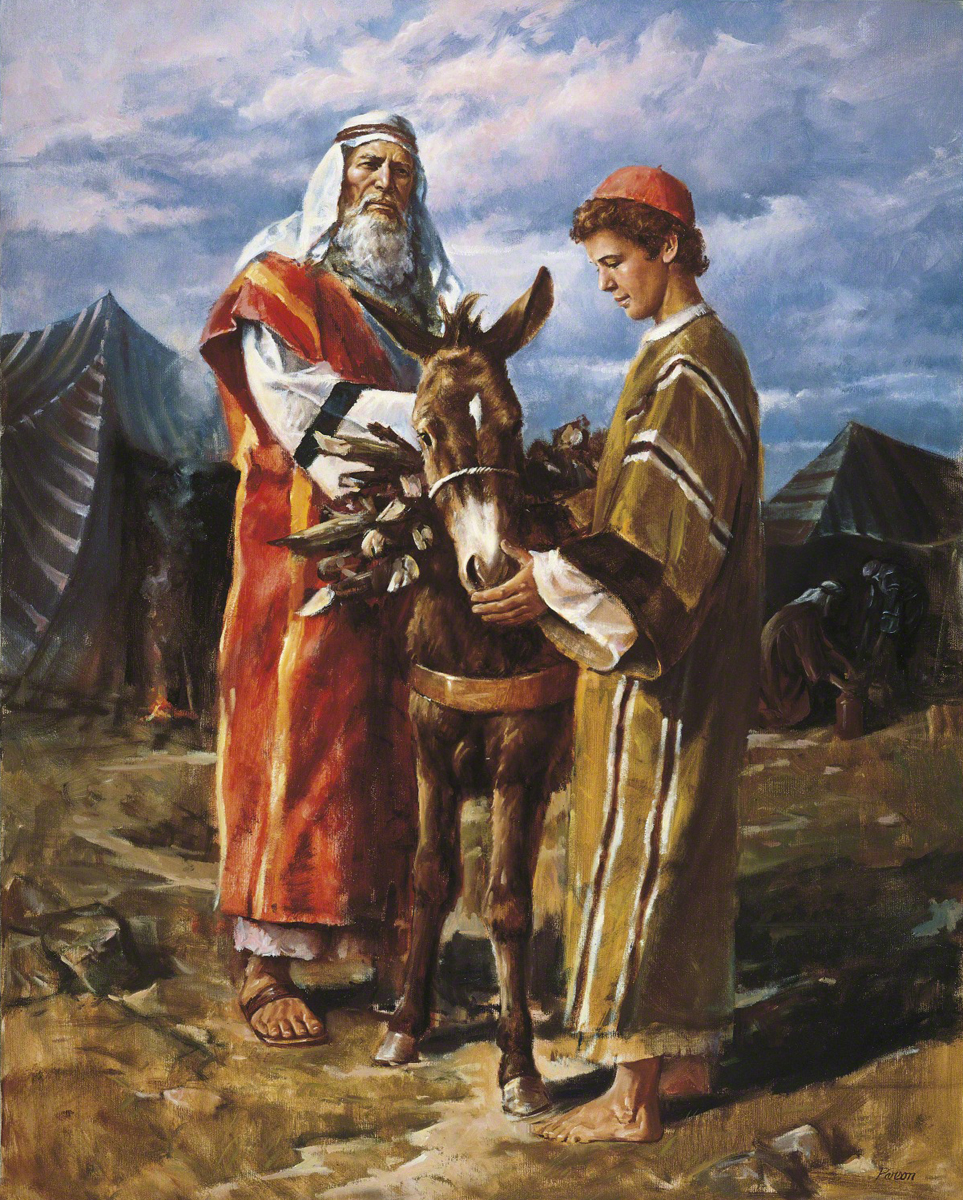
Genesis 22:9 Bound Isaac his son
“Traditionally, an animal’s legs were bound before it was sacrificed. In Jewish literature the story of Abraham and Isaac is known as the Akedah, or ‘The Binding,’ in reference to Abraham binding his son.” (Ensign, Apr. 2013, 47)
Watch: Akedah – the binding
(Genesis 22:1-18) A video of Abraham offering his son Isaac as a sacrifice unto the Lord (12:57)
Genesis 22:13 A ram
‘Remember that Abraham, Moses, Elijah, and others could not see clearly the end from the beginning. They also walked by faith and without sight. Remember again that no gates were open; Laban was not drunk (1 Ne. 4:7) and no earthly hope was justified at the moment Nephi exercised his faith and set out finally to get the plates. No asbestos clothes or other ordinary protective devices were in the fiery furnace to protect the three Hebrews from death (Dan. 3:20) there were no leather nor metal muzzles for the mouths of the lions when Daniel was locked in the den Dan. (6:16)
Remember that there were no clouds in the sky nor any hydrometer in his hand when Elijah promised an immediate break in the long extended drought; though Joshua may have witnessed the miracle of the Red Sea, yet how could he by mortal means perceive that the flooding Jordan would back up for the exact time needed for the crossing, and then flow on its way to the Dead Sea.
Remember that there were no clouds in the sky, no evidence of rain, and no precedent for the deluge when Noah builded the ark according to commandment (Gen. 6:14) There was no ram in the thicket when Isaac and his father left for Moriah for the sacrifice Gen. (22:13) Remember there were no towns and cities, no farms and gardens, no homes and storehouses, no blossoming desert in Utah when the persecuted pioneers crossed the plains. And remember that there were no heavenly beings in Palmyra, on the Susquehanna or on Cumorah when the soul-hungry Joseph slipped quietly into the Grove, knelt in prayer on the river bank, and climbed the slopes of the sacred hill.
But know this: that undaunted faith can stop the mouths of lions, make ineffective the fiery flames, make dry corridors through beds of rivers and seas. Unwavering faith can protect against deluge, terminate droughts, heal the sick, and bring heavenly manifestations. Indomitable faith can help us live the commandments and thereby bring blessings unnumbered with peace, perfection, and exaltation in the kingdom of God. May this be our desire to develop this kind of faith and may we finally attain the blessings which such perfect faith can bring, I pray in the name of Jesus Christ. Amen.’ (Spencer W Kimball, General Conference, October 1952)
Genesis 22:17 I will multiply thy seed
‘Anciently, the vastness of Abraham’s eventual posterity was compared to the sand of the sea, a staggering promise (see Gen. 22:17). The Restoration’s revelations and translations accommodate a vast universe; thus it is no surprise to us that scientists’ latest estimate of the number of stars in the universe is approximately 70 sextillion—“more stars in the sky,” scientists say, “than there are grains of sand in every beach and desert on Earth” (Allison M. Heinrichs, “The Stellar Census: 70 Sextillion,” Los Angeles Times, 26 July 2003; see also Carl Sagan, Cosmos [1980], 196). ‘ Neal A Maxwell, Conference Report, Oct. 2003, 100)
 Latter-day Bloke