1. Balaam refuses Balak’s offer of rewards in exchange for cursing Israel.
Numbers 22–24. The Story of Balaam
‘When the two mighty kings of the Amorites were defeated by the irresistible might of Israel, the Moabites, with their Midianite confederates, were filled with such alarm that Balak, their king, sought assistance. It was not from his own god, Baal, who had proven impotent against Israel during the Amorite conflict, that he sought power, however. Instead, he decided to use Israel’s own God, whose power had been marvelously manifest, against them. To this end he sent a delegation bearing presents to Balaam of Pethor, a celebrated prognosticator in upper Mesopotamia, who apparently had a reputation for being able to bless and curse with great effect (see Numbers 22:3–6).
It is difficult to determine from the record whether or not Balaam was a true prophet of God holding the powers of the priesthood authority. He lived in an area known as Aram, probably named after the son of Kemuel and grandson of Nahor, a cousin of Abraham. Haran, the place of Abraham’s first settlement after he left Ur, was a seat for the worship of Jehovah and was also in Aram. Therefore, Balaam could have been one of the few scattered people such as Jethro, who held the priesthood and exercised its power. The Bible suggests that he had a true knowledge of God and was susceptible to revelation from Him. Regardless of their origin, the Lord raises up inspired men to all nations (see Alma 29:8).
It is significant that Balaam is referred to as a soothsayer or diviner, somewhat on the order of Simon of the New Testament (compare Joshua 13:22; Acts 8:9–24). Although he acknowledged Jehovah and professed his dependence on Him, Balaam was willing to go against the Lord’s counsel and accompany the men of Balak. To assure his responsiveness to God’s will, the Lord sent an angel to threaten him with death should he curse Israel.
One of the remarkable things about Balaam’s blessing of Israel is the Messianic promise of Christ (see Numbers 24:14, 17, 19).
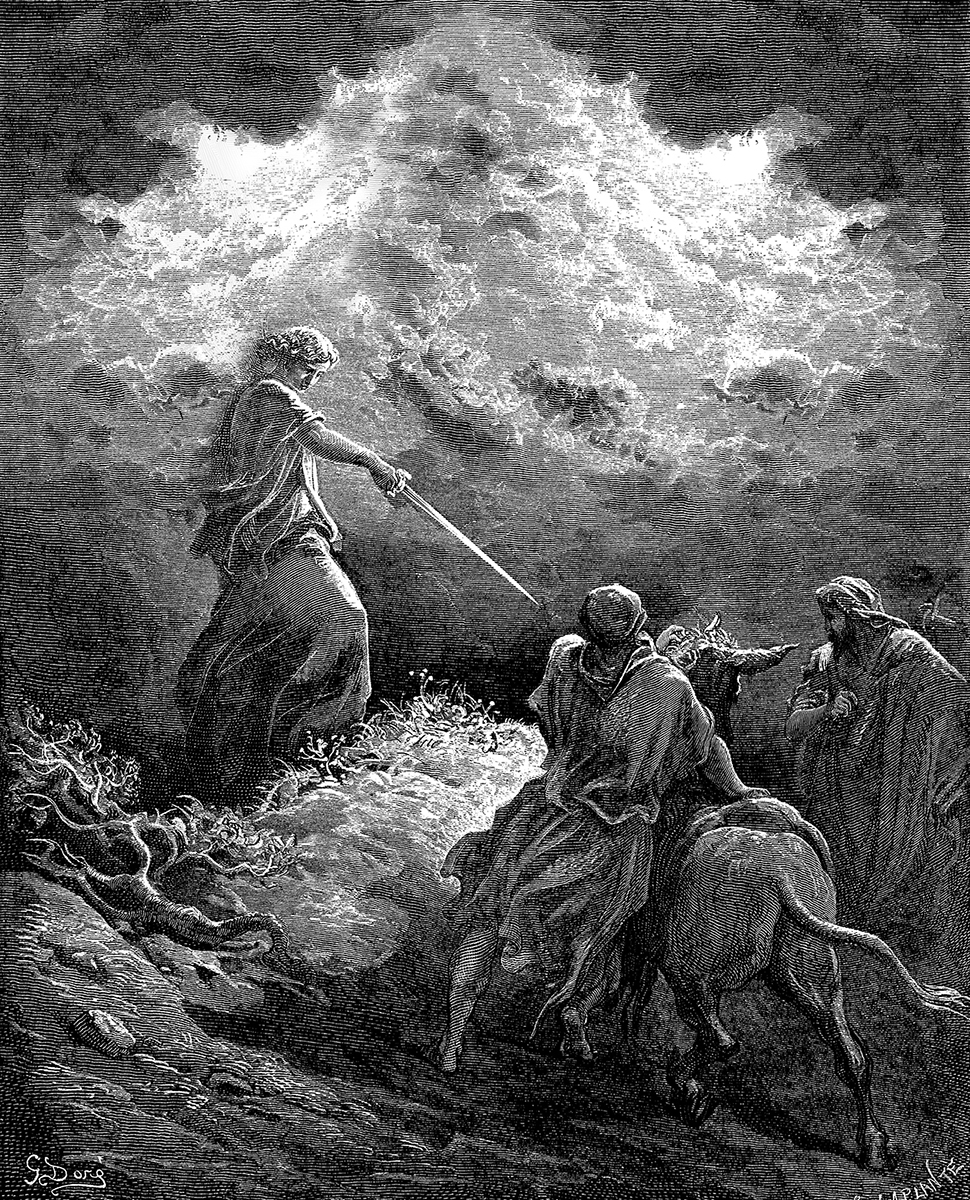
The rebuke received by Balaam from an animal wrought upon by the Spirit of God is a singular event in history. Speculation on how the deed was accomplished is useless. It is certain that the beast spoke in a way understandable to Balaam. Other scriptures indicate that when animals are filled with the divine Spirit and celestialized, they will be able to express themselves in ways presently denied them (see Revelation 4:6, 9; D&C 77:2–4). Balaam is not recorded as showing surprise at this phenomenon, which circumstance has led some to suggest that Balaam’s mind was troubled because of his attempt to serve both God and mammon. Had he been more thoughtful, the unusual behavior of his otherwise obedient mount would have caused him to look about to discover the trouble. Then perchance he would have discovered the angel’s presence.
The incident was sufficient to carry out the Lord’s purposes, however. Balaam was shown that it was not the journey in itself that was displeasing to God, but the feelings and intentions he harbored. The entire incident seems to have been brought about to sharpen his conscience and sober his mind so he would strictly speak only the word of God.
The record next describes the whoredoms Israel committed with the daughters of Moab; that is, Israel joined the women of Moab in worshiping Baal-peor, a fertility god, including offering sacrifices to the god and indulging in sexual immorality. What is not mentioned here but is explained later (Numbers 31:16) is that Balaam advised the Moabites in this action. Evidently, when he saw that he could not earn Balak’s commission by cursing Israel directly, he told Balak that God would only bless Israel when they were righteous. If the Moabites could seduce Israel into idol worship, they would lose God’s power. Thus, Balaam became a symbol of those who use their callings and gifts to get gain and pervert the Lord’s people (see 2 Peter 2:15; Revelation 2:14).’ (Institute Old Testament manual)
Numbers 22:14 I cannot go beyond the word of the Lord my God
‘Balaam knew God too well to suppose he could reverse any of his purposes; and he respected him too much to attempt to do any thing without his permission. Though he was covetous, yet he dared not, even when strongly tempted both by riches and honors, to go contrary to the command of his God. Many make all the professions of Balaam, without justifying them by their conduct. “They pretend,” says one, “they would not do any thing against the word of God for a house full of gold, and yet will do it for a handful!”‘ (Clarke’s Bible Commentary)

2. The Lord shows the danger of Balaam’s stubborn insistence on his own will.
Numbers 22:9-36
‘Balaam would not curse Israel if God would not, but Balak the king tried again. This time he offered more enticing rewards to Balaam.
Balaam tried God again and won a concession; the Lord told him (JST Numbers 22:20): ‘If the men come to call thee, rise up, if thou wilt go with them, but yet the word which I shall say unto thee, shalt thou speak.’ In other words, Balaam had a choice. But Balaam overstepped his privilege, so he was warned and chastised by a dumb beast, which was made able to speak and to see the angel that his master could not see. It is possible that the words could just have appeared to come from a donkey, similar to Moses with a burning bush; however we should not restrict God’s ability to perform any kind of miracle. we know that even animals, when filled with the Spirit of the Lord and celestialized, will be able to express themselves (Rev 4;6,9; D&C 77:2-4) The text uses an interesting word in verse 22 which translators rendered ‘adversary’; the Hebrew is satan.
Of the many lessons found in this episode, one wonders if some of us are like Balak or Balaam as we seek answers to our petitions. We ask the Lord for direction and when we receive it we want something different, either out of selfishness or social pressures.’ (Andrew C Skinner, D Kelly Ogden, Verse by Verse, The Old Testament).

3. Balaam refuses to curse Israel.
Numbers 22:38 The word that God putteth in my mouth, that shall I speak
‘Here was a noble resolution, and he was certainly faithful to it: though he wished to please the king, and get wealth and honor, yet he would not displease God to realize even these bright prospects. Many who slander this poor semi-antinomian prophet, have not half his piety.’ (Clarke’s Bible Commentary)
4. The Israelites destroy the Midianites and slay Balaam.
Numbers 31:3 Avenge the Lord of Midian
‘It was God’s quarrel, not their own, that they were now to take up. These people were idolaters; idolatry is an offense against God; the civil power has no authority to meddle with what belongs to Him, without especial directions, certified in the most unequivocal way. Private revenge, extension of territory, love of plunder, were to have no place in this business; the Lord is to be avenged; and through Him the children of Israel, ( Numbers 31:2;), because their souls as well as their bodies had been well nigh ruined by their idolatry.’ (Clarke’s Bible Commentary)
Numbers 31:16 Trespass against the Lord
‘…the Israelites had intimate contact with the Moabites and the Midianites and began to assimilate their pagan practices and immoral ways – just the kind of activities Balaam had encouraged Balak to promote (See Numbers 31:16, Revelation 2:14). Thus the Lord commanded Moses to strike back in order to eliminate the influence of the local tribes.’ (Richard J Allen, Study Commentary on the Old Testament)
 Latter-day Bloke