1. Moses gives instructions to the Israelites to help them remember their covenants.
Deuteronomy 6:4–9. “Hear, O Israel; The Lord Our God Is One Lord”
‘Verse 4 begins what is known among Jewish people as the Shema (from the Hebrew word meaning “hear”). “The Shema is in Jewish thought the supreme affirmation of the unity of God and is frequently called ‘the acceptance of the yoke of the Kingdom of Heaven’” (Encyclopaedia Judaica, s.v. “Shema, Reading of,” The Shema in Jewish Thought, 14:1372). The entire Shema,which consists of Deuteronomy 6:4–9; Deuteronomy 11:13–21; and Numbers 15:37–41 (in that order), is recited twice daily by all devout Jews as an evening and a morning prayer. It has become traditional for Jewish martyrs to face death with the Shema on their lips. In fact, “Jewish devotional manuals sometimes advise the worshiper to have in mind while reciting the Shema that if he is called upon to suffer martyrdom for the sanctification of God’s name he will do so willingly and with joy” (Encyclopaedia Judaica, s.v. “Shema, Reading of,” The Shema in Jewish Thought, 14:1373). The Shemapassage in Deuteronomy 6 is of interest to Christians also because Jesus said that verse 5 contained the greatest commandment in the law (see Matthew 22:36–37). It is the sum and substance of all other commandments, for if people loved God with all their heart, might, mind, and strength, every aspect of their lives would be devoted to righteousness and holiness. And if these words were constantly in their hearts (see v. 6) and they sought to teach them to their children in every way possible, in every aspect of their lives, through precept and example, at night and in the day, at home or elsewhere, all of society would be dramatically altered. In that respect, this belief of the Jews is correct. The Shema, if it truly is an affirmation of faith and not just words, should be the supreme thought in one’s heart, and it is even worth dying, if living means a denial of that affirmation.
If latter-day revelation the Lord taught a similar principle of commitment: “And all they who suffer persecution for my name, and endure in faith, though they are called to lay down their lives for my sake yet shall they partake of all this glory. Wherefore, fear not even unto death; for in this world your joy is not full, but in me your joy is full. Therefore, care not for the body, neither the life of the body; but care for the soul, and for the life of the soul. And seek the face of the Lord always, that in patience ye may possess your souls, and ye shall have eternal life.” (D&C 101:35–38.)
The Lord emphasized the importance of this injunction by using figurative language commanding the people to bind these words on their foreheads and hands and to put them on the doorposts of their homes. These verses led to the Jewish customs known as the tefillin (or phylacteries) and the mezuzah.
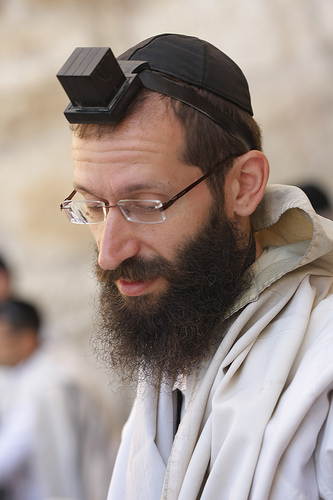
Taking the command literally, the Jews inscribed certain scriptural passages, including Deuteronomy 6:4–9, on tiny pieces of parchment, folded them up, and put them into tiny leather boxes about 1½ inches square. These boxes were then tied to the head to be over the forehead, or on the left biceps, suggesting that the wearer would “fulfill the law with the head and heart” (Fallows, Bible Encyclopedia, s.v. “phylactery,” 3:1344). Some apostate Israelites later viewed these frontlets as amulets to ward off evil spirits. Thus, the Greeks called them phylacteries, which means “safeguards.”
The mezuzah (Hebrew for “doorpost”) was similar to the tefillin in that it was a parchment with a scriptural passage on it inserted into a tiny, cylindrical box. The mezuzah was attached to the door frame, and it became customary for Jews to touch or kiss the mezuzah each time they left or entered the home.
The symbolic words of the commandment teach a beautiful lesson. The doorpost symbolizes the portals through which man moves to interact with his fellow man. As one sets forth from or returns to home, one’s conscious desire should be to do the will of God.’ (Old Testament Institute Manual)

2. Moses counsels the Israelites to obey God’s commandments and remember Him.
Deuteronomy 8:18 it is he that giveth thee power to get wealth
‘Who among the rich and wealthy believes this saying? Who gives wisdom, understanding, skill, bodily strength, and health? Is it not God? And without these, how can wealth be acquired? Whose is providence? Who gives fertility to the earth? And who brings every proper purpose to a right issue? Is it not God? And without these also can wealth be acquired? No. Then the proposition in the text is self-evident: it is God that giveth power to get wealth, and to God the wealthy man must account for the manner in which he has expended the riches which God hath given him.’ (Clarke’s Commentary on the Bible)
3. Moses counsels the Israelites to be mindful of the Rock of their salvation (Jesus Christ).
Deuteronomy 32:15, 18, 30–31. To What or Whom Does the Word Rock Refer?
“Christ is the Stone of Israel. (Gen. 49:24.) ‘I am the good shepherd, and the stone of Israel. He that buildeth upon this rock shall never fall.’ (D. & C. 50:44.) Christ is thus the stone or foundation upon which all men must build. Of him the psalmist prophesied: ‘The stone which the builders refused is become the head stone of the corner.’ (Ps. 118:22; Matt. 21:42; Mark 12:10–11; Luke 20:17–18.) Peter used this truth to teach that the saints ‘as lively stones’ should build ‘a spiritual house,’ with Christ, the Stone of Israel, as the foundation. (1 Pet. 2:1–9.)” (McConkie, Mormon Doctrine, p. 768.)
That the Apostle Paul understood this concept is clear from a statement he made about the children of Israel during the period of their wanderings: “For they drank of that spiritual Rock that followed them: and that Rock was Christ” (1 Corinthians 10:4). In other words, they all ate the same spiritual meat and drank the same spiritual drink.” (Institute Old Testament Manual)
 Latter-day Bloke