1. The strength of righteous parents and the consequences of forsaking their ways
Judges 2:10 there arose another generation after them, which knew not the Lord
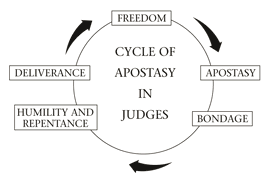
Judges 2:11–13. What Resulted from Israel’s Not Driving the Canaanites Out of the Promised Land?
“The Book of Judges makes clear that Israel did not conquer all of Canaan when first she entered it. … For a long time during the days of the Judges many of the Israelites were essentially ‘hillbillies’ [see Judges 6:2], hemmed in by their enemies on every side. After the generations of Israelites who had been acquainted with Joshua passed away, the effects of Canaanite morals and religion began to be apparent upon the younger generation. For long periods of time the Canaanites conquered Israel and this fact alone would tend to disrupt her settled religious life and practice. Times were rough and banditry was rampant. As the record itself states: ‘In those days there was no king in Israel; every man did that which was right in his own eyes’ [Judges 17:6]. All of this seems to have taken place because Israel did not drive the Canaanites completely out. The Lord said to the Israelites: ‘Ye have not hearkened to My voice; what is this ye have done? Wherefore I also said: I will not drive them out before you; but they shall be unto you as snares, and their gods shall be a trap unto you.’ [Judges 2:2–3.] … Israel’s conduct during this period had a lasting effect upon her religion and morals. For centuries Israel’s prophets and wise men referred to it and denounced her allegiance to old Canaanite practices. It is plain that Israel, during the period of the Judges, compromised her relatively high religious ideals with Canaanite practices and certain elements in her population must have apostatized completely.” (Sperry, Spirit of the Old Testament, pp. 51–52.)
Judges 2:17 Went a whoring after other gods
‘Idolatry, or the worship of strange gods, is frequently termed adultery, fornication, and whoredom, in the sacred writings. As many of their idolatrous practices were accompanied with impure rites, the term was not only metaphorically but literally proper.’ (Clarke’s Commentary on the Bible)
2. Deborah—the strength of a righteous friend
Judges 4:1-10 Deborah and Barak
‘Deborah, whose name means ‘honey bee’, was a wife, a mother and a prophetess to whom Israel went for advice and judgement as she dwelt between Ramah and Bethel in the central hill country of Ephraim. She called Barak, a man of Napthali, to lead a war against the Canaanite oppressors, but Barak said he would not go unless Deborak went as well. Deborah responded that she would go, but because of the way that he was handling the situation (implying his lack of trust in God), the honour would not be his because the Lord was going to deliver ‘Sisera into the hands of a woman’ (vv 8-9)’. (Andrew C Skinner and D Kelly Ogden, Verse by Verse, The Old Testament).
:fill(FFCC00,1)/about/deborah-s-triumphal-song-book-of-judges-173449598-57c78d7e5f9b5829f4cb7c1b.jpg)
Judges 4:11-24 Sisera and Jael
‘With Deborah giving the directions and Barak leading the armies, battle was joined against Jabin, king of Hazor, and his commander, Sisera , at Mount Tabor in the eastern Jezreel Valley. True leaders inspire and sometimes shame (Judges 4:9) their followers to nobler action. That is what Deborah did for Barak: ‘Up; for this is the day in which the Lord hath delivered Sisera into thine hand’ (v14). The Israelites were victorious. The final coup was administered by another woman, Jael, wife of Heber the Kenite, wielding a hammer and tent peg. As it happens, pitching tents and driving tent pins were women’s responsibilities among the nomads.
The ancient laws of hospitality normally meant that one was obligated to protect a guest from harm (See Genesis 19:1-8). Jael, however chose to remain loyal to her family’s previous alliance with Israel.’ (Andrew C Skinner and D Kelly Ogden, Verse by Verse, The Old Testament).
3. Gideon—the strength of faith in God
Judges 6:11–24. Since the Lord Condemns Sign-Seeking, How Do We Explain Gideon’s Request?
“When Gideon asked for a ‘sign’ he seemed only to want a sign that the messenger was a bona fide emissary of the Lord (v. 17). On this point, note that messengers may sometimes be from the wrong source and discernment is important. (See, e.g., D&C 129; see another consideration of the problem in II Corinthians 11:13–15; I Corinthians 12:10; and I John 4:1–2.) (Signs may be given, based upon man’s faith and the will of God. D&C 63:10.)
“When Gideon made a meal of meat, cakes and broth, and the angel turned it into a miraculous burnt offering, this ‘sign’ quite overwhelmed Gideon. But the Lord kindly gave him comfort and peace, and Gideon gratefully named the monument he built there ‘Lord of Peace.’” (Rasmussen, Introduction to the Old Testament, 1:150.)

Judges 7:2 Mine own hand hath saved me
‘Sometimes the task appears overwhelming. We can take fresh courage from the experience of Gideon of old, who, with his modest force, was to do battle with the Midianites and the Amalekites. You will remember how Gideon and his army faced an overwhelming strength of forces vastly superior in equipment and in number. The book of Judges in the Old Testament records that the united enemy, the Midianites and the Amalekites, “lay along in the valley like grasshoppers for multitude; and their camels were without number, as the sand by the sea side for multitude.” Judg. 7:12 Gideon went to Almighty God for his strength.
To his surprise, Gideon was advised by the Lord that his forces were too many in number for the Lord to deliver the enemy into their hands, lest they say, “Mine own hand hath saved me.” Judg. 7:2 Gideon was instructed to proclaim to his people: “Whosoever is fearful and afraid, let him return and depart … from mount Gilead. And there returned of the people twenty and two thousand; and there remained ten thousand.” Judg. 7:3
Then the Lord said, “The people are yet too many.” Judg. 7:4 He instructed Gideon to take the men to water to observe the manner in which they should drink of the water. Those who lapped the water were placed in one group, and those who bowed down upon their knees to drink were placed in another. The Lord said unto Gideon, “By the three hundred men that lapped will I save you, and deliver the Midianites into thine hand: and let all the other people go every man unto his place.” Judg. 7:7
Gideon returned to his forces and said to them, “Arise; for the Lord hath delivered into your hand the host of Midian.”1 Judg. 7:15 And he divided the three hundred men into three companies, and he put a trumpet in every man’s hand, with empty pitchers and lamps within the pitchers. And he said unto them:
“Look on me, and do likewise: and, behold, when I come to the outside of the camp, it shall be that, as I do, so shall ye do.
“When I blow with a trumpet, I and all that are with me, then blow ye the trumpets also on every side … and say, The sword of the Lord, and of Gideon.” He then said in effect, “Follow me.” His exact words were, “As I do, so shall ye do.” Judg. 7:17–18
At the leader’s signal, the host of Gideon did blow on the trumpets and did break the pitchers and did shout, “The sword of the Lord, and of Gideon.” The scripture records the outcome of this decisive battle: “And they stood every man in his place,” and the victory was won.‘ (Thomas S Monson, General Conference, April 2003)

4. Samson—the strength of covenants and the consequences of breaking them
Because the children of Israel had strayed from the ways of Jehovah they were held in bondage to the Philistines for 40 years. Life was not easy for them and most of the people could not remember when they did not suffer from the oppression of their Philistine neighbours.. An angel from God appears to Manoah, an Israelite from the tribe of Dan in the city of Zorah, and to his wife, who is barren. This angel predicts that they will have a son who will begin to deliver the Israelites from the Philistines. Requirements were set up by the angel that she (as well as the child himself) is to abstain from all alcoholic beverages and her promised child is to be brought up as a Nazarite. The word Nazarite, the Bible Dictionary tells us means “A consecrated man” – a man under a vow:
- to abstain from wine
- from any cutting of the hair
- from any contact with the dead.
In due time the son, Samson, is born; he is reared according to these provisions.
Because of what the angel had told Samson’s parents before his birth, they had great hopes for him. As a Nazarite he would certainly be a righteous man, dedicated to jehovah. And it was promised that he was going to begin to deliver Israel from the Philistines.
As it turned out the Lord did use Samson as an instrument in his hands but Samson did not always make wise choices. When he becomes a young man, Samson leaves the hills of his people to see the cities of the Philistines. While there, Samson falls in love with a Philistine woman and despite the objections of his parents he decides to marry her. On the way to ask for the woman’s hand in marriage, Samson is attacked by a lion and kills it. He continues on to the Philistine’s house, winning her hand in marriage. On his way to the wedding, Samson notices that bees have nested in the carcass of the lion and have made honey. He eats a handful of the honey and gives some to his parents.(Remember that part of his Nazarite vow was not to have any contact with dead things?) At the wedding-feast, Samson proposes that he tell a riddle to his thirty groomsmen (all Philistines); if they can solve it, he will give them thirty pieces of fine linen and garments. The riddle (“Out of the eater, came forth meat and out of the strong came forth sweetness.”) is a veiled account of his second encounter with the lion (at which only he was present). The Philistines are unable to solve the riddle. The thirty groomsmen tell Samson’s new wife that they will burn her and her father’s household if she does not discover the answer to the riddle and tell it to them. Samson’s bride wept before him and pestered him for an answer to his riddle and when he tired of her weeping, he told her the answer – which she promptly told the men. The men then came to Samson and said
“What is sweeter than honey?
and what is stronger than a lion?”
Samson said to them,
“If you had not plowed with my heifer,
you would not have solved my riddle.”
Samson leaves the feast and goes to Ashkelon where he kills thirty Philistines of Ashkelon for their garments, which he gives his thirty groomsmen. He then returns to his father’s house at Zorah leaving his wife at Timnah with her father. While he is at Zorah his wife’s father gives her to one of the 30 men who had been his companions at the marriage feast. Her father refuses to allow him to see her, and wishes to give Samson the younger sister. In revenge, Samson attaches torches to the tails of three hundred foxes, leaving the panicked beasts to run through the fields of the Philistines, burning all in their wake. The Philistines find out why Samson burned their crops, and they burn Samson’s wife and father-in-law to death. In revenge, Samson slaughters many more Philistines.
Samson then takes refuge in a cave in the rock of Etam. Because of the losses that Samson had inflicted upon the Philistines they marched to war against the tribe of Judah. The men of Judah were not pleased. “Why have you come to war against us?” they asked. “We have come to bind Samson and to do to him as he has done to us. Anxious to avoid war with the Philistines 3000 men of Judah went to Samson and with Samson’s consent, they tie him with two new ropes and are about to hand him over to the Philistines when he breaks free. Using the jawbone of a donkey, he slays one thousand Philistines. Because of the great slaughter of the Philistines Samson was eleveted to the position of a judge in Israel.
Though Samson had great physical strength he did not have great moral strength. When he went to Gaza to see a harlot his enemies waited at the gate of the city to ambush him, but when Samson came out he carried away the gates.
He then falls in love with a Philistine woman called Delilah. The Philistines approach Delilah and induce her (with 1100 silver coins each) to try to find the secret of Samson’s strength. Samson obviously does not want to tell the secret, so at first he teases her, telling her that he can be bound with 7 fresh sinews from a slain animals. She does so while he sleeps, but when he wakes up he snaps the sinews. She persists, and he tells her he can be bound with new ropes. She binds him with new ropes while he sleeps, and he snaps them, too.She asks again, and he says he can be bound if his locks are woven together. She weaves them together, but he undoes them when he wakes.Eventually Samson tells Delilah that he will lose his strength with the loss of his hair. Delilah calls for a servant to shave Samson’s seven locks. Since that breaks the Nazarite oath, his strength leaves him, and Samson is captured by the Philistines. They burn out his eyes by holding a hot poker near them.After being blinded, Samson is brought to Gaza, imprisoned, and put to work grinding grain.
One day the Philistine leaders assemble in a temple for a religious sacrifice to Dagon, their god, for having delivered Samson into their hands.They summon Samson so that he may entertain them.Three thousand more men and women gather on the roof to watch. Once inside the temple, Samson, his hair having grown long again, asks the servant who is leading him to the temple’s central pillars if he may lean against them Samson was completely humiliated and he called upon the Lord in his humility.
And Samson called unto the LORD, and said, O Lord GOD, remember me, I pray thee, and strengthen me, I pray thee, only this once, O God, that I may be at once avenged of the Philistines for my two eyes.
29 And Samson took hold of the two middle pillars upon which the house stood, and on which it was borne up, of the one with his right hand, and of the other with his left.
30 And Samson said, Let me die with the Philistines. And he bowed himself with all his might; and the house fell upon the lords, and upon all the people that were therein. So the dead which he slew at his death were more than they which he slew in his life.
Samson came into the world as an eagerly anticipated son. he had great potential. The angel who announced his birth said he would begin to deliver Israel from the Philistines. The Lord blessed him with many gifts, including great physical strength. We too are special children. We are children of our Heavenly Father reared in his holy courts in the premortal existence. We too come to this life with gifts and it is often in serving the Lord in his Church that we become aware of or develop our gifts.
As a Nazarite and a member of the house of Israel, Samson made covenants with the Lord. However, he soon broke his Nazarite vow and his covenants as a member of the house of Israel.
- He married outside the covenant house of Israel
- He was immoral with a harlot
- He had his hair cut.
What inner weaknesses caused his downfall? Answers may include self-indulgence, immorality, seeking revenge, and violating covenants.
Samson’s hair was not the source of his strength but was a sign of the covenant he had made with the Lord and was an outward sign that he was consecrated – that he was set apart from other men. The Lord took away his spiritual strength because he had broken his covenants.
We also have signs that mark us as separate – perhaps it is the way we dress, the fact that we live the Word of Wisdom, that we attand Church, that we don’t shop on Sunday – these are all things that make us a separate or a peculiar people.
Like Samson we too have made covenants. We have made covenants at baptism. Some have entered into the Oath and covenant of the Priesthood. Some have made covenants in the temple. Are we being true to those covenants or are we violating them as Samson did?
Because Samson violated his covenants he lost his physical and spiritual strength and the Philistines blinded an bound him. If we break our covenants we forfeit the blessings we could have had and we lose our spiritual strength. We can become spiritually blind and lose our freedom through the consequences of sin. We are blessed that we can come to Church each week and through treh Sacrament we can be reminded of the covenants that we made at baptism and we can renew our commitment. Similarly we can go to the temple and be reminded of the covenants we have made there. The Prophet has suggested that we examine how we use our time and see if we can find more time to attend the temple. Perhaps as the world gets more wicked and Satan gets more powerful we need to go to the temple more often and be strengthened and be reminded of our covenants.
What inner weaknesses may hinder us from fulfilling our potential?
Perhaps we are proud, or lazy, or complacent. Perhaps we are too critical of our brothers and sisters and our leaders. Perhaps we have allowed ourselves to become too focused on the material things of this world or perhaps we have become stained through immorality or other sins. These are all things that can prevent us from achieving our destiny in this life and ultimately our destiny of achieving eternal life.
Elder Kenneth Johnson: How can we really be sure that we are living our lives in harmony with His will and with the assurance that we are not straying off course?
In 1992, following the remodelling and refurbishment of the London Temple, there was intense media interest in the impact of the closure and re-opening on the local community. The Temple is located on the flight path to London’s Gatwick Airport and one of the reporters took the initiative to interview some airline pilots who regularly navigated this route. It was remarkable to read their responses. The light on the pinnacle of the spire had not been illuminated for over two years. They had missed this beacon as it provided them with a landmark that could be referred to with certainty on the planes final descent to the runway. Just as the light on the spire of the Temple helped chart the course for temporal travellers, so Temple covenants provide a light by which we can chart our course in the quest for exaltation.
In his epistle to the Hebrews the Apostle Paul wrote;
“…let us run with patience the race that is set before us, looking unto Jesus the author and finisher of our faith…lest ye be wearied and feint in your minds.”
Robert D Hales:
How Do We Make Sure We Never Break Eternal Covenants Made in the Temple?
Knowing of the existence of temples in many dispensations—as recorded in the scriptures—and the necessity of temple ordinances and covenants required to enter into the celestial kingdom, I have often pondered why one who has taken upon them the sacred ordinances and covenants of the temple and has covenanted with their eternal companion as they were sealed for time and eternity in the temple—literally in the presence of God, angels, and witnesses—would ever allow themself to be unfaithful, thus breaking their covenants and in turn breaking the hearts of their companions and children, who were desirous of being an eternal family.
I have also observed over the years couples who have been able to maintain strong and vital marriages as they remain true to the covenants they take upon themselves in the temple. For those who are not now married, as you prepare for a temple marriage, there is great value in thinking about what makes a good marriage and the kind of person who will be able to make and keep temple covenants. Thinking ahead this way is why successful couples have been able to date and learn to know each other and come to know where the heart of that future companion will be for time and all eternity.
First, these successful couples know individually who they are—a son or daughter of God. They set eternal goals to once again live with our Heavenly Father and His Son Jesus Christ. They strive to leave the ways of the natural man behind.
Second, they know the doctrine and the importance of the saving temple ordinances and temple covenants and their necessity in achieving eternal goals.
Third, they choose to obtain the eternal blessings of the kingdom of God rather than the temporal or temporary possessions of the world.
Fourth, couples realize that when they are sealed for time and all eternity, they have chosen an eternal companion—their courting days are over! There is no need to look any further!
Fifth, couples think of one another before self. Selfishness suffocates spiritual senses. Remember that.
They lift and strengthen one another.
 Latter-day Bloke