1. Ruth leaves her home to go to Bethlehem with Naomi.
Ruth 1:1. What Is the Background of the Book of Ruth?
“Many years had passed since the Israelites had crossed the Jordan and formed a loose tribal confederacy in the central highlands of Canaan. As they established their own settlements, they gradually discarded their nomadic traditions and adopted an agricultural way of life.
“Yet their position remained precarious. The northern tribes were almost constantly at war with those walled cities that remained under the control of the Canaanites, and they frequently had to defend themselves against invasions by people from the east: the Ammonites and Midianites. In contrast, Judah, which occupied the southern end of the Israelite territory, seems to have been relatively tranquil and not involved in the great wars that concerned the Judges.
“The people of Judah regularly battled another sort of enemy: the climate. Judah occupied a rugged plateau in the semiarid lands west of the Dead Sea. Normally, the land was fertile enough to sustain fields of wheat and barley, grape vineyards and groves of olive and fig trees. But occasionally the rains failed, the crops withered and there was famine.
“During one such disaster, a Judean man named Elimelech, who lived in the town of Bethlehem, fled the land with his wife, Naomi, and their two sons, Mahlon and Chilion. The family traveled to Moab, a kingdom on the eastern borders of the Dead Sea. The distance was not great—perhaps 30 or 40 miles along the edge of that inland sea [the Dead Sea].” (Great People of the Bible and How They Lived, p. 126.)
Ruth 1:6-13 Widows
‘Several possible means of survival existed for widowed women. There was the possibility of another marriage for young widows; there was also the possibility of some security through the land laws of Israel. These laws provided ways to redeem land to its former owners (Leviticus 25:23-28, 35 see especially v 25). If any ‘brother’ or near kinsman existed, the levirate marriage system could give the young widow a home and a future (review Genesis 38;8; Numbers 27;1-11, esp v 4; see also Deuteronomy 25:5-6). Note, however, that Naomi was not very optimistic about any solution. She felt that the hand of the Lord was against her, even that he had forsaken her, and so she had recommended that her daughters-in-law return to their families.’ (Andrew C Skinner and D Kelly Ogden, Verse by verse, The Old Testament)
Ruth 1:16-17 Whither thou goest, I go
‘In our selection of heroes, let us nominate also heroines. First, that noble example of fidelity—even Ruth. Sensing the grief-stricken heart of her mother-in-law, who suffered the loss of each of her two fine sons, feeling perhaps the pangs of despair and loneliness that plagued the very soul of Naomi, Ruth uttered what has become that classic statement of loyalty: “Intreat me not to leave thee, or to return from following after thee: for whither thou goest, I will go; and where thou lodgest, I will lodge: thy people shall be my people, and thy God my God.” (Ruth 1:16.) Ruth’s actions demonstrated the sincerity of her words. There is place for her name in the Hall of Fame.’ (Thomas S Monson, “My Personal Hall of Fame,” Ensign, July 1991, 4)
Ruth 2:1-16 Boaz
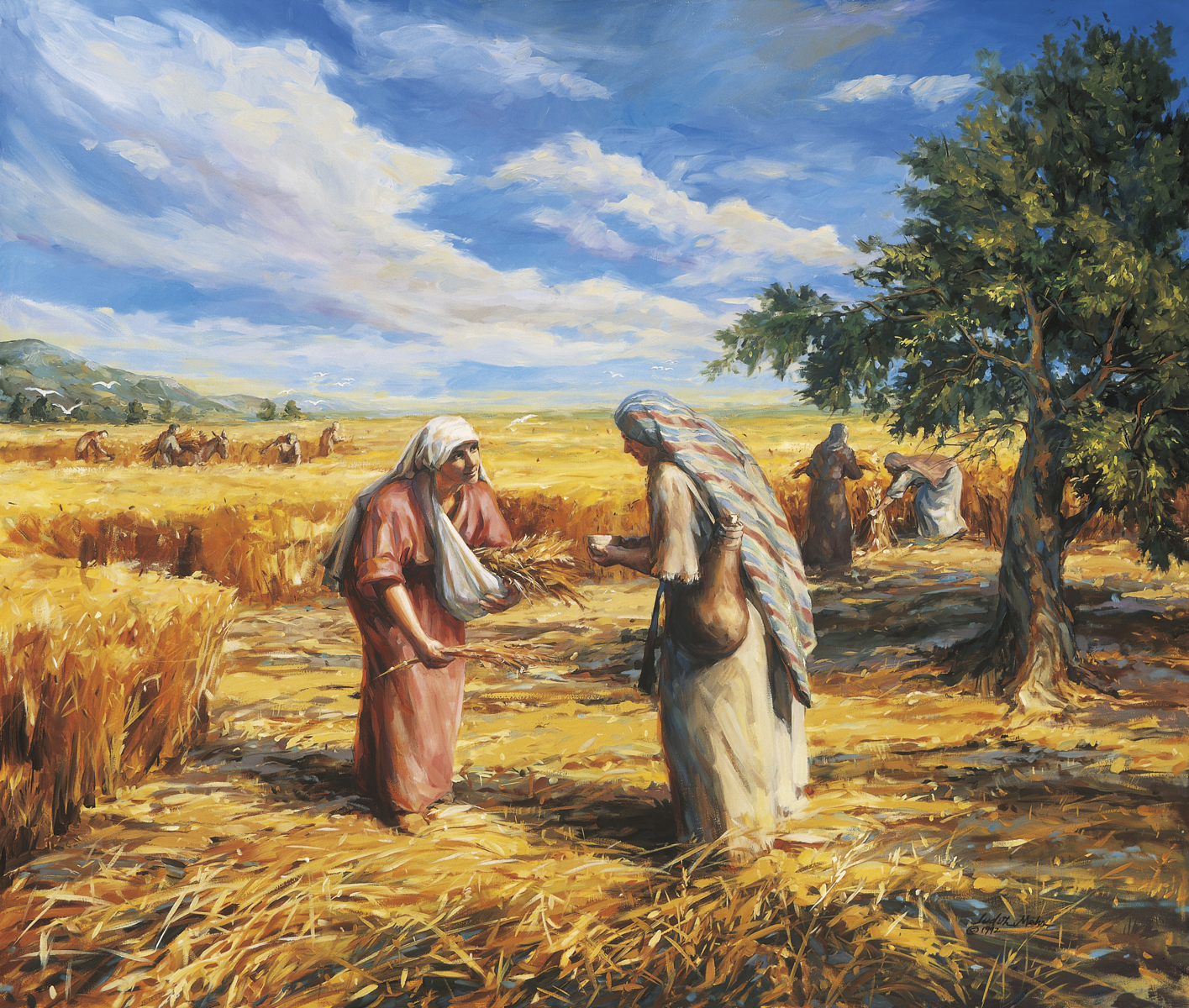
‘A young woman could go out as a gleaner at harvest time and gather enough grain for her food for the winter if she was fortunate, but if she were a foreigner and alone, she also risked being molested or driven off. However, Ruth happened to go to the field of Boaz, a kinsman of Elimelech, who was the deceased husband of Naomi. This was indeed a blessing, as Ruth and Naomi later recognised. According to the description given on him in verse 1, Boaz was an honourable man of good standing. Likewise Ruth was described as an honourable woman of good standing (3:11).
Upon making careful enquiries, Boaz found reason to grant Ruth favours and protection and was kind enough to do so (see especially vv 11 and 12).’ (Andrew C Skinner and D Kelly Ogden, Verse by verse, The Old Testament)
2. Ruth and Boaz marry and have a child.
Ruth 3:4 Uncover his feet
‘Uncover his feet, and lay thee down – It is said that women in the East, when going to the bed of their lawful husbands, through modesty, and in token of subjection, go to the bed’s foot, and gently raising the clothes, creep under them up to their place. See Calmet.
On the whole, we must say, had not Boaz been a person of extraordinary piety, prudence, and continence, this experiment might have been fatal to Ruth. We cannot easily account for this transaction, probably Naomi knew more than she revealed to her daughter-in-law. The experiment however was dangerous, and should in no sense be imitated.’ (Clarke’s Commentary on the Bible)
Ruth 3:10-18
‘Notice Boaz’s reaction, his attitude, his concern for propriety, his methodical plan for action, and his resolution to do his duty by Ruth – if the one with the prior right to marry her should choose not to do so. Ruth returned home in the morning before it was light enough for anyone to recognise her. Naomi was confident that Boaz would take care of the matter that very day.’ (Andrew C Skinner and D Kelly Ogden, Verse by verse, The Old Testament)
Ruth 4:7–12. How Was a Public Agreement Made Legally Binding?
“The public life of an Israelite village was concentrated at its main gate. It was here that matters of law were brought for adjudication before the elders of the community. They also were the official witnesses for transactions such as the one in which Boaz agreed to marry Ruth if her kinsman would give up all rights to her dead husband’s property. A man renouncing property rights removed a sandal and presented it to the new property holder, a gesture that everyone understood and considered binding if witnessed by the elders.” (Great People of the Bible and How They Lived, p. 133.)
Ruth 4:17 They called his name Obed
The book of Ruth tells the story of Ruth, an ancestor of Jesus. Following the death of her husband she decides to leave her own country, people and religion to follow her mother-in-law to Israel. Here she finds a husband in her ‘kinsman’ Boaz. Boaz is a foreshadowing or type of Christ.
- Like Jesus, Boaz was of the tribe of Judah.
- He was an ancestor of David and of Jesus.
- He was born and lived in Bethlehem.
- He owned a field into which he sent His laborers. (He was a ‘Lord of the Harvest’)
- The Hebrew word translated as kinsman, go’el literally means “redeemer.”
- Boaz became the kinsman Redeemer of both Jew and Gentile, by buying the lost inheritance of Naomi and Ruth thus gaining the right to make Ruth his bride. In this way Boaz is a type of Christ’s love and redemptive power.
- Before approaching Boaz in his own place, Ruth washes and anoints herself and puts on raiment.
- When Ruth comes and lays at Boaz’s feet Boaz does not immediately receive her. He tells her that there is a relative closer than Himself who has a right to redeemer. Boaz is acting in accord with the Law of God.
- The Saviour receives and welcomes Jew and Gentile. He pays our debt, and therefore, gains the right to make us His bride.
- Boaz paid the price of the redemption of Naomi and Ruth outside the gate of the city. Hundreds of years later Jesus Christ would pay the price for us also outside the gate of the city.
- He was honouring the demands of the Law and obeying the Lord in his dealings with Ruth. He does not, and cannot redeem Ruth and Naomi until he has obeyed the demands of the law, and then pay the price to redeem her. The Saviour, similarly first fulfills the righteous requirements of the Law, then He pays the price.
3. Hannah is blessed with a son, whom she lends to the Lord as she promised.

1 Samuel 1:11 No razor
‘Hannah’s covenant with the Lord that, if she were given a child, “no razor” would come upon his head seems to be a promise to raise Samuel as a Nazarite, one under a special vow to God never to cut his hair. In Samuel is a great contrast to Samson, the former keeping his Nazarite vows throughout life, becoming a powerful man of God, and the latter violating all his vows, becoming a wretched example of failure to serve God.’ (Institute Old Testament Manual)
1 Samuel 1:19-28 Samuel
‘When the blessing was realised and her baby was born, Hannah named him Samuel (Hebrew, Shmu’el, ‘heard of God’) because she had supplicated the Lord and the Lord had heard her.
True to her promise and with gratitude for her blessing, she gave Samuel to the care of the priestly family at Shiloh after he was weaned. We see in the next chapter, however, that she kept in contact with him. As a Nazarite, Samuel was everything that Samson was not: a truly righteous boy who grew up to become a righteous man.’ (Andrew C Skinner and D Kelly Ogden, Verse by verse, The Old Testament)
1 Samuel 2:1–11 Hannah’s prayer
‘Hannah’s prayer shows her to have been a woman with great faith and love for God. The horn (see v. 1) symbolized power and strength. God had given her the power to bear a child. The rock (see v. 2) was a representation of protection. Jesus Christ is the rock or stone of Israel, the protector from evil (see Matthew 21:42–44). In 1 Samuel 2:10 both allusions are combined into one: the Messiah is “the anointed one” who will break all adversaries of the Lord in pieces (the Greek word for Messiah, Christos, also means “the anointed one”). He it was, Hannah said, who would be given strength in that his horn (power) would be exalted before men. This passage is a choice Old Testament reference to the future Messiah and shows that Hannah was blessed with the gift of prophecy.’ (Old Testament Institute Manual)
1 Samuel 2:21 the Lord visited Hannah, so that she conceived, and bare three sons and two daughters
“As the Lord promises all his children, once a test is fully met, the blessings are then bestowed, whether in this life or the next (see D&C 58:3–4). Hannah was likewise blessed once the commitment to her vow had been fully tested. Not only did Samuel become a great prophet, serving the Lord all his days, but also Hannah’s yearnings for more children were fulfilled. Through Eli the Lord praised Hannah’s commitment to her vow, then blessed her with the promise of more children. Hannah was eventually granted three more sons and two daughters (see 1 Sam. 2:20–21). At last her cup truly overflowed with blessings of great joy.
 Latter-day Bloke