1. The Lord blesses Solomon with wisdom, riches, and honor.
‘Solomon approached the Lord as a humble, obedient servant, and he was rewarded for his meekness with a wise and understanding heart. Perhaps no other person was ever given a greater gift of wisdom. Solomon was charged to keep the Lord’s commandments and statutes so that the Lord might lengthen his days as king.’ (Old Testament Institute Manual)
1 Kings 3:9 An understanding heart
‘The ills of the world would be cured by understanding. Wars would cease and crime disappear. The scientific knowledge now being wasted in the world because of the distrust of men and nations could be diverted to bless mankind. Atomic energy will destroy unless used for peaceful purposes by understanding hearts.
We need more understanding in our relationships with one another, in business and in industry, between management and labor, between government and the governed. We need understanding in that most important of all social units the family, understanding between children and parents and between husband and wife. Marriage would bring happiness, and divorce would be unknown if there were understanding hearts. Hatred tears down but understanding builds up.’ (Howard W Hunter, General Conference, April 1962)

1 Kings 3:16-28
‘In this well-known story illustrating Solomon’s wisdom, you may think he was simply fortunate. Ordinarily no woman who really wanted a child would agree to such a shocking and unsatisfying solution as Solomon proposed. Perhaps his wisdom lay in perceiving that the false claimant would be brazen or selfish enough to agree to the dividing of the child. Naturally, the true mother gave in rather than consent to the child’s death.’ (Andrew Skinner and D Kelly Ogden, Verse by Verse – The Old Testament)
2. King Solomon directs the construction of a great temple and has a palace built for himself.
1 Kings 5:17 Stones
‘Great stones – Stones of very large dimensions.
Costly stones – Stones that cost much labor and time to cut them out of the rock.
Hewed stones – Everywhere squared and polished.’ (Clarke’s Commentary on the Bible)
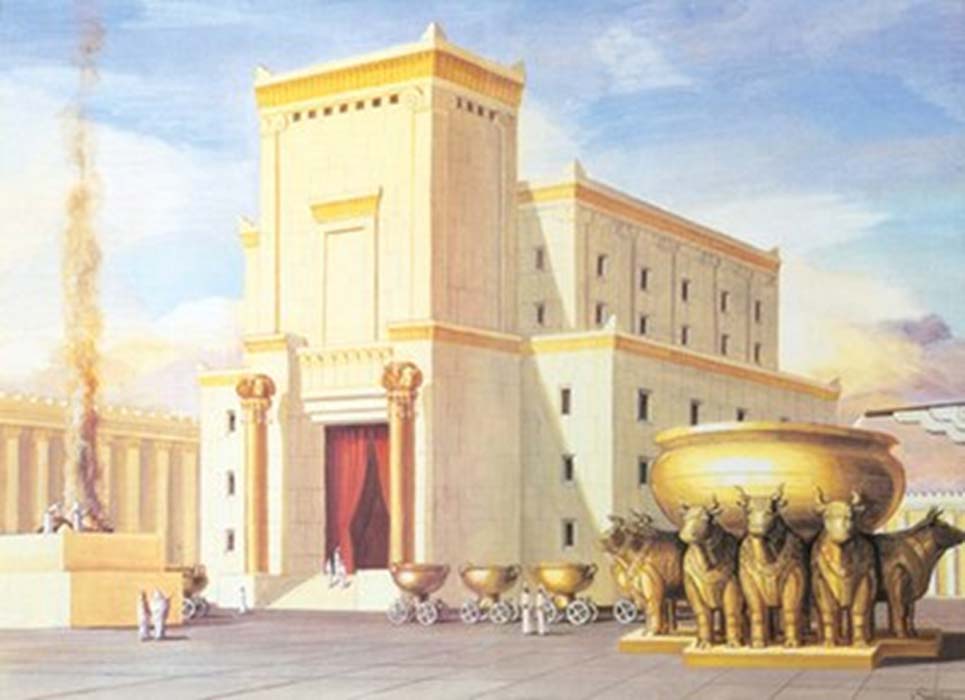
1 Kings 6. How Did Solomon Learn How the Temple Should Be Built?
‘Although David received some revelation about the building of the temple (see 1 Kings 6:30–33), apparently Solomon received even more. President Brigham Young said: “The pattern of this temple, the length and breadth, and height of the inner and outer courts, with all the fixtures thereunto appertaining, were given to Solomon by revelation, through the proper source. And why was this revelation-pattern necessary? Because Solomon had never built a temple, and did not know what was necessary in the arrangement of the different apartments, any better than Moses did what was needed in the tabernacle.” (Discourses of Brigham Young,p. 414.)
The temple of Solomon was later destroyed, and the kingdom of Judah was scattered. Zerubbabel’s temple, which Herod renovated, was later built on the same spot. This later temple was the one standing in the Savior’s day. ‘ (Old Testament Institute Manual)
3. Solomon dedicates the temple.
1 Kings 8. What Occurred at the Dedication of the Temple?
“When the House of the Lord was completed, elaborate preparations were made for its dedication. First came the installation of the Ark of the Covenant and its appurtenances, the Tabernacle of the Congregation, and the holy vessels. With great solemnity and to the accompaniment of ceremonial sacrifice, the Ark was brought by the priests and placed within the Holy of Holies beneath the wings of the cherubim. At this time the Ark contained only the two tables of stone ‘which Moses put there.’ The staves by which the Ark was borne were so drawn out as to be visible from within the Holy Place, and then ‘it came to pass, when the priests were come out of the holy place, that the cloud filled the house of the Lord, So that the priests could not stand to minister because of the cloud: for the glory of the Lord had filled the house of the Lord.’ [1 Kings 8:10–11.]
“Then Solomon addressed the assembled multitude, reciting the circumstances under which the building of the Temple had been conceived by his father David and executed by himself, and proclaiming the mercy and goodness of Israel’s God. Standing before the altar of the Lord, in the court of the Temple, the king spread forth his hands toward heaven, and offered the dedicatory prayer. The king then blessed the people, saying ‘Blessed be the Lord, that hath given rest unto his people Israel, according to all that he promised: there hath not failed one word of all his good promise, which he promised by the hand of Moses his servant. The Lord our God be with us, as he was with our fathers: let him not leave us, nor forsake us.’ [1 Kings 8:56–57.]
“The principal services with the attendant festivities lasted seven days, and ‘on the eighth day he sent the people away: and they blessed the king, and went unto their tents joyful and glad of heart for all the goodness that the Lord had done for David his servant, and for Israel his people.’ [1 Kings 8:66.]” (Talmage, House of the Lord, pp. 34–35.)

4. Solomon becomes excessively wealthy and marries many non-Israelite women who persuade him to worship idols.
1 Kings 11:1–10. What Can We Conclude Regarding Solomon’s Many Marriages?
‘Solomon married “strange women,” that is, foreign women, or those not of the covenant. Solomon’s marriages were for political expediency (see Notes and Commentary on 1 Kings 3:1) and perhaps for personal reasons as well. But these women brought to Israel their idols and heathen worship, which corrupted not only Solomon but the people also.
According to the Doctrine and Covenants, however, some of Solomon’s wives were given to him of the Lord: “David also received many wives and concubines, and also Solomon and Moses my servants, as also many others of my servants, from the beginning of creation until this time; and in nothing did they sin save in those things which they received not of me” (D&C 132:38).
President Joseph Fielding Smith further explained that the Lord “did not condemn Solomon and David for having wives which the Lord gave them.
“Now turn to [2 Samuel] 12:7–8 and you will find that the Lord gave David wives. In your reading of the Old Testament you will also find that Solomon was blessed and the Lord appeared to him and gave him visions and great blessings when he had plural wives, but later in his life, he took wives that the Lord did not give him.” (Answers to Gospel Questions, 4:214.)
Jacob 2:24–31clearly teaches that plural wives may be taken only when doing so is authorized by the Lord. David’s taking plural wives was authorized by the Lord, for David’s wives “were given unto him of me [the Lord], by the hand of Nathan, my servant, and others of the prophets who had the keys of this power” (D&C 132:39). No plural marriages are authorized by the Lord today, and any attempt to justify them from ancient scripture will result in condemnation from the Lord.’ (Old Testament Institute Manual)
 Latter-day Bloke