1. The shepherds of Israel
Ezekiel 34:2-4 Should not the shepherds feed the flocks?
‘There are quorum members and those who should be our quorum members who require our help. John Milton wrote in his poem “Lycidas,” “The hungry sheep look up, and are not fed.”[“Lycidas,” line 125.] The Lord Himself said to Ezekiel the prophet, “Woe be to the shepherds of Israel that … feed not the flock.” Ezek. 34:2–3
My brethren of the priesthood, the task is ours. Let us remember and never forget, however, that such an undertaking is not insurmountable. Miracles are everywhere to be seen when priesthood callings are magnified. When faith replaces doubt, when selfless service eliminates selfish striving, the power of God brings to pass His purposes. We are on the Lord’s errand. We are entitled to the Lord’s help. But we must try. From the play Shenandoah comes the spoken line which inspires: “If we don’t try, then we don’t do; and if we don’t do, then why are we here?”’ (Thomas S Monson, General Conference, October 2004)

Ezekiel 34:1–10. “Should Not the Shepherds Feed the Flocks?”
‘In a tone very similar to Jeremiah’s (see Jeremiah 23:1–8), Ezekiel condemned the pastors, or shepherds, of the Lord’s spiritual flock, the religious leaders of Ezekiel’s day.
In contrast to the Lord’s care of His flock, the shepherds of Israel fed themselves but not the flock. The negligent shepherds did not strengthen the sick, bind up the broken, bring back again those who were driven away, or seek for the lost sheep—all of which any real shepherd would do for his own sheep. Instead, they ruled the sheep with force and cruelty and let them wander to become a prey to beasts.
President Spencer W. Kimball, in a priesthood session of general conference, charged the present shepherds—priesthood leaders—of the kingdom to be concerned about the welfare of the flock:
“As we read and study the scriptures, we are made conscious of the fact that the Savior has always been concerned about the welfare of the members of his flock, both individually and collectively. It is about that principle of caring for and ministering to the needs of the Church membership in these troubled days that I desire to speak to you brethren tonight.
“Bishops and branch presidents, please be ever alert to the needs of the precious individuals and families who make up the membership of your wards and branches. You are the nurturing shepherds of our people. To the greatest extent possible, let your counselors and others who serve and work under your direction be the managers of programs. If you will pursue this emphasis, you will often be able to detect very early some of those members who have serious difficulties, while their challenges and problems are still small and manageable. Be conscious of the little tensions and problems you may see in families so that you can give the required attention, counsel, and love when it is most needed. An hour with a troubled boy or girl now may save him or her, and is infinitely better than the hundreds of hours spent in their later lives in the reclamation of a boy or girl if they become inactive.
“As we have said so many times, delegate those tasks which others can do so that you are free to do those things which you, and you alone, can do. Home teachers are to help watch over the flock. Even though they don’t counsel as bishops and branch presidents do, home teachers can render much appropriate and preventive help under the direction of the quorum leaders and bishoprics.
“Stake presidents, bishops, and branch presidents, please take a particular interest in improving the quality of teaching in the Church. The Savior has told us to feed his sheep (see John 21:15–17). I fear that all too often many of our members come to church, sit through a class or meeting, and they then return home having been largely uninformed. It is especially unfortunate when this happens at a time when they may be entering a period of stress, temptation, or crisis. We all need to be touched and nurtured by the Spirit, and effective teaching is one of the most important ways this can happen. We often do vigorous enlistment work to get members to come to church but then do not adequately watch over what they receive when they do come.” (In Conference Report, Oct. 1980, p. 67; see also Ensign, Nov. 1980, pp. 45–46.)’ (Institute Old Testament Manual)
2. Repentance and forgiveness
Ezekiel 18:21-22 They shall not be mentioned unto him
‘What a fabulous promise, but it requires two alls to receive the promise of the third. Turn from all; keep all; then all is forgiven. This requires being “all in”!
We should not be like the man who, as the Wall Street Journal reported, sent an envelope filled with cash along with an anonymous letter to the Internal Revenue Service which said, “Dear IRS: Enclosed please find money I owe for past taxes. P.S. If after this my conscience still bothers me, I’ll send you the rest.” [See, for example, Roy B. Zuck, comp., The Speaker’s Quote Book: Over 5,000 Illustrations and Quotations for All Occasions (2009), 107–8.]
That’s not how we do it! We don’t hold back to see what the minimum is we can get by with.’ (Gary B Sabin, General Conference, April 2017)
Ezekiel 18:31 Cast away from you all your transgressions
‘Not only cease from sin, but with indignation throw it away, as a loathsome, pernicious thing, or as a burden will sink you.’ (Matthew Poole’s Commentary)
Ezekiel 18:24,26 A person cannot be saved by his former righteousness
“Having received the necessary saving ordinances—baptism, the gift of the Holy Ghost, temple ordinances and sealings—one must live the covenants made. He must endure in faith. No matter how brilliant was the service rendered by the bishop or stake president or other person, if he falters later in his life and fails to live righteously ‘to the end’ the good works he did all stand in jeopardy.” (Spencer W Kimball, Miracle of Forgiveness, p. 121.)
Ezekiel 18:23 Have I any pleasure at all that the wicked should die?
‘No! That is foreign to him whose name is love, and whose nature is mercy. On the contrary he “wills that he should return from his evil ways and live.”‘ (Clarke’s Commentary on the Bible)
Ezekiel 18:25 The way of the Lord is not equal
‘The word means literally, weighed out, balanced. The accusation of the Israelites was still (here and in Ezekiel 18:29) that the Lord was arbitrary and unjust. His statement in reply is that He rewards and punishes according to eternal and immutable principles of right. Every man must reap that which he has sown.’ (Ellicott’s Commentary for English Readers)
3. Ezekiel’s vision of the valley of bones
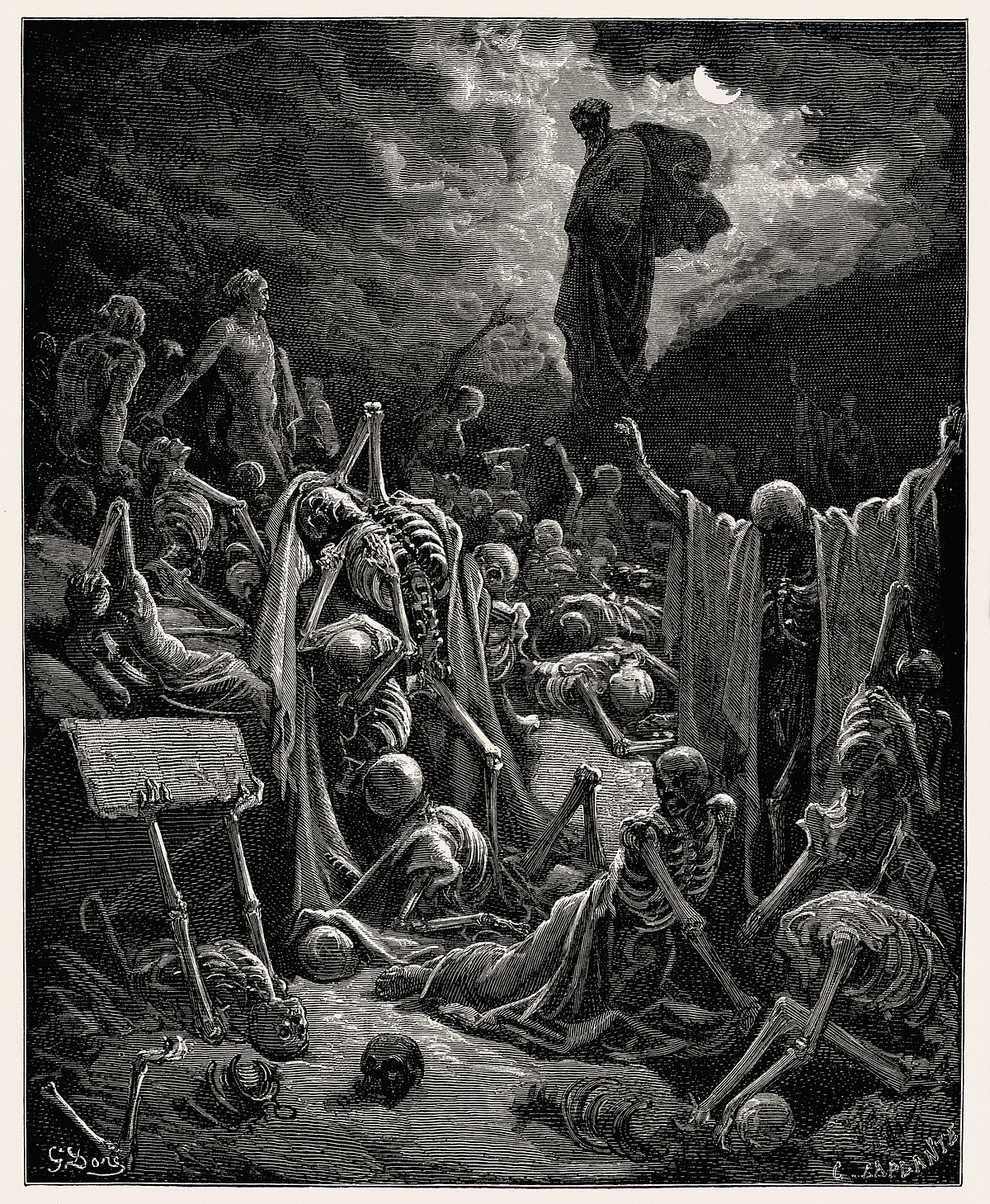
Ezekiel 37:1–14. Is Ezekiel’s Vision of the Valley of Bones about the Resurrection or about the Renewal of the House of Israel?
‘Often prophetic utterances have dual meanings. Such is the case for the well-known allegory of the scattered dry bones. The beauty of prophecy is that the Lord can reveal to those who are spiritually alert more than one truth in one prophecy.
Sidney B. Sperry wrote the following commentary on the dual nature of this prophecy: “It will be seen from this passage that the doctrine of the resurrection from the dead … is invoked to symbolize the restoration of Israel’s exiles to their own land. The exiles are represented—so it seems to me—as having lost hope (their bones are dried up) of ever living again as a nation. But the Lord shows them that they can be restored through His mighty power even as the dead will be raised in the resurrection. The doctrine of the resurrection of the body is assumed. Some writers contend that the idea of resurrection was not known among the Hebrews at this early time. But the fact that Ezekiel speaks as he did would seem to me an indication that the doctrine had long been understood in Israel. Any true prophet would understand the doctrine of the resurrection, so Latter-day Saints believe, and Israel had had many prophets long before Ezekiel’s time.” (The Voice of Israel’s Prophets, pp. 225–26.)
The symbolic meaning of this prophecy as it relates to the gathering of Israel is apparent: The bones represent Israel in its lost and scattered state; the graves indicate where Israel is as well as its condition of spiritual death. The spirit, or ruach in Hebrew (see Ezekiel 37:9), means the new spirit of righteousness the people will have when they have been resurrected, that is, restored from their fallen state. The source of this new life will be the Holy Ghost.
But Ezekiel’s account of the Resurrection is literal, as well as symbolic of the future gathering of Israel. Elder Bruce R. McConkie testified: “There is nothing more real, more literal, more personal than the resurrection, as Ezekiel then beheld in vision. He saw the dead live again, live literally and personally, each one becoming in physical makeup as he had been in mortality. It was with each of them as it would be with their Lord, when he, having also come forth from his valley of dry bones, stood in the upper room with his disciples, ate before them, and permitted them to handle his physical body. To his people the Lord’s voice came: ‘I will open your graves, and cause you to come up out of your graves, and bring you into the land of Israel.’ (Ezek. 37:1–14.) He who shall do all this, as we are now acutely aware, is the Lord Jesus Christ who is the God of Israel.” (The Promised Messiah, pp. 270–71.)’ (Old Testament Institute Manual)
4. The stick of Judah and the stick of Joseph
Ezekiel 37:15–20. What Is the Symbolism of the Two Sticks Being Joined Together?
‘This passage is another example of the dual nature of prophecy. Sperry explained: “What is the meaning of these ‘sticks’ and what is their significance? Most commentators simply believe that each piece of wood represents one of the two kingdoms, either Judah or Israel (Ephraim), which are to be bound together or united under the Lord’s direction. This act symbolizes the reunion of Ephraim and Judah into one kingdom. … However, the Latter-day Saints insist that such an interpretation is by no means complete. … What they do believe is that each of the sticks represents a scripture, a significant piece of writing. The Bible represents the scripture of Judah. To an average person not of our faith this conclusion may seem reasonable, but he will ask immediately what scripture represents the stick of Ephraim. To which we reply, the Book of Mormon. The Nephite scripture is the record of the descendants upon this continent of Joseph who was sold into Egypt.” (Voice of Israel’s Prophets, pp. 226–27.)
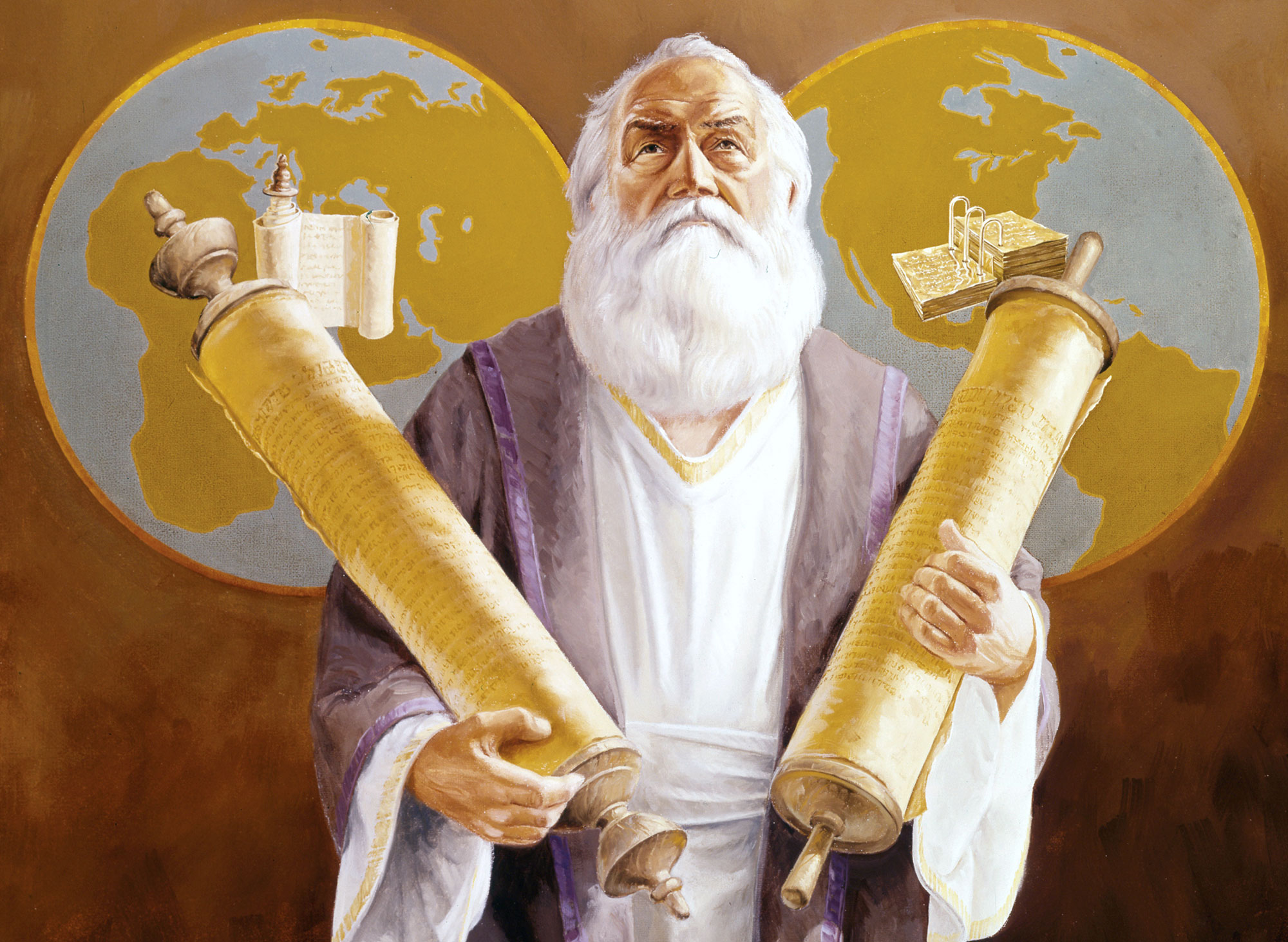
The Doctrine and Covenants and the Book of Mormon affirm that Ezekiel’s prophecy deals with the Bible and the Book of Mormon being joined together. Doctrine and Covenants 27:5teaches that the Book of Mormon is the stick of Ephraim. The Book of Mormon, in 1 Nephi 13:40–41; 2 Nephi 29:10–14; and Mormon 7:8–9speaks of the records of the Jews and the records of the Nephites being gathered together into one.
The sign that Jesus Christ gave the Nephites that the restoration of the tribes of Israel was at hand was the coming forth of the Book of Mormon, which made the combining of the records possible (see 3 Nephi 20:46; 21:1–7; 29:1). This truth is sustained by Elder Bruce R. McConkie: “Because [the Book of Mormon] came forth, as the seeric insight of Ezekiel has so plainly set forth, latter-day Israel would be gathered, her people would become clean before the Lord, he would make with them again his everlasting gospel covenant, and his tabernacle and temple would be in their midst forevermore. (Ezek. 37:15–28.)” (Promised Messiah, p. 146.)’ (Institute Old Testament Manual)
 Latter-day Bloke