1. Daniel and his friends refuse to eat King Nebuchadnezzar’s food; they are blessed with good health and wisdom.
‘Let us clearly understand the pressures that the four young men were under. They had been carried away as captives by a conquering power and were in the household of a king who held the power of life or death over them. And yet Daniel and his brothers refused to do that which they believed to be wrong, however much the Babylonian culture believed it to be right. And for that fidelity and courage, the Lord blessed them and “gave them knowledge and skill in all learning and wisdom” Dan. 1:17
Seduced by our culture, we often hardly recognize our idolatry, as our strings are pulled by that which is popular in the Babylonian world. Indeed, as the poet Wordsworth said: “The world is too much with us” (“The World Is Too Much with Us; Late and Soon,” in The Complete Poetical Works of William Wordsworth [1924], 353). ‘ (David R Stone, General Conference, April 2006)
‘After the death of King Solomon in 975 B.C., the Ten Tribes revolted and separated themselves from the Tribe of Judah. A divided Israel was not able to hold its own against the other powers of that region. Egypt and Assyria would take turns overrunning the land of Israel. In the year 607 B.C., Assyria proper and the northern provinces fell into the hands of the Medes, while Syria lay open to be seized by the Babylonians.
While this struggle was going on, it seemed an appropriate time for Egypt to attack Palestine. The king of the Babylonians sent his son, Nebuchadnezzar, to drive the Egyptians back. While the battle raged against the Egyptians, the king passed away and Nebuchadnezzar became the ruler of Babylon. He was successful against the Egyptians and became ruler over all of Syria to the Egyptian border. He ruled by terror, crushing his enemies by fire and sword, and weakening them with deportations to other parts of his empire.
It was in the midst of this battle-torn era that Daniel was born. As a youth, he and certain other Hebrews were taken into the court of Nebuchadnezzar for service. They were chosen because of their wisdom and knowledge and ability to learn. Thus, Daniel was brought into a strange land with strange customs, a strange environment, and a very different religious heritage
Daniel’s first test in being “in the world” came when the servant of Nebuchadnezzar ordered him to drink of his wine and eat of the “king’s meat.” Daniel “purposed in his heart that he would not defile himself with the portion of the king’s meat, nor with the wine which he drank” ( Dan. 1:8)
The servant argued that the king had made him responsible for training these young men, and had commanded they should eat and drink the same as the others. If they did not, the king would see that they were growing weak and thin, and would surely have the servant killed. Then Daniel begged that he and his friends be allowed to follow the health habits that had been given to them. His request was that they be proved for ten days—for ten days they would feed upon grains and drink water, to see if they were not healthier than all the rest.
Daniel’s strategy was most interesting. He did not challenge the beliefs of the Babylonians. Instead, he volunteered to conduct a test as to which way was best. The servant agreed to the test. For the next ten days, Daniel and those who were with him ate and drank only of the things that they knew they should. At the end of the tenth day, Daniel and his friends were found to be healthier and stronger than all the rest. Daniel soon found that he did not have to adopt a different standard of values when he was “in the world.”
I remember that as a young executive many years ago, part of my job involved attending dinners sponsored by different business groups. Each dinner was always preceded by a social hour. I felt very uncomfortable in these settings. After the first one or two dinners, I started coming late to miss the social hour. My boss thought this was not a good practice because I was missing valuable time associating with business leaders. Still, I felt awkward visiting in groups where I was the only one without a drink in my hand. I kept wondering what to do with my hands. You can always put one hand in your pocket, but you look a little foolish with both of them there. I tried holding a glass of 7-Up, but it had the appearance of an alcoholic beverage.
Finally I went over to the bartender and asked him if he had any drink that was distinctively different in appearance from an alcoholic beverage. He went into the kitchen and came back with a half gallon of milk and poured me a glass. Pouring a glass of milk at a cocktail hour was a unique event. It seemed to attract the attention of everyone, and I became the target of a lot of jesting. It embarrassed me at first, until I discovered that I was meeting more business leaders than I had at any previous gathering. I found that I did not have to violate Church standards to become a viable, contributing member of my chosen profession. It was more the case that success came because I did adhere to my values.
It soon became a practice at the social hours in that community to always have a carton of milk on the bar. I was amazed, as time passed, by how many of my associates were joining me for a glass of milk during the hour that we spent together. I found, just as Daniel did, that being different in the world brought some interesting reactions, but obedience to the Lord’s law is always associated with His blessings.’ (L Tom Perry, General Conference, April 1988)

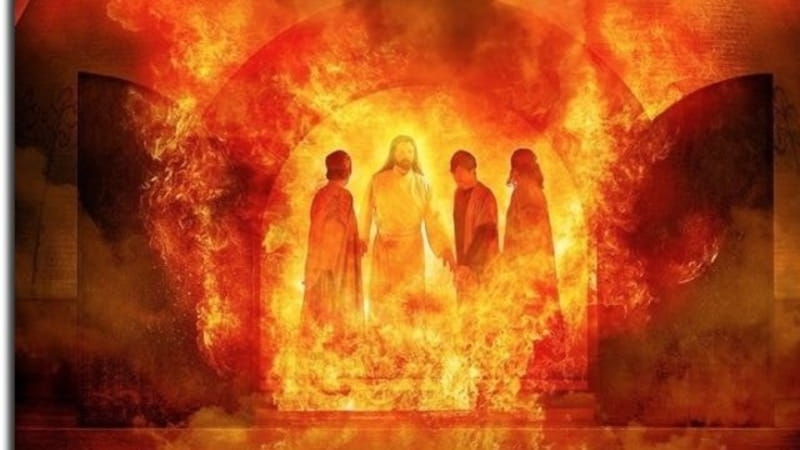
2. The Lord saves Shadrach, Meshach, and Abednego from death in the fiery furnace.
Daniel 3:19–23. The Casting of Shadrach, Meshach, and Abed-nego into the Furnace
‘To heat the furnace “seven times more than it was wont to be” (Daniel 3:19) is presumed to be an idiomatic way of saying that the furnace was to be heated much hotter than usual—to be heated as hot as it could be heated (see Clarke, Commentary,4:578). “If the three were brought up to the furnace, it must have had a mouth above, through which the victims could be cast into it. When heated to an ordinary degree, this could be done without danger to the men who performed this service; but in the present case the heat of the fire was so great, that the servants themselves perished by it.” (C. F. Keil and F. Delitzsch, Commentary on the Old Testament, 9:3:130.)
The king apparently viewed the events in the furnace through an opening at the bottom (see D. Guthrie and J. A. Motyer, eds., The New Bible Commentary: Revised, p. 692).’ (Institute Old Testament Manual)
3. Daniel prays in spite of the king’s decree and is thrown into a den of lions. The Lord sends an angel to protect Daniel.
‘Daniel was still in favor with the next two succeeding kings, but the king’s advisers were jealous and tried to find some reason to discredit Daniel. They could find none, but knowing of Daniel’s prayers to his God, contrived to have the king issue a decree that anyone asking a petition of any god or man save the king should be cast into the den of lions.
You know what happened. In spite of this order, Daniel continued to pray. When he was seen, he was taken before the king, who, because of his regard for Daniel, was displeased with himself for issuing the decree and would have freed Daniel; but he was reminded that the law of the Medes and Persians required that no decree may be changed but must be carried out.
As Daniel was cast into the den of lions, the disturbed king said to him, “Thy God whom thou servest continually, he will deliver thee” (Dan. 6:16)
He spent a sleepless night and went early to the den of lions, where he rejoiced to find Daniel still alive, who said to him, “My God hath sent his angel, and hath shut the lions’ mouths, that they have not hurt me: forasmuch as before him innocency was found in me; and also before thee, O king, have I done no hurt” (Dan. 6:22)
The king had Daniel brought out of the lions’ den and his accusers cast in, who were immediately killed by the hungry beasts.’ (N Eldon Tanner, General Conference, April 1979)
Daniel 6:1-5 Darius
‘Belshazzar’s successor, King Darius, also honored Daniel, elevating him to the highest position of prominence. There followed the envy of the crowd, the jealousy of princes, and the scheming of ambitious men.’ (Thomas S Monson, General Conference, April 1982)
Daniel 6:7-9 All the presidents
‘As Daniel’s adversaries could have no advantage against him by any law now in being, they therefore contrive a new law, by which they hope to insnare him, and in such a matter as they knew they would be sure of doing it. They pretended that this law, which they wished to have enacted, was the result of mature deliberation; that all the presidents of the kingdom, the governors, princes, &c., had consulted together about it, and that they not only agreed to it, but advised it, for divers good causes and considerations; nay, they intimate to the king that it was carried nemine contradicente. All the presidents, say they, are of this mind, and yet we are sure that Daniel, the chief of the three presidents, did not agree to it; and we have reason to think that many more excepted against it, as absurd and unreasonable. ‘ (Benson Commentary)
Daniel 6:10 His windows being open
‘He would not shut them to conceal himself, but “kneeled down with his face turned toward Jerusalem, and prayed thrice each day, giving thanks to God as usual.” When the Jews were in distant countries, in prayer they turned their faces towards Jerusalem; and when in Jerusalem, they turned their faces towards the temple. Solomon, in his prayer at the dedication of the temple, 1 Kings 8:48, had entreated God to hear the prayers of those who might be in strange lands, or in captivity, when they should turn their faces towards their own land, which God gave unto their fathers; and towards the city which he had chosen, and the house which was dedicated to his name. It was in reference to this that Daniel turned his face towards Jerusalem when he prayed.’ (Clarke’s Commentary on the Whole Bible)
Daniel 6:12-15 Hast thou not signed a decree…?
‘They had enough now, they came with open mouth, they pleaded the breach of the king’s laws, they tell the king he had signed it, and it could not be disannulled; the king’s authority and the honour of the nation lay at stake. The king owned such a law, and it was unalterable.’ (Matthew Poole’s Commentary)
Daniel 6:21 O king, live forever
‘He does not reproach him for his unkindness to him, and his easiness in yielding to the malice of his persecutors; but, to show that he has heartily forgiven him, he meets him with his good wishes. ‘ (Benson Commentary)
Daniel 6:24. Daniel’s Accusers Cast into the Lions’ Den
‘The term or ever, as used in Daniel 6:24, means “before.” Some have attacked the cruelty of condemning the women and children, too. To an absolute monarch, however, it probably seemed the logical thing to do, for out of these families might come insurrection in the future. The lesson must be severe enough to warn any others who might be jealous of the king’s favorite and most valuable servant. An absolute monarch would likely feel that any other course would slowly cause him to lose power.’ (Institute Old Testament Manual)
4. Esther risks her life to save her people.
Esther 3:1–6. Why Would Mordecai Not Bow to Haman?
“The only explanation offered is that Mordecai claimed exemption on the ground that he was a Jew. Probably the inference is justified that Haman was demanding not mere allegiance but worship, and Mordecai would not break the first commandment. … If fear of idolatry lay behind the refusal to bow down then no Jew would bow down, and Haman’s decision to take vengeance on the whole people becomes understandable. Similar acts of revenge involving wholesale slaughter are recorded by Herodotus (i. 106; iii. 79). … In Esther, however, anti-semitism proper makes its appearance with Haman’s express intention of wiping out the Jewish race. It might well seem incredible that one man’s injured pride should lead to such an irrational conclusion if it were not that history has produced an equally irrational attack on the Jews in the 20th century.” (Guthrie and Motyer, New Bible Commentary,pp. 416–17.)’

Esther 4:1–17. Was Esther Foreordained?
‘“The Jewish people of the empire suffered deep shock when the terrible news was spread. And upon Esther there came a double burden: first the saddening news of the proclamation of death for her people; then the challenge to risk death herself to try to avert the general calamity.
“One of the hints of religiousness in the major characters of this story is given in Mordecai’s challenging statement to Esther, ‘… Who knoweth whether thou art come to the kingdom for such a time as this? It appears that an overseeing Providence and purpose are implied, even though God is not explicitly mentioned here or elsewhere in this book.” (Ellis T. Rasmussen, An Introduction to the Old Testament and Its Teachings, 2:116.)
In other words, Mordecai told Esther that she was, perhaps, raised up at that time for that very purpose. It is also implied that Esther’s beauty was a gift from God to put her into the position where she could gain the favor of the king and save her people.’ (Institute Old Testament Manual)
Esther 4:16 And if I perish, I perish
‘signifying, that she readily and cheerfully risked her life for the good of her people; and if such was the pleasure of God, that she should lose it, she was content, and acquiesced in his will, leaving herself entirely in his hands, to dispose of her as he thought fit.’ (Gill’s Exposition of the Entire Bible)
Esther 5:1-3 What wilt thou, queen Esther?
‘Physically, emotionally, and spiritually prepared, Esther stood in the inner court of the king’s house. When the king saw her, he held out his golden scepter, telling her that he would grant whatever request she had. She invited the king to a feast she had arranged, and during the feast she revealed that she was a Jew. She also exposed Haman’s underhanded plot to exterminate all of the Jews in the kingdom. Esther’s plea to save herself and her people was granted.’ (Thomas S Monson, General Conference, April 2009)
Esther 5:1–8. Why Was Esther’s Timing So Important?
‘Esther seized advantage in her first favorable reception to enhance her good standing with the king and to bring about a strategic announcement of her request. But the first delay was not enough. She offered a second banquet the next night. What happened in those twenty-four hours was of the greatest importance (see chap. 6). The sudden desire of the king to read the records was obviously inspired from the Lord. The fasting and faithfulness of Esther and her people was productive and brought the Lord into the situation. With Haman’s powerful position and favor in the eyes of the king (see Esther 3:1–2), a direct accusation by Esther might well have been rejected had the king not been prepared beforehand.’ (Old Testament Institute Manual)
Esther 7:3 Then Esther the queen answered
‘Esther, at length, surprises the king with a petition, not for wealth, or honour, or the preferment of some of her friends to some high post, which the king expected, but for the preservation of herself and her countrymen from death and destruction. ‘ (Benson Commentary)
Esther 8:5 The letters devised by Haman
‘Esther shows considerable skill in wording her request. She avoids speaking of the king’s letters, but calls them “the letters, the device of Haman, which hewrote.” It is the king, however, to whom the injury is done—“to destroy the Jews which are in all the king’s provinces.”’ (Ellicott’s Commentary for English Readers)
 Latter-day Bloke