The Savior knows us personally.
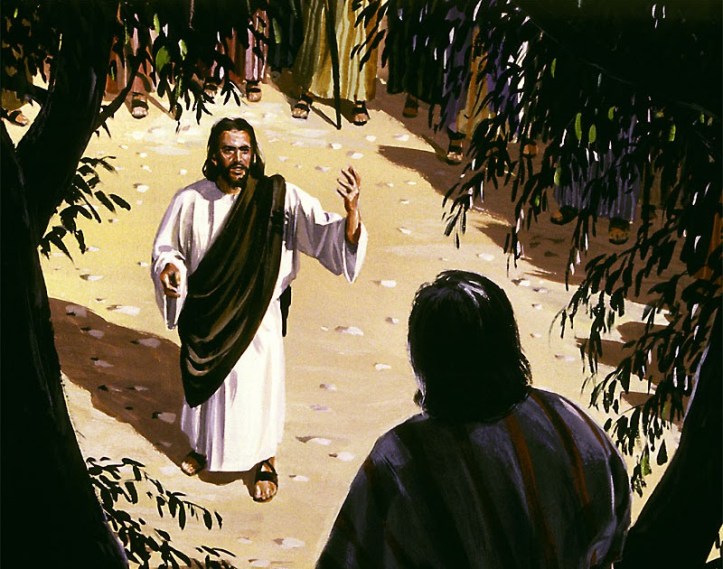
‘Jesus was on His way to Jerusalem for the last time. He passed through Jericho, where he encountered a man named Zacchaeus. Zacchaeus was a good man, who gave half of his goods to the poor and made “fourfold” restitution when necessary—well beyond what the law of Moses required (see Leviticus 5:16; Numbers 5:7). He was sincere and determined to do all he could to make things right. However, before his meeting with Jesus, Zacchaeus could have been considered the epitome of the “lost.” Not only was he a despised publican, but he was “the chief among the publicans.” Some people regarded Jewish publicans as having forfeited their claim to be among Abraham’s chosen offspring, but the Savior offered fellowship and salvation even to Zacchaeus, affirming that he “also is a son of Abraham.” The Savior’s own words help us understand the way the Savior viewed him: “For the Son of man is come to seek and to save that which was lost.” (See Luke 19:1–10.)’ (New Testament Institute Manual)
Jesus Christ is our King.
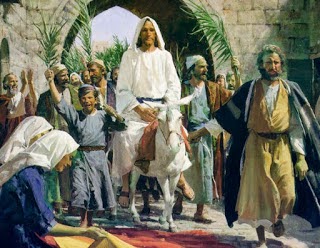
The day of Jesus’ triumphal entry into Jerusalem is still remembered in our day by the Christian celebration of “Palm Sunday.” In Jerusalem, some Christian groups assemble atop the Mount of Olives and parade down the Kidron Valley and up to the Old City of Jerusalem, bearing palm branches.
“Mark, Luke, and John mention a colt only, whereas the text of Matthew clearly indicates that the disciples brought an ass and a colt (the colt being the male foal, or offspring, of an ass). There was actually only one animal intended—Jesus, of course, could ride only one animal. The discrepancy in the number of animals is resolved by a simple correction that the Prophet Joseph Smith made: Matthew 21:2 and 5 in the Joseph Smith Translation indicate that only one animal was involved.” (D. Kelly Ogden, Where Jesus Walked: The Land and Culture of New Testament Times, 115.)
What is the significance of Jesus riding into Jerusalem on a colt?
Matthew 11 verses 4 and 5 refer to Zech 9:9. ¶Rejoice greatly, O adaughter of Zion; shout, O daughter of Jerusalem: behold, thy bKing cometh unto thee: he is cjust, and having salvation; lowly, and driding upon an eass, and upon a fcoltthe foal of an ass.
Israelite royalty traditionally rode on the colt of a donkey (horses were linked to war, asses to royalty and judgement). Donkeys were also associated with peace.
The use of the title “Son of David” indicated that the multitude accepted the Savior as the long-awaited Messiah. Many of the people expected him to now go into the city and take possession of the armies of Israel and lead them to victory over their enemies and then establish a reign of peace and justice and righteousness upon the earth.
The two great commandments are to love God and love others as ourselves.
“To love God with all your heart, soul, mind, and strength is all-consuming and all-encompassing. It is no lukewarm endeavor. It is total commitment of our very being—physically, mentally, emotionally, and spiritually—to a love of the Lord.
“The breadth, depth, and height of this love of God extend into every facet of one’s life. Our desires, be they spiritual or temporal, should be rooted in a love of the Lord. Our thoughts and affections should be centered on the Lord. …
“Why did God put the first commandment first? Because He knew that if we truly loved Him we would want to keep all of His other commandments. …
“We should put God ahead of everyone else in our lives.
“When Joseph was in Egypt, what came first in his life—God, his job, or Potiphar’s wife? When she tried to seduce him, he responded by saying, ‘How then can I do this great wickedness, and sin against God?’ (Genesis 39:9). … When Joseph was forced to choose, he was more anxious to please God than to please his employer’s wife. When we are required to choose, are we more anxious to please God than our boss, our teacher, our neighbor, or our date? …
“If someone wants to marry you outside the temple, whom will you strive to please—God or a mortal? … You should qualify for the temple. Then you will know that there is no one good enough for you to marry outside the temple. If such individuals are that good, they will get themselves in a condition so that they too can be married in the temple.
“We bless our fellowmen the most when we put the first commandment first” (Ezra Taft Benson, “The Great Commandment—Love the Lord,” Ensign, May 1988, 4–6; see also Mark 12:28–34).

We will be protected as we avoid following blind guides.
| SUMMARY | MEANING | ||
| 1 | Matthew 23:13
But woe unto you, scribes and Pharisees, hypocrites! for ye shut up the kingdom of heaven against men: for ye neither go in [yourselves], neither suffer ye them that are entering to go in. |
They make heaven inaccessible The scribes and the Pharisees are the ones who should lead. They should be the ones expecting the Messiah and the first to welcome him. They were the only ones who didn’t. They would have absolutely nothing to do with him, and they turned the people away from him | |
| 2 | Matthew 23:14
Woe unto you, scribes and Pharisees, hypocrites! for ye devour widows’ houses, and for a pretense make long prayer: therefore ye shall receive the greater damnation. |
They make long prayers while take advantage of the innocent such as the widows A number of years ago, Elder Francis M. Lyman had this to say about length of prayers: ‘It is not necessary to offer very long and tedious prayers, either at opening or closing. It is not only not pleasing to the Lord for us to use excess of words, but also it is not pleasing to the Latter-day Saints. Two minutes will open any kind of meeting, and a half minute will close it. |
|
| 3 | Matthew 23:15
Woe unto you, scribes and Pharisees, hypocrites! for ye compass sea and land to make one proselyte, and when he is made, ye make him twofold more the child of hell than yourselves. |
They convert men and make them hypocrites also | |
| 4 | Matthew 23:16-22
Woe unto you, [ye] blind guides, which say, Whosoever shall swear by the temple, it is nothing; but whosoever shall swear by the gold of the temple, he is a debtor! [Ye] fools and blind: for whether is greater, the gold, or the temple that sanctifieth the gold? And, Whosoever shall swear by the altar, it is nothing; but whosoever sweareth by the gift that is upon it, he is guilty. [Ye] fools and blind: for whether [is] greater, the gift, or the altar that sanctifieth the gift? Whoso therefore shall swear by the altar, sweareth by it, and by all things thereon. And whoso shall swear by the temple, sweareth by it, and by him that dwelleth therein. And he that shall swear by heaven, sweareth by the throne of God, and by him that sitteth thereon. |
They made contract law overcomplicated by their oaths The Lord does not uniformly condemn the making of oaths—especially in connection with the temple. Indeed, temples are for the making of oaths and covenants. Of course, the Pharisees had missed the spirit of the law. They didn’t know which was more important the gold of the temple or the temple itself. | |
| 5 | Matthew 23:23-24
Woe unto you, scribes and Pharisees, hypocrites! for ye pay tithe of mint and anise and cummin, and have omitted the weightier [matters] of the law, judgment, mercy, and faith: these ought ye to have done, and not to leave the other undone. [Ye] blind guides, which strain at a gnat, and swallow a camel. |
Their thinking was completely hypocritical focusing on the minutia while ignoring the weighty Our tendency—it is an almost universal practice among most Church members—is to get so involved with the operation of the institutional Church that we never gain faith like the ancients, simply because we do not involve ourselves in the basic gospel matters that were the center of their lives.
“We are so wound up in programs and statistics and trends, in properties, lands, and mammon, and in achieving goals that will highlight the excellence of our work, that we ‘have omitted the weightier matters of the law.’ And as Jesus would have said: ‘These [weightier things] ought ye to have done, and not to leave the other undone.’ (Matt. 23:23.)
“We are not saved by Church programs as such, by Church organizations alone, or even by the Church itself. It is the gospel that saves. The gospel is ‘the power of God unto salvation’ (Rom. 1:16).” (Sermons and Writings of Bruce R. McConkie, 237.) |
|
| 6 | Matthew 23:25-26
Woe unto you, scribes and Pharisees, hypocrites! for ye make clean the outside of the cup and of the platter, but within they are full of extortion and excess. [Thou] blind Pharisee, cleanse first that [which is] within the cup and platter, that the outside of them may be clean also. |
They were condemned for their washings ignoring their inner purity | |
| 7 | Matthew 23:27-28
Woe unto you, scribes and Pharisees, hypocrites! for ye are like unto whited sepulchres, which indeed appear beautiful outward, but are within full of dead [men’s] bones, and of all uncleanness. Even so ye also outwardly appear righteous unto men, but within ye are full of hypocrisy and iniquity. |
They made an outward show but were filthy within | |
| 8 | Matthew 23:29-33
Woe unto you, scribes and Pharisees, hypocrites! because ye build the tombs of the prophets, and garnish the sepulchres of the righteous, And say, If we had been in the days of our fathers, we would not have been partakers with them in the blood of the prophets. Wherefore ye be witnesses unto yourselves, that ye are the children of them which killed the prophets. Fill ye up then the measure of your fathers. [Ye] serpents, [ye] generation of vipers, how can ye escape the damnation of hell? |
They honor the past prophets but kill the present day prophets | |
The praise of men can prevent us from being valiant disciples of Jesus Christ.
”It is most important that we as members of the Church stand firmly and unitedly in the cause of truth and righteousness. We have declared to the world that we have the gospel of Christ, that we are going to stand against vice. Shall we stand firm, or shall we waver and be driven by the wind and tossed? Shall we forsake the cause of righteousness in order to please men, because we desire to give lip service rather than heart service, or because of some political power that is brought to bear upon us?” (N Eldon Tanner, General Conference, October 1970)
 Latter-day Bloke