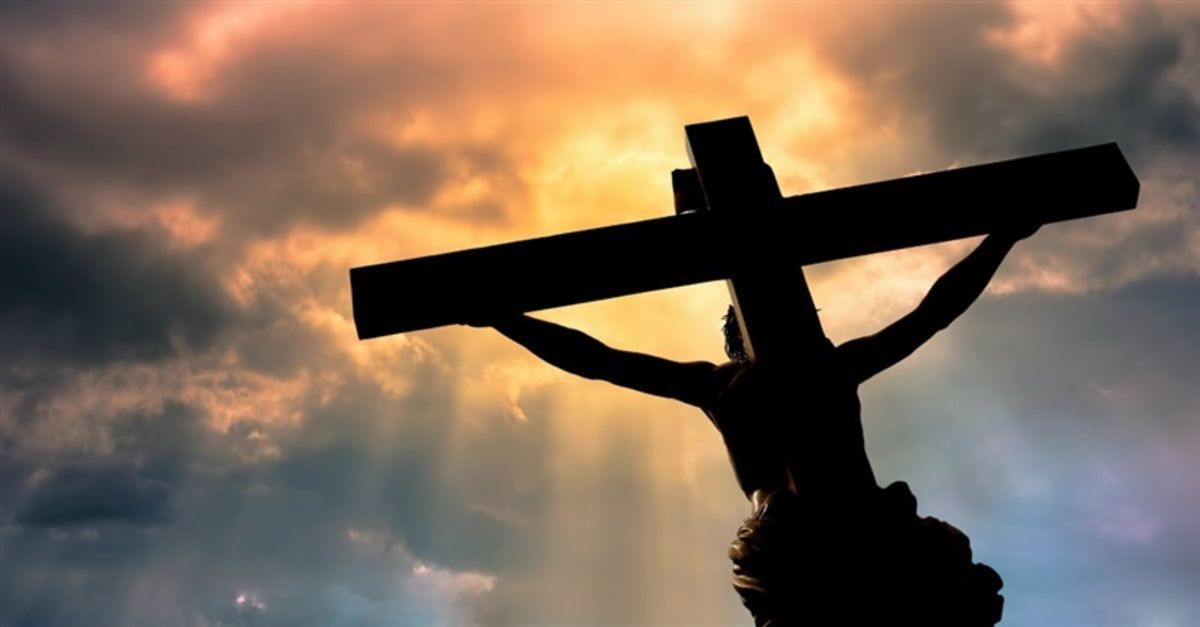
Jesus Christ’s willingness to suffer shows His love for the Father and for all of us.
Climbing is a unique sport, presenting mental and physical stress that you learn to overcome by operating close to your limits. Sometimes your limits are higher than you realize. “Of course, you recognize your limits in climbing by falling off the rock,” says Alan Czenkusch [leader of Whistepig Climbing School of Del Norte, Colorado]. “However, you’re safe because you’re on belay.” The belay anchor system is the crux of climbing. It allows falls with impunity – almost. The person running the rope does so to protect the climber. There is a great responsibility and obligation to this concept and Czenkusch explains it solemnly. The belayer protects himself by the use of pitons and other devices which give him fail-safe redundant protection. When the belayer calls out to the climber below “On Belay” it means he is set up correctly and has assumed a serious duty and would even give up his own life to protect the climber. Such dedication should allow the person below to ascent with no fear of falling. The mutual trust which allows belaying is part of the camaraderie, the intimacy, the mystique of mountaineering. Belaying has brought Czenkusch his best and worst moments in climbing. Czenkusch once fell from a high precipice, yanking out three mechanical supports and pulling his belayer off a ledge. He was stopped upside down 10 feet from the ground when his spread-eagled belayer arrested the fall with the strength of his outstretched arms. “Don saved my life,” says Czenkusch. “How do you respond to a guy like that? Give him a used climbing rope for a Christmas present? No, you remember him. You always remember him.”

Ancient prophets foresaw the Savior’s suffering and Crucifixion.
Consider these Old Testament prophecies and the New Testament fulfillment by Christ:
- Born in Bethlehem (Micah 5:2, Matthew 2:1; Luke 2:4-7)
- Born of a virgin (Isaiah 7:14; Matthew 1:21-23) as a descendant of Abraham (Genesis 12:1-3; 22:18; Matthew 1:1; Galatians 3:16), of the tribe of Judah (Genesis 49:10; Luke 3:23, 33; Hebrews 7:14), and of the house of David (2 Samuel 7:12-16; Matthew 1:1)
- Herod killing the infants (Jeremiah 31:15; Matthew 2:16-18)
- Taken to Egypt (Hosea 11:1; Matthew 2:14-15)
- Heralded by the messenger of the Lord (John the Baptist) (Isaiah 40:3-5; Malachi 3:1; Matthew 3:1-3)
- Anointed by the Holy Spirit (Isaiah 11:2; Matthew 3:16-17)
- Preached good news (Isaiah 61:1; Luke 4:14-21)
- Performed miracles (Isaiah 35:5-6; Matthew 9:35)
- Cleansed the Temple (Malachi 3:1; Matthew 21:12-13)
- Ministered in Galilee (Isaiah 9:1; Matthew 4:12-16)
- Entered Jerusalem as a king on a donkey (Zechariah 9:9; Matthew 21:4-9)
- Rejected by Jews (Psalm 118:22; 1 Peter 2:7)
- Died a humiliating death (Psalm 22; Isaiah 53) involving: rejection (Isaiah 53:3; John 1:10-11; 7:5,48), betrayal by a friend (Psalm 41:9; Luke 22:3-4; John 13:18), sold for 30 pieces of silver (Zechariah 11:12; Matthew 26:14-15), silence before His accusers (Isaiah 53:7; Matthew 27:12-14), being mocked (Psalm 22: 7-8; Matthew 27:31), beaten (Isaiah 52:14; Matthew 27:26), spit upon (Isaiah 50:6; Matthew 27:30), piercing His hands and feet (Psalm 22:16; Matthew 27:31), being crucified with thieves (Isaiah 53:12; Matthew 27:38), praying for His persecutors (Isaiah 53:12; Luke 23:34), piercing His side (Zechariah 12:10; John 19:34), given gall and vinegar to drink (Psalm 69:21, Matthew 27:34, Luke 23:36), no broken bones (Psalm 34:20; John 19:32-36), buried in a rich man’s tomb (Isaiah 53:9; Matthew 27:57-60), casting lots for His garments (Psalm 22:18; John 19:23-24).
- Rose from the dead! (Psalm 16:10; Mark 16:6; Acts 2:31)
- Ascended into Heaven (Psalm 68:18; Acts 1:9)
- Sat down at the right hand of God (Psalm 110:1; Hebrews 1:3)
Opposition cannot stop the work of God.
‘Today members of the Church do not often face persecution in the form of physical violence or harm, but perhaps some application can be made to the pressures we may feel from society, particularly the peer group pressures that our young people feel when they live up to the standards of dress and morality set by our present-day leaders. If these young people are prayerful and live the commandments, they will feel good about these high standards and will be able to stand up to criticism.
Our youth should always remember that when they were baptized they took upon themselves the name of Jesus Christ; they can be proud to stand up for his principles and those of our present-day leaders. By so doing they will receive rich rewards in this life and in the eternities to come, for theirs is the kingdom of heaven.
Whenever we live up to the best that is in us, we live up to the principles and the ideals the Savior gave us. To follow him brings peace to the soul.’ (O Leslie Stone, General Conference, October 1974)
Why do we need such resilient faith? Because difficult days are ahead. Rarely in the future will it be easy or popular to be a faithful Latter-day Saint. Each of us will be tested. The Apostle Paul warned that in the latter days, those who diligently follow the Lord “shall suffer persecution.”122 Timothy 3:12 That very persecution can either crush you into silent weakness or motivate you to be more exemplary and courageous in your daily lives.
‘How you deal with life’s trials is part of the development of your faith. Strength comes when you remember that you have a divine nature, an inheritance of infinite worth. The Lord has reminded you, your children, and your grandchildren that you are lawful heirs, that you have been reserved in heaven for your specific time and place to be born, to grow and become His standard bearers and covenant people. As you walk in the Lord’s path of righteousness, you will be blessed to continue in His goodness and be a light and a savior unto His people.’ (Rusell M Nelson, General Conference, April 2011)
The Savior offers us hope and forgiveness.

‘The scriptures teach us that God’s love for His children is perfect. He knows their potential for good, regardless of their past. By all accounts, there could not have been a more aggressive or harsh enemy of the followers of Jesus Christ than Saul of Tarsus. Yet once God showed Saul light and truth, there was never a more devoted, enthusiastic, or fearless disciple of the Savior. Saul became the Apostle Paul. His life offers a wonderful example of how God sees people not only as they currently are but also as they may become. We all have, in our own lives, Saul-like individuals with Paul-like potential. Can you imagine how our families, our communities, and the world at large might change if we all tried to see each other as God sees us?
Too often we look at the offender the way we would look at an iceberg—we see only the tip and not beneath the surface. We do not know all that is going on in a person’s life. We do not know their past; we do not know their struggles; we do not know the pains they carry. Brothers and sisters, please do not misunderstand. To forgive is not to condone. We do not rationalize bad behavior or allow others to mistreat us because of their struggles, pains, or weaknesses. But we can gain greater understanding and peace when we see with a broader perspective.
Certainly those who are less spiritually mature may indeed make serious mistakes—yet none of us should be defined only by the worst thing we have ever done. God is the perfect judge. He sees beneath the surface. He knows all and sees all (see 2 Nephi 2:24 He has said, “I, the Lord, will forgive whom I will forgive, but of you it is required to forgive all men” D&C 64:10
Christ Himself, when He was unjustly accused, then savagely assaulted, beaten, and left suffering upon the cross, in that very moment said, “Father, forgive them; for they know not what they do” Luke 23:34
In our shortsightedness, we may sometimes find it easy to develop resentments toward others who do not act or think the way we do. We may form intolerant attitudes based on such things as rooting for opposing sports teams, holding different political views, or having different religious beliefs.’ (Kevin R Duncan, General Conference, April 2016)
 Latter-day Bloke