Jesus Christ directs His Church through the Holy Ghost.
The compilation known as the book of Acts presents our first glimpse of the Church after the departure of Jesus. It is generally understood to have been written by Luke, and is in reality a sequel to the book of Luke.
How were the early apostles especially prepared for the work assigned to them? (See Acts 1:3)
Read Acts 1:4–8
- What were the Apostles to wait for before they began preaching the gospel?
- Why would the Lord tell the Apostles to wait until they received the Holy Ghost?
- Read Doctrine and Covenants 42:14.
- Why can’t we teach or minister properly without first receiving the Holy Ghost?
The Apostles of Jesus Christ are called by God through revelation.
- What vacancy did the apostasy and death of Judas bring about?
- Read verses 21–22. What qualifications did Peter set for the individual who was chosen to be the new Apostle? (He needed to have “companied” with the Apostles and also to have been a witness of the resurrected Lord).
- Could a man living today fill both these requirements?
“Some years ago . . . two missionaries came to me with what seemed to be a very difficult question, to them. A young Methodist minister had laughed at them when they had said that apostles were necessary today in order for the true church to be upon the earth. And they said the minister said: ‘Do you realize that when they met to choose one to fill the vacancy caused by the death of Judas, that they said it had to be one who companied with them and had been a witness of all things pertaining to the mission and resurrection of the Lord? How can you say you have apostles, if that be the measure of an apostle?’
“And so these young men said, ‘What shall we answer?’ I said to them: ‘Go back and ask your minister friend two questions. First, how did the Apostle Paul gain what was necessary to be called an apostle? He didn’t know the Lord; had no personal acquaintance. He hadn’t accompanied the apostles. He hadn’t been a witness of the ministry, nor the resurrection of the Lord. How did he gain his testimony sufficient to be an apostle? Now the second question you ask him: How does he know that all who are today apostles have not likewise received that witness?’ “I bear witness to you that those who hold the apostolic calling may, and do, know of the reality of the mission of the Lord” (Harold B Lee)
- How was Matthias chosen?
- What key to the process is revealed in Acts 1:24?
- Why is that important?
What is the most critical consideration in choosing and ordaining a new Apostle?
With reference to the calling of Matthias Mark E. Petersen stated, “There was a great significance in this action. It demonstrated beyond all doubt the fact that it was the plan and purpose of the Lord that the Quorum of Twelve should continue to be a Quorum of Twelve and not a Quorum of Eleven, or a Quorum of Ten, or Nine, finally to disappear…It gave encouragement to the Saints. It proved to them and to all men that the Church organization as provided by the Savior was to go on without change as long as men were willing to hear and accept the true gospel.” (“Which Church is Right,” Latter-day Tracts [Pamphlets], 6.)
“Is there a difference between the organization of the Church today and anciently?
Since I was ordained an apostle on October 7, 1943, I have participated and assisted in the call of a great many General Authorities. How were they called? May I assure you that every one of those men was called by God, by prophecy and by revelation. There was a process of elimination through much fasting and prayer. Many people may have been considered, but finally, one man from the entire Church was nominated by the Prophet of the Lord, approved by his counselors and by the members of the Council of the Twelve, sustained by the people, and ordained by the Prophet of the Lord. This is comparable to the same operation in the days of Peter following the ascension of the Christ, when the remaining apostles, with Peter presiding as the prophet of God, combed the area for great men and by the process of elimination brought it down to two: Joseph called Barsabas, who was surnamed Justus, and Matthias. Peter took leadership and explained the qualifications necessary, stating that the appointee must have been associated with them during the entire ministry of the Christ from his baptism to his ascension, thus being a special witness of the Christ. (Spencer W Kimball, Faith Precedes the Miracle [Salt Lake City: Deseret Book Co., 1972], 45.)
We receive the blessings of the Atonement as we live the first principles and ordinances of the gospel.
Acts 2:36
“That is the kind of teaching that introduced the gospel of Jesus Christ in the ancient day. There is no equivocation, no temporizing, there is no dodging of the issue. There is the straightforward declaration that this man who had lived among them was recognized of God, that they had taken him in foul hands and had destroyed his life, but that he was raised up and had become and was recognized of God as both Lord and Christ.
That is our religion. That is what we believe. Wipe that out, and we have nothing left upon which to rest our faith. It is basic to every principle that is acknowledged in our teaching.” (Elder Albert E Bowen, Conference Report, April 1952, Afternoon Meeting 64.)

The Holy Ghost inspires us to act on what we learn.
Acts 2:37
“Ever since, this very question has been asked by people all over the world, by people like you and me. Daily we are confronted with decisions concerning our physical, emotional, and spiritual well-being of those around us. Our decisions are based upon our understanding of what is good and right for us, and we try to avoid pitfalls and mistakes. We hope for happiness, and we wish for comfort.
In my own life, this hope and wish for a happier and more meaningful life causes me to evaluate my daily decisions more carefully. And never do I feel the need for some guiding principle more than when I come to a crossroad, for without some direction I feel incapable of pursuing my course consistently.
But it is one thing to know the way, and another to take it. Some of us probably struggle to find guiding principles, some sort of foundation on which to build, and others have designed the perfect plan but never find the motivation, time, or courage to use it. In one way or another, we are paralyzed by the lack of understanding that true happiness comes from realizing our plans, beliefs, and hopes.
I believe that the foundation and guiding light for all our decisions is the gospel of Jesus Christ and His message to the world. The teachings of Christ must be embedded in our desire to choose the right and in our wish to find happiness. His righteous life must be reflected in our own actions. The Lord not only teaches love, Heis love. He not only preached the importance of faith, repentance, baptism, and the gift of the Holy Ghost, He lived accordingly. His life reflected the gospel that He preached. There was and is total harmony between His thoughts and His actions.” (Hans B Ringger, General Conference, April 1990)
Acts 2:38
“By this we learn that the promise of the Holy Ghost is made unto as many as those to whom the doctrine of repentance was to be preached, which was unto all nations…We discover here that we are blending two principles together in these quotations. The first is the principle of repentance, and the second is the principle of the remission of sins; and we learn from Peter that remission of sins is to be obtained by baptism in the name of the Lord Jesus Christ; and the gift of the Holy Ghost follows inevitably, for, says Peter, ‘you shall receive the Holy Ghost.’
“Therefore we believe in preaching the doctrine of repentance in all the world, both to old and young, rich and poor, bond and free…But we discover, in order to be benefitted by the doctrine of repentance, we must believe in obtaining the remission of sins. And in order to obtain the remission of sins, we must believe in the doctrine of baptism in the name of the Lord Jesus Christ. And if we believe in baptism for the remission of sins, we may expect a fulfillment of the promise of the Holy Ghost, for the promise extends to all whom the Lord our God shall call; and hath He not surely said, as you will find in the last chapter of Revelation-‘And the Spirit and the bride say, Come. And let him that heareth say, Come. And let him that is athirst come. And whosoever will, let him take the water of life freely’ (Rev. 22:17).” (Joseph Smith, History of The Church, 2: 256 – 257.)
As we are filled with the Holy Ghost, we can share the gospel with boldness.
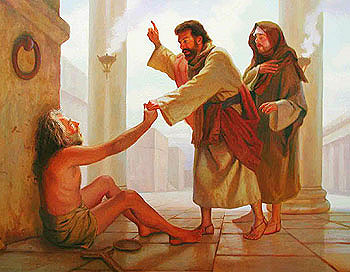
Acts 3:6
“’Such as I have.’ All of us need to ponder those words. Do we, too, have something we need to share? Yes! We have the gospel of Jesus Christ, the gospel of peace, the gospel of joy. We have truths that can make any person better and more fulfilled, any marriage happier and sweeter, any home more heavenly. We have the priesthood power of God to bless our homes and lives and the lives of others. Yes, it is to ourselves, our homes, our quorums, our classes, our Church assignments that we must carry more energetically those things that we have received. And it is to our nonmember neighbors and associates that we are now asked to also “give such as we have.” The Lord has commanded us to do so. We must lengthen our stride and must do it now.” (Spencer W Kimball, “Always a Convert Church: Some Lessons to Learn and Apply This Year,” Ensign, Sept. 1975, 2)
“Of course, the tidal wave of conversion that swept Jerusalem under Peter’s direction aroused the anger and fear of both Sadducee and Pharisee. But Peter’s compelling declarations could not be silenced. In prison he overwhelmed his accusers with a piercing testimony of Jesus and found himself set free by angels as well as mortal men. Such powers stunned Jewish lawyers, who marveled at these ‘unlearned and ignorant men.’ (Acts 4:13.) They did not understand that in the gospel of Jesus Christ those have never been synonymous terms.” (Jeffrey R Holland, However Long and Hard the Road [Salt Lake City: Deseret Book Co., 1985], 96.)
“We stand in awe before the great Peter, who had so completely received his total assurances and who had so graciously donned the robe of leadership and the mantle of authority and the courage of the inspired and assured. What strength he had come to have as he led the saints and faced the world with all its persecutors, unbelievers, and difficulties. And, as he rehearsed over and over his absolute knowledge, we glory in his stamina as he faced mobs and prelates, officials who could take his life, and as he boldly proclaimed the resurrected Lord, the Prince of Peace the Holy One and the Just, the Prince of Life, the Prince and Savior. Peter certainly now was sure, impregnable, never to falter. We should gain much sureness by his certainty.” (Spencer W Kimball. General Conference, April 1969)
 Latter-day Bloke