As members of the Church, we testify of Jesus Christ and share His gospel.
Acts 16:6
‘No man can fill a mission acceptably before the heavens, unless God should give to him revelation, from time to time, to direct him in all his missionary labors. We have abundant testimony in the New Testament concerning this matter. Even when some of the very greatest revelators that we have any record of undertook to do things of their own accord, they were led directly different from their own judgments, in regard to their missionary labors. Paul had, at a certain time, a great desire to visit a certain place; such desire arose from his own natural judgment; but the Holy Ghost forbade him. Here it required a new revelation to know whether his own inclinations should be followed or not.’ (Orson Pratt, Journal of Discourses)
Acts 16:15
“If Lydia was the first one baptized, then she has the distinction of being the first person in Europe to accept Christianity. Whether ‘her household’ means she had children, or whether it refers to her servants or to both we do not know, but they became the nucleus of a thriving branch of the Church in that city, and in Lydia’s home town as well.” (David O McKay, Ancient Apostles [Salt Lake City: Deseret Book Co., 1964], 186)
Acts 16:26
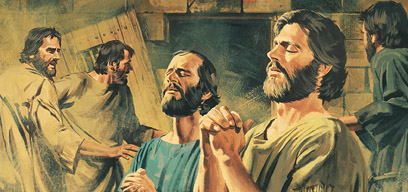
“With their backs sore and bleeding, their bodies chilled by the cold and dampness, their legs cramped and aching, hungry and sleepless and surrounded by the blackness of midnight, Paul and Silas who knew they were suffering for the sake of the true Gospel, could rejoice and praise the Lord. This they did at midnight, by praying and singing ‘praises unto God.’ Their voices rang out through the prison cells; and prisoners, hard hearted and sinful, listened in surprise to the first Christian hymn they had ever heard. The power of the Lord manifested itself not only in the hearts of His true servants, but in the entire prison and the town as well; for ‘suddenly there was a great earthquake, so that the foundations of the prison were shaken.’ All the bolts and bars at the doors fell from their sockets and the doors of the prison flew open, and ‘every one’s bands were loosed,’ but not a prisoner tried to escape.” (David O McKay, Ancient Apostles [Salt Lake City: Deseret Book Co., 1964], 187-8.)
We are the offspring of God.
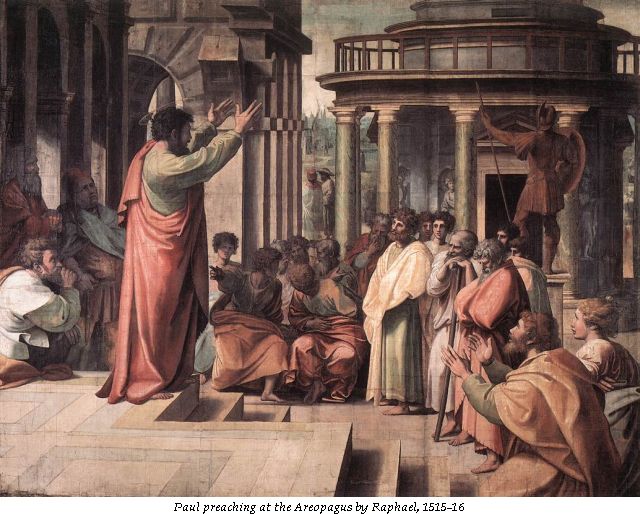
“Why are a few members, who somewhat resemble the ancient Athenians, so eager to hear some new doubt or criticism? (See Acts 17:21.) Just as some weak members slip across a state line to gamble, a few go out of their way to have their doubts titillated. Instead of nourishing their faith, they are gambling ‘offshore’ with their fragile faith. To the question ‘Will ye also go away?’ these few would reply, ‘Oh, no, we merely want a weekend pass to go to a casino for critics or a clubhouse for cloakholders.’ Such easily diverted members are not disciples but fair-weather followers.” (Neal A Maxwell,Ensign, November 1988, pp. 32-33.)
“This sermon of Paul’s was preached some nineteen hundred years ago, but it has its application to us. Truly, the intervening years have brought great changes in some things, notably in the fields of science and industry; but with respect to the subject of Paul’s sermon, the world today is in about the same status as it was then, for God to many is still an ‘unknown God,’ and therefore, ignorantly worshipped. Perhaps he is not thought of as being ‘like unto gold, or silver, or stone, graven by art and man’s device’; yet superstition and idolatry, in some forms, are still the order of the day. Some deny the very existence of God; others define him as ‘cosmic energy,’ as though he might be a current of electricity. He has been spoken of as ‘the first great cause,’ and as the ‘universal consciousness.’ God would not be described in such vague terms if men had the knowledge of him possessed by Paul.
“There are some people in the world today, however, as there were in Paul’s day, who know that God is their father and that he is not far from them. If they were to speak on the subject, they would tell you that of all their possessions, this knowledge is the most precious. From it, they obtain power to resist temptation, courage in times of danger, companionship in hours of loneliness, and comfort in sorrow. This knowledge of God gives them faith and hope that tomorrow will be better than today. It is an anchor to their souls which gives purpose to life, though all men and things around them be in confusion and chaos.” (Marion G Romney, “God Is Not Far from Us,”Ensign, Aug. 1976, 2)
‘Inseparable with the idea of a Divine Personal Being is the acceptance of Him as the Creator of the world. True Christianity does not look upon the universe as the result of mere interaction of matter and motion, of law and force, but, on the contrary, it regards all creation as the product of a Divine Intelligence “who made the world and all things therein”’ (David O McKay, General Conference, April 1944)
“Before the world was created, we all lived as the spirit children of our Heavenly Father. Through a natural process of inheritance we received in embryo the traits and attributes of our Heavenly Father. We are His spirit children. Some of what our Eternal Father is, we have inherited. What he has become we may become.” (M Russell Ballard, Our Search for Happiness: An Invitation to Understand The Church of Jesus Christ of the Latter-day Saints [Salt Lake City: Deseret Book Co., 1993], 70.)
“When men heard that young Joseph Smith was claiming God had manifested Himself to the boy, they mocked him and turned away from him, just as in the Christian era wise and able men in Athens turned away from a singular man ministering in their midst. Yet the fact remains that Paul, in that earlier experience, was the only man in that great city of learning who knew that a person may pass through the portals of death and live. He was the only man in Athens who could clearly delineate the difference between the formality of idolatry and the heartfelt worship of the only true and living God.” (Howard W Hunter, “The Sixth Day of April, 1830,” Ensign,May 1991, 63)
Baptism must be followed by receiving the gift of the Holy Ghost.
Acts 16:31
“Is belief alone enough to bring salvation to the contrite soul? Assuredly yes, if by belief is meant the ringing declaration of him who, baptizing our Lord, then testified: ‘He that believeth on the Son hath everlasting life’ (John 3:36); or if by belief is meant the pronouncement of Jesus: ‘He that believeth on me, the works that I do shall he do also; and greater works than these shall he do’ (John 14:12); or if by belief is meant that pure, perfect faith in Christ which presupposes and in fact cannot exist without the works of righteousness. (Mormon Doctrine, 2nd ed., pp. 78-80; See Heb. 11:1-3.) But belief alone is scarcely the beginning of that course leading to a celestial inheritance if it is isolated as a thing apart, if it is supposed that it does not embrace within its folds both baptism and a subsequent course of enduring to the end. (2 Ne. 31:15-21.) And in the very case at hand, Paul and Silas teach the gospel to the whole group, baptize them, and without question give them the gift of the Holy Ghost, thus starting them out in the direction of salvation. (Bruce R McConkie, Doctrinal New Testament Commentary, 2:151.)
 Latter-day Bloke