We all face temptation, but God provides a way to escape it.
How does Satan entice us to sin?
Can Satan make you sin?
How may Satan have power or influence with us?
What strategies does he use to trap you in sin?
“All beings who have bodies have power over those who have not.The devil has no power over us only as we permit him” (Teachingsof the Prophet Joseph Smith, 181).
What does this add to your understanding of Satan’s power to entice us to sin?
President Boyd K. Packer:
“The story is told of a king who was choosing between two driversfor his coach. He ordered each of them to drive his coach down a steep, winding road cut into a high cliff. The first driver came down slowly, hugging the wall of the cliff. The second driver demonstrated great talent and ability. He raced down the mountain, with the coach so close at times that half thewheel was off the edge of the cliff. The king was very thoughtful, then wisely chose the first man todrive his coach. It is best to stay on the safe side of things.”
According to this story, what is one good way to avoid Satan’s power?
‘Our challenges, including those we create by our own decisions, are part of our test in mortality. Let me assure you that your situation is not beyond the reach of our Savior. Through Him, every struggle can be for our experience and our good. Each temptation we overcome is to strengthen us, not destroy us. The Lord will never allow us to suffer beyond what we can endure. (Robert D Hales, General Conference, April 2009)
The sacrament unifies us as members of Christ’s Church.
There seems to have been a tradition in Corinth, where people would attend the religious meetings of the various temples primarily for a free meal. The Lord’s supper seemed to have been used as a meal by many, and so was causing dissensions.
1 Corinthians 11:23 For I have received of the Lord that which also I delivered unto you, That the Lord Jesus the same night in which he was betrayed took bread:
‘Paul seems to have mentioned the fact that it was on the very night on which he was betrayed, in order to throw around it the idea of greater solemnity. He wished evidently to bring before their minds the deeply affecting circumstances of his death; and thus to show them the utter impropriety of their celebrating the ordinance with riot and disorder.’ (Barnes’ Notes on the Bible)
1 Corinthians 11:24 And when he had given thanks, he brake it, and said, Take, eat: this is my body, which is broken for you: this do in remembrance of me.
25 After the same manner also he took the cup, when he had supped, saying, This cup is the new testament in my blood: this do ye, as oft as ye drink it, in remembrance of me.
26 For as often as ye eat this bread, and drink this cup, ye do shew the Lord’s death till he come.
“That is the real purpose of the sacrament, to keep us from forgetting, to help us to remember. I suppose there would never be an apostate, there would never be a crime, if people remembered, really remembered, the things they had covenanted at the water’s edge or at the sacrament table and in the temple. I suppose that is the reason the Lord asked Adam to offer sacrifices, for no other reason than that he and his posterity would remember-remember the basic things that they had been taught. I guess we as humans are prone to forget. It is easy to forget. Our sorrows, our joys, our concerns, our great problems seem to wane to some extent as time goes on, and there are many lessons that we learn which have a tendency to slip from us. The Nephites forgot. They forgot the days when they felt good.” (The Teachings of Spencer W. Kimball, edited by Edward L. Kimball [Salt Lake City: Bookcraft, 1982], 113.)
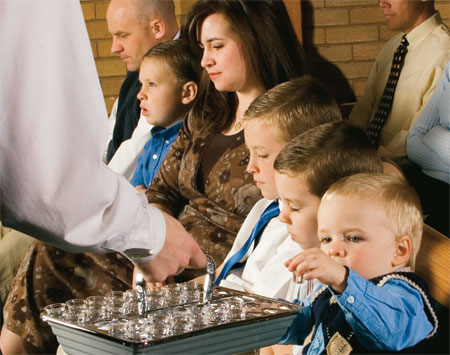
1 Corinthians 11: 27 Wherefore whosoever shall eat this bread, and drink this cup of the Lord, unworthily, shall be guilty of the body and blood of the Lord.
28 But let a man examine himself, and so let him eat of that bread, and drink of that cup.
‘He is to examine himself about his knowledge, whether he rightly understands what Christ is, what the nature of the sacrament is, what he doth in that sacred action; about his faith, love, repentance, new obedience, whether he be such a one as God hath prepared that holy table for; it is the children’s bread, and not for dogs; a table Christ hath spread for his friends, not for his enemies.’ (Matthew Poole’s Commentary)
1 Corinthians 11: 29 For he that eateth and drinketh unworthily, eateth and drinketh damnation to himself, not discerning the Lord’s body.
“The sacrament meeting is the most sacred and the most important meeting required of all the members of the Church. If any of the members are not in good standing; if they have in their hearts any feeling of hatred, envy, or sin of any kind, they should not partake of these emblems. If there are any differences or feelings existing between brethren, these differences should be adjusted before the guilty parties partake; otherwise they will eat and drink unworthily and bring upon them the condemnation spoken of by Paul. We should all see that our hearts and hands are clean and pure.” (Joseph Fielding Smith,Doctrines of Salvation, 3 vols., edited by Bruce R. McConkie [Salt Lake City: Bookcraft, 1954-1956], 2: 343.)
We should seek for gifts of the Spirit to benefit all of Heavenly Father’s children.
1 Corinthians 12:7 But the manifestation of the Spirit is given to every man to profit withal.
‘How can man profit by it if he hasn’t received it? How can he receive it unless he follows the gospel path as taught by the Christ and has the Holy Ghost conferred upon him by the laying on of hands by one authorized to bestow it?’ Delbert L Stapley, General Conference, October 1963)
1 Corinthians 12:8 For to one is given by the Spirit the word of wisdom; to another the word of knowledge by the same Spirit;
“The greatest knowledge is that which opens the way to exaltation. As with wisdom, there are varying degrees of knowledge, temporal and spiritual, greater and smaller. The ultimate and sublime purpose of knowledge is ‘for the salvation of our souls.’ (Jacob 4:13.)
“Firsthand knowledge comes with the aid of the Spirit. To read the scriptures gives one knowledge of what others have said. That is secondhand knowledge. When the Spirit bears witness to the truth of what the prophets have written, it becomes the personal and firsthand knowledge of the reader. The knowledge thus obtained is a gift of God.” (S. Brent Farley, Studies in Scripture, Vol. 8: Alma 30 to Moroni, ed. by Kent P. Jackson, [Salt Lake City: Deseret Book Co., 1988], 307.)
1 Corinthians 12:9 To another faith by the same Spirit; to another the gifts of healing by the same Spirit;
‘Some may say that the gift of healing was only intended for ancient times, to establish the Gospel; that the people in those days needed some miraculous power and evidence to convince them of the truth of the Gospel; but I find that the gift of healing was given for the benefit of all who had faith to be healed. This was the way that the Lord administered in ancient times, and there is just as much necessity in our day that the sick should be healed, as there was eighteen centuries ago; and the Lord is just as willing, inasmuch as we will exercise faith in him, to bestow the gift of healing now as he was in ancient times.’ (Orson Pratt, Journal of Discourses)
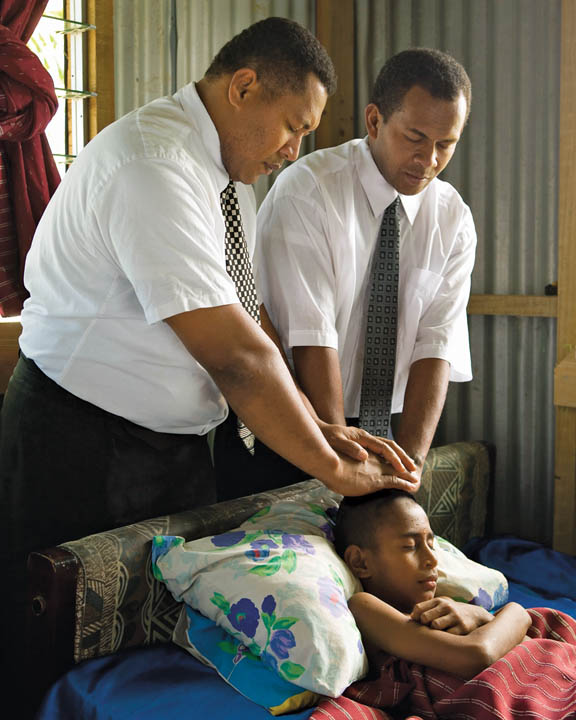
1 Corinthians 12:10 To another the working of miracles; to another prophecy; to another discerning of spirits; to another divers kinds of tongues; to another the interpretation of tongues:
11 But all these worketh that one and the selfsame Spirit, dividing to every man severally as he will.
Marvin J Ashton: ‘Let us review some of these less-conspicuous gifts: the gift of asking; the gift of listening; the gift of hearing and using a still, small voice; the gift of being able to weep; the gift of avoiding contention; the gift of being agreeable; the gift of avoiding vain repetition; the gift of seeking that which is righteous; the gift of not passing judgment; the gift of looking to God for guidance; the gift of being a disciple; the gift of caring for others; the gift of being able to ponder; the gift of offering prayer; the gift of bearing a mighty testimony; and the gift of receiving the Holy Ghost.’
“The scriptures state clearly that while our respective callings may be different and may change from time to time, all callings are important to the operation of the Church. We need the priesthood quorums to assert themselves and fulfill their divinely mandated stewardship, just as we need the Relief Society, the Primary, the Young Women, the Sunday School, and the activities committees to perform their vital functions. And we need the officers and members of all of these inspired organizations to work together, assisting each other as needed for the benefit of individuals and families. This is not man’s work nor woman’s work; it is all God’s work, which is centered on the atonement of our Lord Jesus Christ.” (M Russell Ballard”Strength in Counsel,” Ensign, Nov. 1993, 77)
Charity is the greatest spiritual gift.
In the first century A.D., members of the growing Church in Corinth were enthusiastic about the gospel. Almost all were recent converts to the Church. Many were attracted to it through the preaching of the Apostle Paul and others.
But the Saints at Corinth were also contentious. They argued amongst themselves. Some felt superior to others. They took each other to court.
When Paul heard this, feeling a sense of frustration, he wrote them a letter pleading with them to become more unified. He answered many of the questions they had been arguing about. Then, toward the end, he told them that he wanted to show them “a more excellent way.”
Do you remember the words he wrote next?
“Though I speak with the tongues of men and of angels, and have not charity,” he told them, “I am become as sounding brass, or a tinkling cymbal.”
Orson Scott Card put this into modern terms for us: “And though I attend all my meetings faithfully, and fulfil all my callings, and make a home teaching visit during the first week of the month; and though in all ways I am an active Church member, yet if I do not spend time in love and service for others, then I am not yet a Saint, for I do not yet love the Lord with all my heart, might, mind, and strength; and I do not love my neighbor as myself.”

But wait a minute – let’s go back to what Paul says in verse 3:
And though I bestow all my goods to feed the poor, and though I give my body to be burned, and have not charity, it profiteth me nothing.
Isn’t bestowing one’s goods to the poor charity? Can we bestow our goods to the poor without having charity?
Dallin H. Oaks said
“We know from these inspired words that even the most extreme acts of service fall short of the ultimate ‘profit’ unless they are motivated by the pure love of Christ. If our service is to be most efficacious, it must be unconcerned with self and heedless of personal advantage. It must be accomplished for the love of God and the love of his children.” (Pure in Heart [Salt Lake City: Bookcraft, 1988], 47.)
On the other hand – we can talk about love and charity but without corresponding actions it is meaningless. Dieter F Uchtdorf said: ‘True love requires action. We can speak of love all day long—we can write notes or poems that proclaim it, sing songs that praise it, and preach sermons that encourage it—but until we manifest that love in action, our words are nothing but “sounding brass, or a tinkling cymbal”.’
Thus, as Moroni declared, “except men shall have charity they cannot inherit” the place prepared for them in the mansions of the Father (Ether 12:34;).He also wrote:‘But charity is the pure love of Christ, and it endureth forever; and whoso is found possessed of it at the last day, it shall be well with him.’ (Moroni 7:47)
The converse would seem to be true – if we are not found possessed of it at the last day it will not be well with us.
H Burke Petersen said: ‘Charity is measured in several ways. Perhaps a supreme form of charity may be exhibited by one who withholds judgment of another’s acts or conduct, remembering that there is only one who can look into the heart and know the intent—and know the honest desires found therein. There is only one whose right it is to judge the success of another’s journey through life. Uncalled-for judgments or prejudiced feelings keep many from displaying a truly charitable attitude or a willingness to help those in need, even those in our own family circle.’
A story is told about Alexander the Great. When he had his portrait painted, the selected artist was greatly perplexed about how to do it. Alexander had an ugly scar from battle on the side of his forehead. The artist did not want to paint that scar in the portrait, because it would be offensive. But leaving the scar out of the painting would not be honest either, and the likeness of his king would be false. The artist finally arrived at a decision what to do. He asked Alexander to lean his head forward and rest it on the fingers of his hand in a way that covered the scar. The finished portrait of the great conqueror was valued as a success.
Do you and I find ways to portray other people in the best light possible, or do we instead focus on their scars?
 Latter-day Bloke