Ministers of the gospel preach with sincerity and love.
Watch: Inviting other to ‘Come and See’
‘Paul rejoiced in the fact that what he had told the Thessalonians was not meaningless words to them, for they had listened with great interest, and what was taught them produced a powerful desire for righteousness in their lives. He was explicit in stressing that the Holy Spirit also gave them full assurance that what was taught was true. He did not hesitate to say that his life, as well, was further proof to them of the truthfulness of the message. Paul was pleased that the gospel message had been received with such joy and happiness, despite many hardships. Finally, he noted what must have been their crowning achievement—that they were inspiring examples to all their neighbors and that from them the word of the Lord had extended to others everywhere, far beyond their boundaries. Paul paid tribute to them when he told them that wherever he traveled, he found people telling him about their remarkable good works and faith in God. ‘ (Joseph B Wirthlin, General Conference, April 1976)
‘King Benjamin taught, “When ye are in the service of your fellow beings ye are only in the service of your God” (Mosiah 2:17). There are many ways to serve others, but sincerity and love are the key. Here are some other tips and suggestions on how to serve:
- Don’t forget that service to your family comes first.
- Make your service fit individual needs. Think about what someone might like, want, or need.
- Keep service activities simple, and include others in planning and carrying them out.
- A smile, a cheerful attitude, a listening ear, sincere praise, and quiet acts of kindness are important forms of service.
- Remember and apply the counsel given in Mosiah 4:21. Share generously with others.’ (New Era, October 2008)
As we follow Jesus Christ, we can become holy.
Watch: The Beauty of Holiness
‘ Under President Gordon B. Hinckley’s inspired direction, temples are now more accessible than ever. Inscribed on each temple are the words “Holiness to the Lord.”1 [See Ex. 28:36 Ex. 39:30 Ps. 93:5 Translated equivalents are used on temples in non-English-speaking localities.] That statement designates both the temple and its purposes as holy. Those who enter the temple are also to bear the attribute of holiness.2 [See Ex. 19:5–6 Lev. 19:1–2 Ps. 24:3–5 1 Thes. 4:7 Moro. 10:32–33 D&C 20:69 D&C 110:6–9 see also Bible Dictionary, “Holiness,” 703–4.] It may be easier to ascribe holiness to a building than it is to a people. We can acquire holiness only by enduring and persistent personal effort. Through the ages, servants of the Lord have warned against unholiness. Jacob, brother of Nephi, wrote: “I would speak unto you of holiness; but as ye are not holy, and ye look upon me as a teacher, [I] must … teach you the consequences of sin.”3 2 Ne. 9:48‘ (Russell M Nelson, General Conference, April 2001)
Jesus was born in a stable because there was no room in the inn. During his mortal life Jesus said that he had no place to lay His head. Joseph Smith and Brigham Young stated, respectively, at the cornerstone ceremonies of the Nauvoo and Salt Lake temples that these buildings were designed to remedy that situation.
Emblazoned on each LDS temple are the words:
‘HOLINESS TO THE LORD
THE HOUSE OF THE LORD’
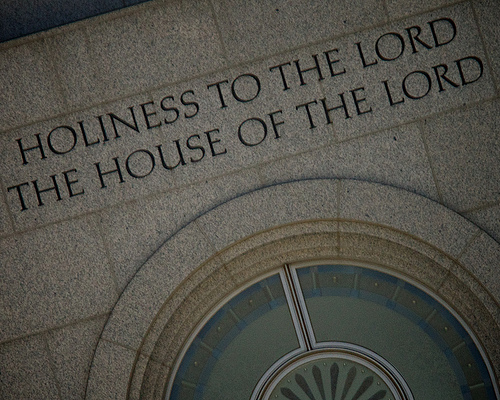
Brigham Young used the phrase ‘Holiness to the Lord’ in dedicating the Salt Lake Temple and said that the temple was a monument to the Saints’ “liberality, dedication and faith.” He explained what the phrase ‘Holiness to the Lord’ meant to him:
‘Thirty years’ experience has taught me that every moment of my life must be holiness to the Lord, resulting from equity, justice, mercy, and uprightness in all my actions, which is the only course by which I can preserve the Spirit of the Almighty to myself.’ (Quoted in Exterior Symbolism of the Salt Lake Temple, Richard G Oman, BYU Studies Vol 36 No 4 page 42, 1996-1997)
According to President Gordon B Hinckley:
‘The first phrase of this statement is a declared recognition of the Almighty and a pledge of holiness and reverence before Him. The second is a statement of ownership. This is His house, built through the consecrations of the people and presented to him as their offering of love and sacrifice.’ (Exterior Symbolism of the Salt Lake Temple, p 52)
At the dedication of the Jordan River Temple President Ezra Taft Benson said:
‘When the Saviour walked the earth, He stated that there was no place to lay His head. He may have been referring to the fact that in His day there was no temple in the Holy land which had not been desecrated. Today there are many dedicated temples, hallowed places where the son of Man may come.’ (The Teachings of Ezra Taft Benson, page 250)
We should work to provide for ourselves and those in need.
‘How I admire men, women, and children who know how to work! How the Lord loves the laborer! He said, “In the sweat of thy face shalt thou eat bread,” Genesis 3:19 and “The laborer is worthy of his hire.”D&C 84:79 He also gave a promise: “Thrust in your sickle with all your soul, and your sins are forgiven you.” D&C 31:5 Those who are unafraid to roll up their sleeves and lose themselves in the pursuit of worthwhile goals are a blessing to their families, communities, nations, and to the Church.
The Lord doesn’t expect us to work harder than we are able. He doesn’t (nor should we) compare our efforts to those of others. Our Heavenly Father asks only that we do the best we can—that we work according to our full capacity, however great or small that may be.
Work is an antidote for anxiety, an ointment for sorrow, and a doorway to possibility. Whatever our circumstances in life, my dear brethren, let us do the best we can and cultivate a reputation for excellence in all that we do. Let us set our minds and bodies to the glorious opportunity for work that each new day presents.’ (Dieter F Uchtdorf, General Conference, October 2009)
An apostasy was to precede the Second Coming of Jesus Christ.
‘Prior to His Crucifixion, the Lord Jesus Christ had established His Church. It included apostles, prophets, seventies, teachers, and so forth. [See Luke 10:1, 17 Ephesians 4:11 Articles of Faith 1:6 And the Master sent His disciples into the world to preach His gospel. [See Matthew 28:19–20 Mark 16:15
After a time the Church as established by the Lord fell into spiritual decay. His teachings were altered; His ordinances were changed. The Great Apostasy came as had been foretold by Paul, who knew that the Lord would not come again “except there come a falling away first.”2 Thessalonians 2:3 “Falling away” is translated from the Greek apostasia, meaning “apostasy.”]
This Great Apostasy followed the pattern that had ended each previous dispensation. The very first was in the time of Adam. Then came dispensations of Enoch, Noah, Abraham, Moses, and others. Each prophet had a divine commission to teach of the divinity and the doctrine of the Lord Jesus Christ. In each age these teachings were meant to help the people. But their disobedience resulted in apostasy. Thus, all previous dispensations were limited in time and location. They were limited in time because each ended in apostasy. They were limited in location to a relatively small segment of planet earth.’ (Russell M Nelson, General Conference, October 2006)
“Now the only safety we have as members of this church is to do exactly what the Lord said to the Church in that day when the Church was organized. We must learn to give heed to the words and commandments that the Lord shall give through his prophet. . . . You may not like what comes from the authority of the Church. It may contradict your political views. It may contradict your social views. It may interfere with some of your social life. But if you listen to these things, as if from the mouth of the Lord himself . . . ‘the gates of hell shall not prevail against you. . . .’” (Harold B Lee in Conference Report, Oct. 1970, 152; see also D&C 21:4–6 ).
 Latter-day Bloke