
Understanding true doctrine will help us avoid being deceived.
‘The Lord poured out His Spirit upon the people and gave them visible manifestations of His power, in addition to the inspiration of the Holy Ghost which made them all see and comprehend alike, and which bore witness to the divine mission of Christ and to the mission of the Apostles whom He had sent forth. These signs were seen in their midst, which comforted and made them strong. But after a time the people began to go astray. Wicked men took the Apostles and put them to death. Some were cast unto wild beasts; some were thrown into caldrons of boiling oil; some were crucified; others were tormented in various ways, persecuted and afflicted and slain. Then others began to depart from the faith, bringing in damnable heresies. Others began to preach for hire and divine for money, making merchandise of the souls of men. And thus the apostasy went on until darkness covered the minds of the people, and paganism was introduced into the Christian church. And the time came when that wicked power spoken of in the Revelation overcame the saints. The Spirit of God left the polluted church. The body became dead. Just as when the spirit of man leaves his body, the carcass begins to crumble; every particle seems desirous to get away from every other particle. So it was after the time that the Apostles fell. The Holy Ghost left the church. The spirit of revelation departed from the body and dissolution set in. Darkness ensued. Apostasy prevailed.’ (Charles W Penrose, Journal of Discourses)
‘Just as a cucumber must be prepared and cleaned before it can be changed into a pickle, so you and I can be prepared with “the words of faith and of good doctrine” (1 Timothy 4:6) and initially cleansed through the ordinances and covenants administered by the authority of the Aaronic Priesthood.’ (David A Bednar, General Conference, April 2007)
President Joseph F. Smith said: “When [we receive] the truth [we] will be saved by it. [We] will not be saved merely because someone taught it to [us], but because [we] received and acted upon it” (in Conference Report, Apr. 1902, 86; see also Teaching, No Greater Call [1999]
If we are “example[s] of the believers,” we can lead others to the Savior and His gospel.
“The Apostle Paul wrote an epistle to his beloved companion Timothy in which he provided inspired counsel equally as applicable to you and me today as it was to Timothy. Listen carefully to his words: ‘Neglect not the gift that is in thee,’ ‘but be thou an example of the believers, in word, in conversation, in charity, in spirit, in faith, in purity.’ (1 Tim. 4:14, 12.)
“We need not wait for a cataclysmic event, a dramatic occurrence in the world in which we live, or a special invitation to be an example-even a model to follow. Our opportunities lie before us here and now. But they are perishable. Likely they will be found in our own homes and in the everyday actions of our lives. Our Lord and Master marked the way: ‘[He] went about doing good.’ (Acts 10:38.) He in very deed was a model to follow-even an example of the believers.
“Are we?” (Thomas S Monson, “An Example of the Believers,” Ensign, Nov. 1992, 98)
“God hath not given us the spirit of fear; but of power, and of love, and of a sound mind.”
‘Our world today is difficult. We have rampant evil, corruption in every nation, terrorism reaching even safe places, economic collapse, unemployment, disease, natural disasters, civil wars, despotic leaders, and so on. What should we do? Do we flee or fight? Which is right? Either choice can be dangerous. It was dangerous for George Washington and his armies to fight but also for our pioneer ancestors to flee. It was dangerous for Nelson Mandela to struggle for freedom. It has been said that for evil to prevail, it is only necessary for good people to do nothing. [See John Stuart Mill, Inaugural Address: Delivered to the University of St. Andrews, Feb. 1, 1867 (1867), 36.]
In whatever we do, we should not decide nor act out of a spirit of fear. Truly, “God hath not given us the spirit of fear” 2 Timothy 1:7 (Do you realize the idea of “fear not” is emphasized throughout the scriptures?) The Lord has taught me that discouragement and fear are tools of the adversary. The Lord’s answer to hard times is to go forward with faith.‘
(Stanley G Ellis, General Conference, October 2017)
Studying the scriptures can help us overcome the perils of the last days.
‘The Apostle Paul also saw our day. He described it as a time when such things as blasphemy, dishonesty, cruelty, unnatural affection, pride, and pleasure seeking would abound. (See 2 Timothy 3:1-7) He also warned that “evil men and seducers shall wax worse and worse, deceiving, and being deceived.” (2 Timothy 3:13)
Such grim predictions by prophets of old would be cause for great fear and discouragement if those same prophets had not, at the same time, offered the solution. In their inspired counsel we can find the answer to the spiritual crises of our age.
In his dream, Lehi saw an iron rod which led through the mists of darkness. He saw that if people would hold fast to that rod, they could avoid the rivers of filthiness, stay away from the forbidden paths, stop from wandering in the strange roads that lead to destruction. Later his son Nephi clearly explained the symbolism of the iron rod. When Laman and Lemuel asked, “What meaneth the rod of iron?” Nephi answered, “It was the word of God; and [note this promise] whoso would hearken unto the word of God, and would hold fast unto it, they would never perish; neither could the temptations and the fiery darts of the adversary overpower them unto blindness, to lead them away to destruction.” (1 Nephi 5:23-24) Not only will the word of God lead us to the fruit which is desirable above all others, but in the word of God and through it we can find the power to resist temptation, the power to thwart the work of Satan and his emissaries.
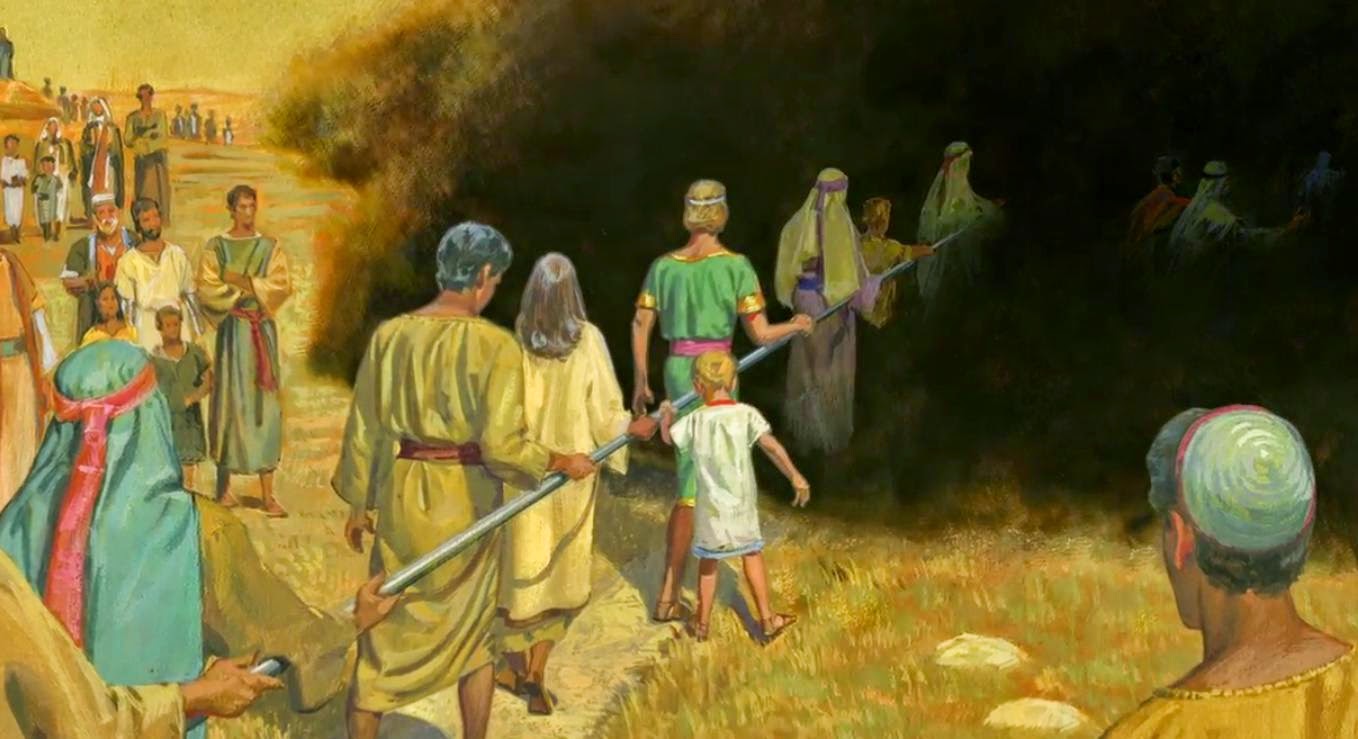
Paul’s message is the same as Lehi’s. After portraying the terrible wickedness of future times—future to him, but present to us!—he said this to Timothy: “But continue thou in the things which thou hast learned. …
“From a child thou hast known the holy scriptures, which are able to make thee wise unto salvation.” (2 Timothy 3:14-15)’ (Ezra Taft Benson, General Conference, April 1986)
Followers of Christ forgive one another.
‘Onesimus was a runaway slave who belonged to Philemon. Onesimus had fled to where Paul was imprisoned and was subsequently converted to the gospel. Paul then wrote to Philemon to admonish him to receive Onesimus back as “a brother beloved” (Philemon 1:16).
Paul explained that he had chosen not to use his authority as an Apostle of Jesus Christ to demand that Philemon do “that which is convenient”—to receive Onesimus back (Philemon 1:8). Instead, Paul simply requested that Philemon honor his wishes because of Paul’s advanced age and his suffering as a prisoner (see Philemon 1:9).
It may seem strange that Paul would suggest that Philemon might accept Onesimus back because it was “convenient” (Philemon 1:8). However, at the time the King James Version of the Bible was produced, convenient could mean “suitable” or “fitting.” The original Greek word translated as “convenient” is formed from a verb meaning “to come up to,” and the term carries the idea of measuring up to a certain mark or standard. Paul’s use of the word hints that Philemon should forgive Onesimus because it was the most fitting or becoming thing for a true follower of Christ “to come up to.” Paul then set an example of Christian charity when he offered to personally compensate Philemon for any financial loss that resulted from Onesimus’s actions (see Philemon 1:18).’ (Institute New Testament manual)
 Latter-day Bloke