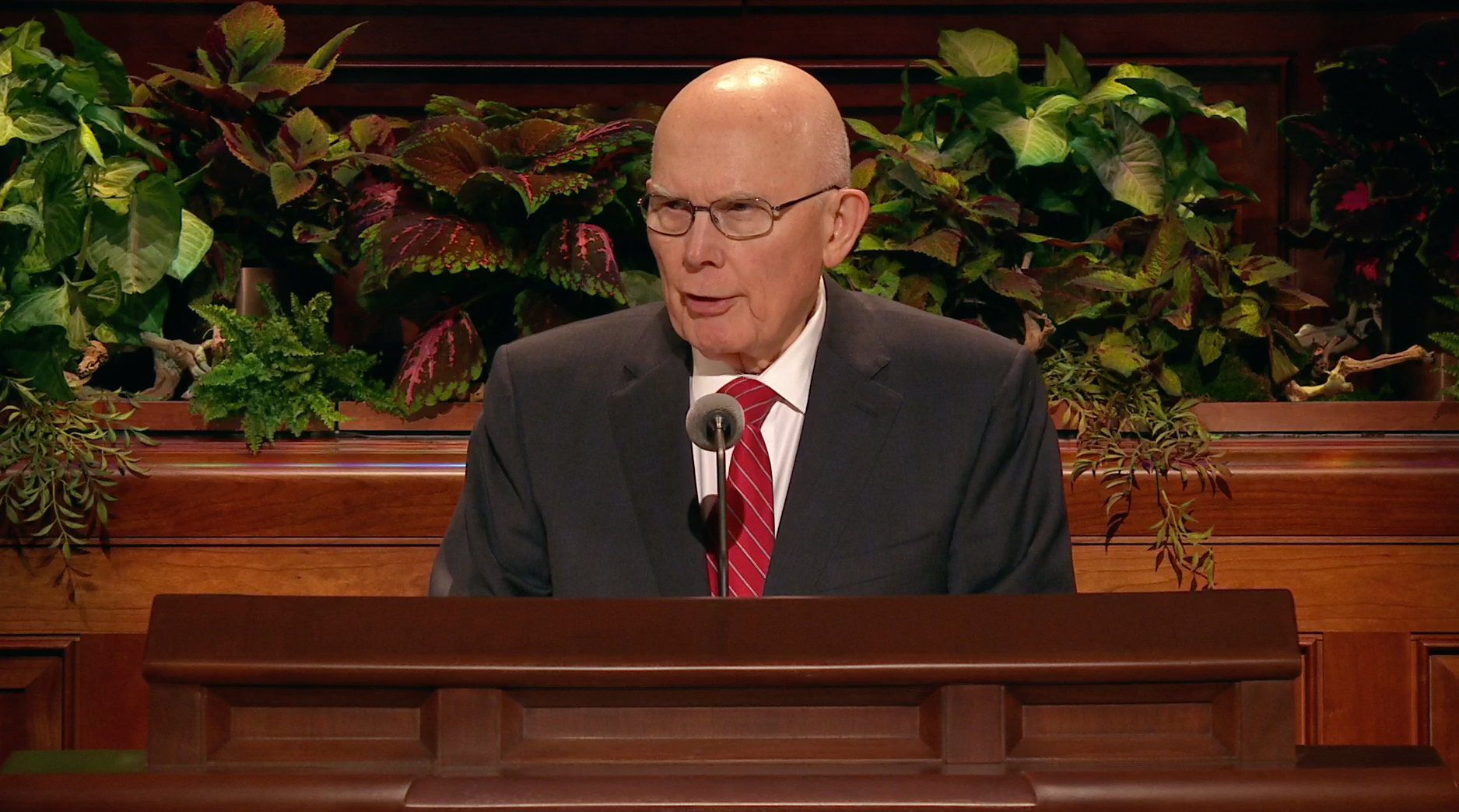
In this talk President Oaks used the commandments to love the Lord and to love our neighbour as a vehicle to discuss LGBT issues and hwo we should respond to them and to our brothers and sisters who are affected by them.
‘I begin with what Jesus taught were the two great commandments.
“Thou shalt love the Lord thy God with all thy heart, and with all thy soul, and with all thy mind.
“This is the first and great commandment.
“And the second is like unto it, Thou shalt love thy neighbour as thyself.”
This means we are commanded to love everyone, since Jesus’s parable of the good Samaritan teaches that everyone is our neighbor. But our zeal to keep this second commandment must not cause us to forget the first, to love God with all our heart, soul, and mind. We show that love by “keep[ing] [His] commandments.” God requires us to obey His commandments because only through that obedience, including repentance, can we return to live in His presence and become perfect as He is.
What do you see as the relationship between these two great commandments?
‘President Nelson reminded all of us that “our commission as Apostles is to teach nothing but truth. That commission does not give [Apostles] the authority to modify divine law.” Thus, my sisters, the leaders of the Church must always teach the unique importance of marriage between a man and a woman and the related law of chastity. ‘
President Oaks is here referring to a BYU devotional that President Nelson gave in September 2019 (The Love and Laws of God). In it President Nelson said:
‘It is precisely because we do care deeply about all of God’s children that we proclaim His truth. We may not always tell people what they want to hear. Prophets are rarely popular. But we will always teach the truth! ‘
Do you have examples in your life when the loving, but unpopular, thing has been to teach the truth?
‘The work of The Church of Jesus Christ of Latter-day Saints is ultimately concerned with preparing the children of God for the celestial kingdom, and most particularly for its highest glory, exaltation or eternal life. That highest destiny is possible only through marriage for eternity. Eternal life includes the creative powers inherent in the combination of male and female—what modern revelation describes as the “continuation of the seeds forever and ever.”’
Sister Bonnie L Oscarson in General Conference in April 2015 said:
‘For anyone to attain the fulness of priesthood blessings, there must be a husband and a wife sealed in the house of the Lord, working together in righteousness and remaining faithful to their covenants. This is the Lord’s plan for His children, and no amount of public discourse or criticism will change what the Lord has declared. We need to continue to model righteous marriages, seek for that blessing in our lives, and have faith if it is slow in coming. Let us be defenders of marriage as the Lord has ordained it while continuing to show love and compassion for those with differing views. ‘
‘Meanwhile, we must try to keep both of the great commandments. To do so, we walk a fine line between law and love—keeping the commandments and walking the covenant path, while loving our neighbors along the way. This walk requires us to seek divine inspiration on what to support and what to oppose and how to love and listen respectfully and teach in the process. Our walk demands that we not compromise on commandments but show forth a full measure of understanding and love. Our walk must be considerate of children who are uncertain about their sexual orientation, but it discourages premature labeling because, in most children, such uncertainty decreases significantly over time. Our walk opposes recruitment away from the covenant path, and it denies support to any who lead people away from the Lord. In all of this we remember that God promises hope and ultimate joy and blessings for all who keep His commandments. ‘
Why is it important that we walk that fine line between law and love? How can we do it? How can we disagree without being disagreeable?
‘Further, we must never persecute those who do not share our beliefs and commitments. Regretfully, some persons facing these issues continue to feel marginalized and rejected by some members and leaders in our families, wards, and stakes. We must all strive to be kinder and more civil. ‘
How can we teach our children (and each other) to be kinder and more civil towards those who do not share our beliefs? How do we remain loving and kind when others may charge us with bigotry or fanaticism?
(Note: passages in italics are excerpts from President Oaks’ address.)
 Latter-day Bloke