On a cold morning in New York City in February 1910, as Vincenzo di Francesca, an Italian Protestant minister, walked down Broadway, a strong wind moved the pages of a book lying on a barrel full of ashes. He thought it looked like a religious book.
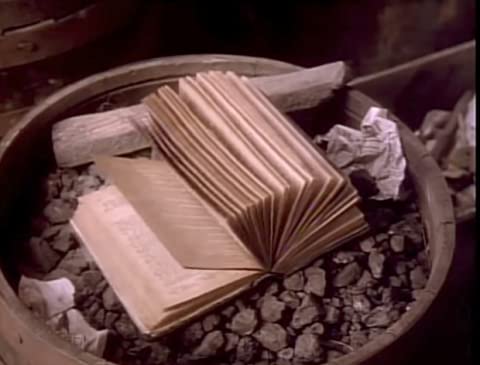
Curiosity pushed him to approach it. He picked it up and saw that it was printed in English, but the front pages were missing.
He saw names – Alma, Mosiah, Mormon, Moroni, Isaiah, Lamanites—except for Isaiah, all were names he had never before heard. He wrapped the book in a newspaper and took it home.
At home, as he turned the torn pages he was convinced that it was a religious book that talked of things to come. But he did not know the name of the church because the cover and front pages had been torn off.
For several hours he read the remaining pages and came to the conclusion that the book was a fifth gospel of the Redeemer.
At the end of the day, he locked the door of his room, knelt with the book in his hands, and read Moroni chapter 10. He prayed to God in the name of Jesus Christ to tell him if the book was of God.
He said that his heart began to palpitate, and a feeling of gladness filled him and left him with a joy that human language cannot find words to describe. He had received the assurance that God had answered his prayer and that the book was of greatest benefit to him and to all who would listen to its words.
He continued his services in the parish, but his preaching included words from this unknown book. The members of his congregation were so interested that they became dissatisfied with his colleagues’ sermons.
On Christmas Eve, 1910 in his sermon that evening, Pastor di Francesca told the story of the birth and mission of Jesus Christ as given in this new book. When he had finished, some of his colleagues publicly contradicted all he had said.
He was twice required to appear before his church’s ruling committee. They counseled him to burn the book, which they said was of the devil.
He replied, “I will not burn the book because of the fear of God. I have asked him if it were true, and my prayer was answered affirmatively and absolutely, which I feel again in my soul as I defend his cause now.”
The second time he appeared before the council he was again told to burn the book. He refused and said that he looked forward with joy to the time when the church to which the book belonged would be made known to him and he could become part of it. He was stripped of his position as a pastor of the church.
In November 1914, Vincenzo was called into the Italian army and saw action in France. Once he related to some men in his company the story of the people of Ammon—how they had refused to shed the blood of their brothers and had buried their arms rather than be guilty of such great crimes. The chaplain reported him to the colonel, and the next day he was escorted to the colonel’s office. He asked Vincenzo to tell him the story he had related. He received as punishment a ten-day sentence of bread and water, with the order that he was to speak no more of the book.
After the end of the war, Vincenzo returned to New York, where he met an old friend, a pastor of my former church. He interceded for Vincenzo with the Church, and Vincenzo was admitted to the congregation as a lay member.
As an experiment, it was agreed that Vincenzo should accompany one of the pastors on a mission to New Zealand and Australia.In Australia, they met some Italian immigrants who asked questions about the errors in some Bible translations. They were not satisfied with his companion’s answers. When they asked Vincenzo about it, he told the story of Christ’s appearance to the people of America. When they asked him where he had learned such teachings, he told them of the book he had found. He was once again cut off from the church.
He returned to Italy shortly after. Then, in May 1930, while seeking in a dictionary for some information, he suddenly saw the entry “Mormon.” He read the words carefully and found that a Mormon Church had been established in 1830 and that this church operated a university at Provo. He wrote to the university president, asking for information about the book and its missing pages.
He received an answer two weeks later telling him that his letter had been passed on to the President of The Church of Jesus Christ of Latter-day Saints. On June 16, 1930, President Heber J. Grant answered his letter and sent a copy of the Book of Mormon in Italian. He informed him that he would also give his request to Elder John A. Widtsoe, president of the European Mission, with headquarters in Liverpool. A few days later, Elder Widtsoe wrote to him, sending him a pamphlet that contained the story of the Prophet Joseph Smith, the gold plates, and the coming forth of the Book of Mormon. At long last, Vincenzo had learned the rest of the story of the torn book he had found on top of a barrel of ashes.
Wars intervened but finally and Vincenzo was forced to wait many years before he could be baptised but finally on January 18, 1951, President Bringhurst of the Swiss-Austrian Mission arrived in Sicily and baptized Vincenzo. This was the first baptism performed in Sicily. When he came up out of the water, he said, “I have prayed daily for many years for this moment.”
On April 28, 1956, Vincenzo entered the temple at Bern, Switzerland and received his endowment.
There is a special power about the Book of Mormon. It bears a strong, silent witness of its truth as one reads it.
Parley P. Pratt stated, “The Spirit of the Lord came upon me, while I read [The Book of Mormon], and enlightened my mind, convinced my judgment, and rivetted the truth upon my understanding, so that I knew that the book was true, just as well as a man knows the daylight from the dark night.” (Journal of Discourses, 5:194.)
While Vincenzo’s story is unusual in that he received a testimony of the Book of Mormon without knowing the name of the book or where it came from, millions and millions of people have tested Moroni’s promise and received a witness of the Spirit. The Book of Mormon has great power!
President Russell M. Nelson made these promises to all who will receive the wonderful, divine gift of the Book of Mormon:
“When I think of the Book of Mormon, I think of the word power. The truths of the Book of Mormon have the power to heal, comfort, restore, succour, strengthen, console, and cheer our souls.
“My dear brothers and sisters, I promise you that as you prayerfully study the Book of Mormon every day, you will make better decisions—every day. I promise that as you ponder what you study, the windows of heaven will open, and you will receive answers to your own questions and direction for your own life.”
May we all treat the Book of Mormon as sacred, utilize it fully, draw from its power continually, and by it better come to know “the only true God, and Jesus Christ, whom [He] has sent.”
 Latter-day Bloke