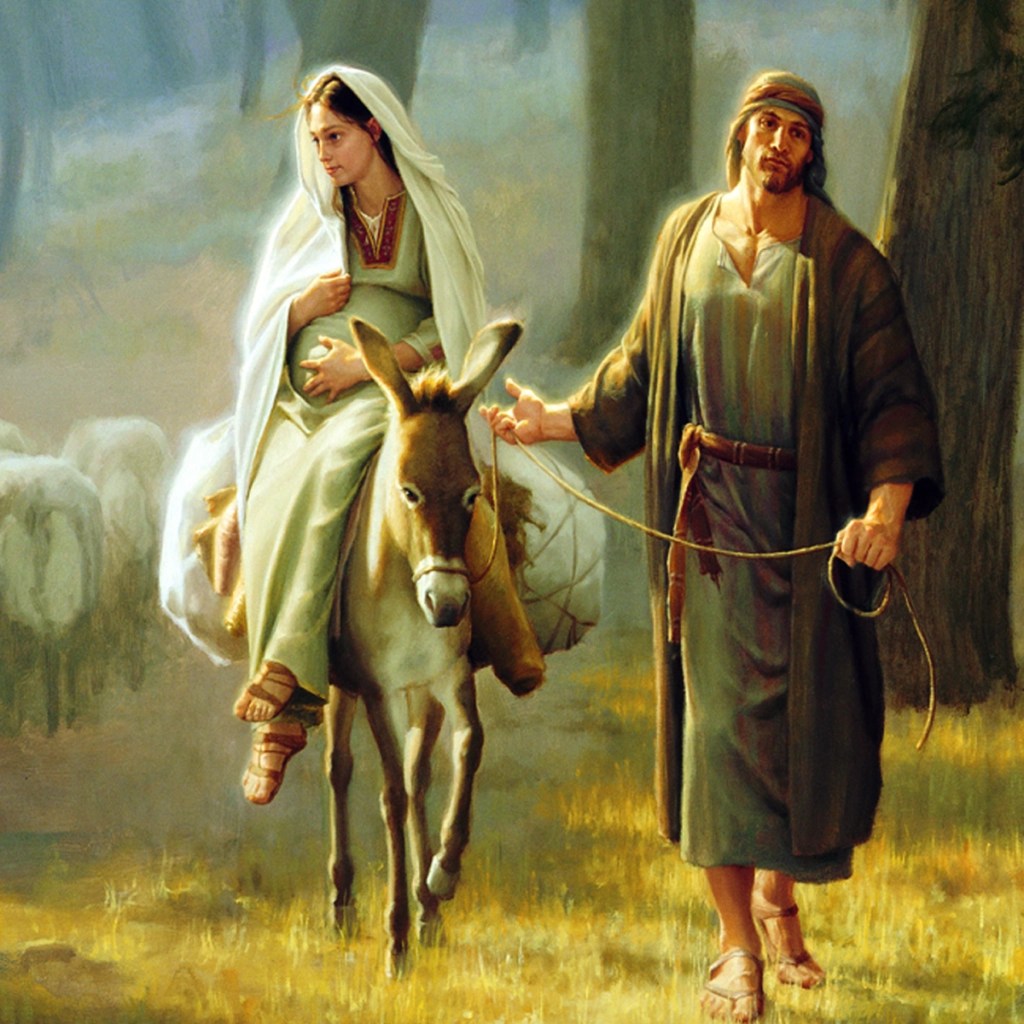
One impression which has persisted with me recently is that this is a story—in profound paradox with our own times—that this is a story of intense poverty. I wonder if Luke did not have some special meaning when he wrote not “there was no room in the inn” but specifically that “there was no room for them in the inn.” (Luke 2:7; italics added.) We cannot be certain, but it is my guess that money could talk in those days as well as in our own. I think if Joseph and Mary had been people of influence or means, they would have found lodging even at that busy time of year. I have wondered if the Inspired Version also was suggesting they did not know the “right people” in saying, “There was none to give room for them in the inns.” (JST, Luke 2:7.)
We cannot be certain what the historian intended, but we do know these two were desperately poor. At the purification offering which the parents made after the child’s birth, a turtledove was substituted for the required lamb, a substitution the Lord had allowed in the Law of Moses to ease the burden of the truly impoverished. (See Lev. 12:8.) . . .. . . As a father I have recently begun to think more often of Joseph, that strong, silent, almost unknown man who must have been more worthy than any other mortal man to be the guiding foster father of the living Son of God. It was Joseph selected from among all men who would teach Jesus to work. It was Joseph who taught him the books of the law. It was Joseph who, in the seclusion of the shop, helped him begin to understand who he was and ultimately what he was to become.
I was a student at BYU just finishing my first year of graduate work when our first child, a son, was born. We were very poor, though not so poor as Joseph and Mary. My wife and I were both going to school, both holding jobs, and in addition worked as head residents in an off-campus apartment complex to help defray our rent. We drove a little Volkswagen which had a half-dead battery because we couldn’t afford a new one (Volkswagen or battery).
Nevertheless, when I realized that our own night of nights was coming, I believe I would have done any honorable thing in this world, and mortgaged any future I had, to make sure my wife had the clean sheets, the sterile utensils, the attentive nurses, and the skilled doctors who brought forth our first born son. If she or that child had needed special care . . . I believe I would have ransomed my very life to get it.
I compare those feelings (which I have had with each succeeding child) with what Joseph must have felt as he moved through the streets of a city not his own, with not a friend or kinsman in sight, nor anyone willing to extend a helping hand. In these very last and most painful hours of her “confinement,” Mary had ridden or walked approximately 100 miles from Nazareth in Galilee to Bethlehem in Judea. Surely Joseph must have wept at her silent courage. Now, alone and unnoticed, they had to descend from human company to a stable, a grotto full of animals, there to bring forth the Son of God. I wonder what emotions Joseph might have had as he cleared away the dung and debris. I wonder
if he felt the sting of tears as he hurriedly tried to find the cleanest straw and hold the animals back.
I wonder if he wondered: “Could there be a more unhealthy, a more disease-ridden, a more despicable circumstance in which a child could be born? Is this a place fit for a king? Should the mother of the Son of God be asked to enter the valley of the shadow of death in such a foul and unfamiliar place as this? Is it wrong to wish her some comfort? Is it right He should be born here?” But I am certain Joseph did not mutter and Mary did not wail. They knew a great deal and did the best they could.
Jeffrey R. Holland Maybe Christmas Doesn’t Come from a Store Ensign, Dec. 1977, 63–65
 Latter-day Bloke