Who were Matthew and Luke?
The earliest Christian writers to mention this Gospel all agreed that its author was Matthew, who was one of the Savior’s Twelve Apostles and an eyewitness to many of the events he described. This is supported by the title given to his Gospel in the Joseph Smith Translation: “The Testimony of St. Matthew.” Before his conversion and call to the apostleship, Matthew was a publican, or tax collector, known as Levi, the son of Alphaeus (see Matthew 9:9; Mark 2:14; Luke 5:27–32). (New Testament Institute Student Manual)
While the writer of the Gospel of Luke is not identified by name within the book, textual evidence as well as tradition credit Luke as the author of this Gospel. Much of this evidence stems from the book of Acts, which was also written by Luke. Though known as the “beloved physician” (Colossians 4:14) mentioned by Paul, Luke was foremost “a messenger of Jesus Christ” (Joseph Smith Translation, Luke 1:1 [in Luke 1:1, footnote a]). Luke was one of Paul’s “fellowlabourers” (Philemon 1:24) and Paul’s missionary companion (see 2 Timothy 4:11). Because Luke did not claim to have been an eyewitness of the Savior, but rather to have gained a perfect understanding from those who were “eyewitnesses, and ministers of the word” (Luke 1:2), it may be presumed that he was converted to Christianity at some point following the Savior’s Resurrection and Ascension. (New Testament Institute Student Manual)
Jesus Christ was born of a mortal mother and an immortal Father.
Jesus Christ is the Son of God
‘Elder James E. Talmage (1862–1933) of the Quorum of the Twelve Apostles explained the importance of Gabriel’s declaration regarding the parentage of Jesus Christ (see Luke 1:32): “That Child to be born of Mary … was of right to be called the ‘Son of the Highest.’ In His nature would be combined the powers of Godhood with the capacity and possibilities of mortality. … The Child Jesus was to inherit the physical, mental, and spiritual traits, tendencies, and powers that characterized His parents—one immortal and glorified—God, the other human—woman” (Jesus the Christ, 3rd ed. [1916], 81).
Elder Talmage also taught that through Jesus’s mortal mother, Mary, He inherited the ability to “lay down His life voluntarily.” But from His Heavenly Father, Jesus inherited the ability to endure suffering during His atoning sacrifice “such as no other being who has lived on earth might even conceive as possible” (Jesus the Christ, 613). Since this suffering would be “more than man can suffer, except it be unto death” (Mosiah 3:7), only a Being with power over death could endure it.
President Russell M. Nelson declared: “From His immortal Father, Jesus inherited the power to live forever. From His mortal mother He inherited the fate of physical death. Those unique attributes were essential for His mission to atone for the sins of all mankind. Thus Jesus the Christ was born to die (see 3 Nephi 27:13–15). He died that we might live. He was born that all humankind could live beyond the grave” (“Christ the Savior Is Born,” New Era, Dec. 2006, 5).’ (Institute New Testament Manual)
Why was it necessary that Jesus have an immortal father and a mortal mother?
God’s blessings come in His own time
Zacharias and Elisabeth waited for many years before their prayers for a son were answered. Neal A. Maxwell wrote:
“Faith in God includes faith in His timing. Frankly, some of us have some difficulty with this significant dimension of faith. We clearly prefer our own time to His ‘own due time.’
“…Patience stretches our capacity to bide our time while both wondering and sustaining. This vital elasticity will be especially needed as part of maintaining faith in God’s timing in the last days, during which ‘all things must come to pass in their time’ (D&C 64:32).” (That Ye May Believe [Salt Lake City: Bookcraft, 1992], 51-53.)
Why is patience such an important Christ-like attribute for us to develop?
The faithful willingly submit to God’s will.
Luke 1:38 And Mary said, Behold the handmaid of the Lord; be it unto me according to thy word. And the angel departed from her.
The word translated as handmaid specifically refers to a slave who has been offered her freedom but chooses voluntarily to remain with the family and is branded to signify this relationship. In using this term Mary may have been indicating that she voluntarily accepted God’s will for her and that she would align herself with him forever.
We don’t know how much Mary knew but we do know that she knew enough to accept her assignment humbly and with great faith. Her assent to God’s plan for her made possible God’s plan for all of us.
Behold thy handmaiden, Lord.
Ready now am I,
To live thy word, to teach thy word,
To praise thy name on high.
Behold my hands, O Lord,
Consecrated to thee,
To serve thy daughters, to serve thy sons,
To comfort each one tenderly.
Behold mine eyes, O Lord,
Windows to my soul,
To see thy light, to love thy light,
To know and shape my role.
Behold the handmaiden of the Lord;
Be it unto me according to thy word.
As Mary spoke, so speak I.
Heavenly Father, I will try
To do thy will,
Thy laws fulfill,
In service to magnify thee,
In humility to seek thee,
Always to speak of thee,
And thine,
As mine.
Behold thy handmaiden.
Behold my heart, O Lord,
Waiting here before thee,
To feel thy love, to share thy love;
Ever thy child I will be.
(Eloise Bell and Dorothy Nielson)

And God required her to go through many tribulations. Mary risked being stoned to death for being pregnant outside of marriage. Joseph believed her when she said that she ‘knew not a man’ because he had received an angelic visitor. Others in her family and amongst her neighbours were not blessed with such a heavenly announcement and no doubt Mary suffered from many sidelong glances and dark mutterings. The tender mercies of the Lord provided Mary with a confidante in Elizabeth who was able to provide her with much needed help and support.
Neal A. Maxwell: “The marvelous, spiritually submissive Mary likewise expressed it (true submissiveness) in few words. Though filled with wonderment about the miraculous impending birth of Jesus, she said, ‘Behold the handmaid of the Lord; be it unto me according to thy word’ (Luke 1:38).
“Her words can guide us when we too are puzzled by what is impending or unfolding in our lives.” (Sermons Not Spoken [Salt Lake City: Bookcraft, 1985], 8-9.)
Have you ever had to say to the Lord ‘Be it unto me according to Thy word’? How did it turn out?
Joseph
‘When Mary was found to be with child, Joseph, knowing he was not the father, had several options. First, he could have subjected Mary to a public divorce and perhaps even execution, for people would have presumed that Mary was guilty of adultery—a crime punishable by death under the law of Moses (see Leviticus 20:10; John 8:5). Second, Joseph could have had his betrothal to Mary privately annulled before two witnesses. A third option was to proceed with the marriage. Joseph was inclined to show mercy to Mary by quietly annulling the betrothal agreement (see Matthew 1:19). However, when assured by an angel that Mary’s child was the Son of God, Joseph elected to marry her, though doing so could have brought upon him public shame and ridicule (see Matthew 1:20–25; Luke 3:23; John 8:41).
Gerald N. Lund, who later became a member of the Seventy, discussed Joseph’s visions and spiritual sensitivity: “Matthew tells us that [Joseph] was of the lineage of King David, that he was a just and considerate man, that in a dream an angel told him who Jesus would be, that he was obedient, and that he gave Jesus his name, which means savior. (See Matt. 1.) We know that he took Mary to Bethlehem, where Jesus was born. (See Luke 2:4–6.) Less than two years later, Joseph took his family into Egypt to escape Herod, after being warned in a dream. In Egypt, a dream again told him when to return, and another dream told him to go to Galilee. (See Matt. 2:13–15, 19–22.) Four dreams from God! Joseph must have been an exceptionally visionary and spiritually sensitive man” (Jesus Christ, Key to the Plan of Salvation [1991], 51–52).’ (Institute New Testament Manual)

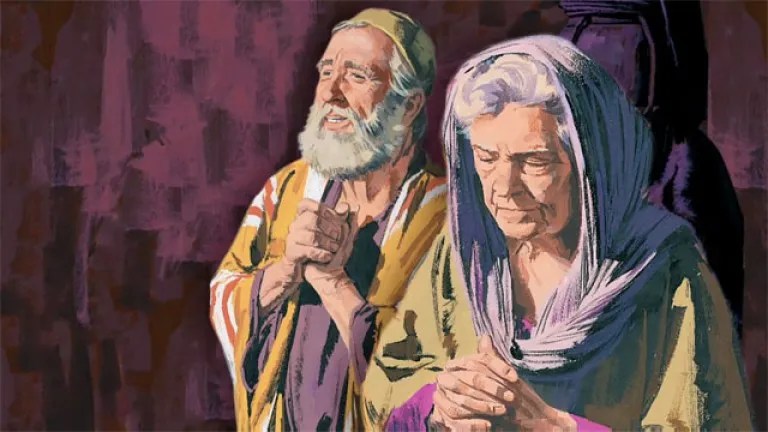
Elisabeth and Zacharias
We are told in Luke 1:6 that Zacharias and Elisabeth ‘were both righteous before God, walking in all the commandments and ordinances of the Lord blameless.’
“I have always been touched that in her moment of greatest need, her singular time of confusion and wonder and awe, Mary went to another woman. She knew she could go to Elisabeth. I have also been touched that age was no factor here; in God’s love there is no generation gap. Mary was very young-probably in her mid-teens at most-and Elisabeth was well beyond her childbearing years. The scripture says she was ‘well stricken’ in years. (Luke 1:7.) Yet these two women came together, greeting one another in a bond that only women can know. Indeed, it was their very womanhood that God used for his holiest of purposes. And in the special roles they were destined to play, these two beloved women-representing both personally and dispensationally the old and the new-sang to each other even as the babe in the womb of one leapt in recognition of the divinity of the other.
“Elisabeth was not petty or fearful or envious. Her son would not have the fame or role or divinity that had been bestowed on Mary’s child; but her only feelings were of love and devotion. To this young, bewildered kinswoman she said only, ‘Blessed art thou among women, and blessed is the fruit of thy womb. And whence is this to me, that the mother of my Lord should come tome?’ (Luke 1:42-43.)
“…This exchange between these two different yet similar women seems to me the essence of love and peace and purity. Surely the challenge for our day is to be equally pure …….. When we pollute the powerful potential for love with our pettiness and our fears, then disease replaces emotional health, and despondency replaces peace.” (Jeffrey R. Holland and Patricia T. Holland, On Earth As It Is in Heaven [Salt Lake City: Deseret Book Co., 1989], 33.)
‘With God nothing shall be impossible’ (Luke 1:37)
‘You who may be momentarily disheartened, remember, life is not meant to be easy. Trials must be borne and grief endured along the way. As you remember that “with God nothing shall be impossible” Luke 1:37know that He is your Father. You are a son or daughter created in His image, entitled through your worthiness to receive revelation to help with your righteous endeavors. You may take upon you the holy name of the Lord. You can qualify to speak in the sacred name of God (see D&C 1:20 It matters not that giants of tribulation torment you. Your prayerful access to help is just as real as when David battled his Goliath (see 1 Sam. 17)’ (Russell M Nelson, General Conference, April 1988)
 Latter-day Bloke