Relevant clips from The Chosen:
January 23-29
Mark 1:29-31, Jesus Heals Peter’s Mother-in-Law
Mark 1:40-44, Jesus Heals a Leper
Who was Mark?
“John Mark, commonly known as Mark, is the author of the Gospel of that name. He was the son of one of the leading women in the early church in Jerusalem. Believers assembled at her home, and Peter returned there after being freed from prison (Acts 12:12-17). John Mark was chosen as a companion of Paul and Barnabas as they left on the first missionary journey (Acts 12:25,13:5) but for an unnamed reason he left the two brethren about half way into the journey (Acts 13:13)…Peter speaks of Mark as his son and as being with him in Babylon-probably Rome (1 Pet 5:13). An ancient tradition states that Mark wrote his gospel in Rome, taking his material directly from Peter.” (Institute Manual, The Life and Teachings of Jesus & his Apostles, 2nd ed., p. 253)
Repentance is a mighty change of mind and heart.
“John [the Baptist] held the Aaronic Priesthood, and was a legal administrator, and the forerunner of Christ, and came to prepare the way before him. … John was a priest after the order of Aaron before Christ. …
“The keys of the Aaronic Priesthood were committed unto him, and he was as the voice of one crying in the wilderness, saying, ‘Prepare ye the way of the Lord and make his paths straight.’ [Matthew 3:3.] …
“The Savior said unto John, I must be baptized by you. Why so? To answer my decrees [see Matthew 3:15]. … Jesus had no legal administrator [except] John.
“There is no salvation between the two lids of the Bible without a legal administrator.” (Discourse given by Joseph Smith on July 23, 1843, in Nauvoo, Illinois.

Why was John the Baptist’s role important?
“Receiving Jesus Christ” means receiving Jesus for who he really is. To try to pick and choose the things about Jesus you find convenient to receive, rejecting the rest, is not to receive Jesus as he really is.
John 12:48 He that rejecteth me, and receiveth not my words, hath one that judgeth him: the word that I have spoken, the same shall judge him in the last day.
Here receiving or rejecting Jesus is directly connected with receiving or rejecting his teachings. It is simply unthinkable that a person could claim to have “received Jesus” and yet have no desire to learn and obey his teachings.
How is President Nelson preparing us to receive Jesus Christ?
To be acceptable with God, we must bring forth fruits fit or worthy for repentance. There must be tangible evidence of our repentance.

‘Learning from the Lord requires repentance. The word repentance comes from the Greek word metanoia, which means “a change of mind.” When the Lord communicates truth to us, our minds become more like his.’ (Lisa Nicolaysen, Learning from the Lord, Ensign, October 1986)
What fruits of repentance are identified in Luke 3:8-13?
- He that hath two coats, let him impart to him that hath none; and he that hath meat, let him do likewise.
- Exact no more than that which is appointed you.
- Do violence to no man, neither accuse any falsely; and be content with your wages.
Can you see fruits of repentance in your own life?
We follow Jesus Christ when we are baptized and receive the Holy Ghost.
‘Jesus confirmed that “strait is the gate, and narrow is the way, which leadeth unto life.” Matt. 7:14Specifically, He said, “Except a man be born of water and of the Spirit, he cannot enter into the kingdom of God.” John 3:5 This means we must “repent, and be baptized every one … in the name of Jesus Christ for the remission of sins, and … receive the gift of the Holy Ghost.” Acts 2:38
Notwithstanding He was sinless, Jesus Christ Himself was baptized and received the Holy Ghost to witness “unto the Father that he would be obedient unto him in keeping his commandments” 2 Ne. 31:7 see also Matt. 3:13–17 Mark 1:9–11 Luke 3:21–22 John 1:29– and to show us “the straitness of the path, and the narrowness of the gate, by which [we] should enter, he having set the example before [us].” And He said, “He that is baptized in my name, to him will the Father give the Holy Ghost, like unto me; wherefore, follow me, and do the things which ye have seen me do.” 2 Ne. 31:9, 12
There are no exceptions granted; none are needed. As many as will believe and be baptized—including by proxy—and endure in faith, shall be saved, “not only those who believed after [Christ] came in the meridian of time, in the flesh, but all those from the beginning, even as many as were before he came.” D&C 20:26 It is for this reason that the gospel is preached “also to them that are dead, that they might be judged according to men in the flesh, but live according to God in the spirit.” 1 Pet. 4:6′ (Elder D Todd Christofferson, General Conference, October 2009)
Jesus Christ was baptized to “fulfil all righteousness.”
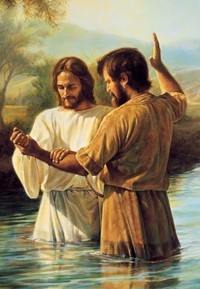
Matthew 3:11 Baptism of fire
President Marion G. Romney (1897–1988) of the First Presidency described the effect that the “baptism of fire” has upon the soul: “The baptism of fire and of the Holy Ghost … effects the great change in the hearts of men referred to by Alma [see Alma 5:14]. It converts them from carnality to spirituality. It cleanses, heals, and purifies the soul. … It is the spiritual rebirth spoken of by Jesus to Nicodemus [see John 3:3–5]. Faith in the Lord Jesus Christ, repentance, and water baptism are all preliminary and prerequisite to it, but it is the consummation. To receive it is to have one’s garments washed in the atoning blood of Jesus Christ” (Learning for the Eternities, comp. George J. Romney [1977], 133).
- What do the scriptures teach about the necessity of baptism? (3 Nephi 11:38)
- What does baptism by immersion symbolize? (Romans 6:3–5)
- How should my baptismal covenants change the way I live? (Mosiah 18:8–10)
- Why don’t we baptize infants? (Moroni 8:8–12)
- Why is it important that baptism be performed by someone with authority, not just sincere intent? (Hebrews 5:4)
- If I am already baptized into another church, why do I need to be baptized again? (D&C 22:1–4)
- Why must baptism be followed by receiving the gift of the Holy Ghost? (John 3:5)
The members of the Godhead are three separate beings.
‘You wouldn’t miss your son’s baptism, would you? Neither would our Heavenly Father.
The doctrinal importance of Christ’s baptism cannot be overstated. We learn so much about perfect obedience and humble submissiveness to the will of the Father. We also learn that the members of the Godhead are three separate personages: manifested as the voice of God from heaven, the Christ, and the presence of the Holy Ghost as represented by the dove. Yet, as we begin to think of the most transcendent spiritual manifestations in all the scriptures, we cannot find another situation in which all three members of the Godhead were manifest: not with Moses on Mt. Sinai, not on the Mount of Transfiguration, not on the day of Pentecost, not when the Savior appeared to the Nephites, not even in the Sacred Grove. The baptism of our Lord was different. No other event in history was holy enough, perfect enough, important enough, or symbolic enough to require the presence of God the Father, God the Son, and God the Holy Ghost.’
(GospelDoctrine.com)
 Latter-day Bloke