Jesus Christ’s miracles “manifested forth his glory.”
‘Turning water into wine was the Savior’s first recorded miracle. But why did he do it? Sherrie Mills Johnson, who teaches in the department of ancient scripture at BYU, thinks Jesus was doing more than just providing refreshment at a marriage in ancient Cana.
“What we find in this very first miracle … is that Jesus is proclaiming his mission. That he came to earth to change peoples’ hearts,” Johnson told a class during a BYU’s Campus Education Week on Aug. 16.
The story in John 2:1-11 is familiar to readers of the New Testament. Mary, the mother of Jesus, tells him the wedding feast is out of wine. Jesus asks servants to fill some pots with water, and then miraculously the water is transformed into wine.
But there is more going on here than first meets the eye…
The word translated as “miracle” in John gives clues to the symbolic purpose of the story. Johnson said that the original Greek word used to describe Jesus’ miracles is semeion. Semeion means “sign or indication.” Johnson said this demonstrates that the important thing about miracles is their symbolic teachings. “There are messages in these miracles.”
…In John’s story of this miracle, after Mary tells her son there is no wine, Jesus responds: “Woman, what have I to do with thee? mine hour is not yet come” (John 2:4).
“I tell my students at the university not to speak to their mothers like this … it would be very rude,” Johnson said. “But in the culture of the time, what Jesus is saying there is ‘Woman’ meaning ‘Of all the women in the world, you are THE woman to me.’ … In the culture Jesus is coming from, this is an incredible show of reverence.”
…”What he is saying there is, ‘It’s not time for my mission to begin yet. My Father in Heaven is not instructing me what to do yet, but you are my mother, and so whatever you want I’ll do,” Johnson said. “So in that one verse, we have an amazing amount of love and reverence and honor that the Savior is showing for his mother.”
Likewise, the Mary shows deep reverence for her son when she turns to the servants and says, “Whatsoever he saith unto you, do it” (John 2:5). “She knows something. She’s seen him do these kind of things before,” Johnson said.
The next verse is about waterpots and is naturally overlooked. But to Johnson, it is an incredible verse full of meaning: “And there were set there six waterpots of stone, after the manner of the purifying of the Jews, containing two or three firkins apiece” (John 2:6).
Weddings like these lasted one to two weeks, Johnson said. “They’ve been there for some time, long enough to run out of wine.” There must have been plenty of empty wine pots and jugs available. But Jesus didn’t ask the servants to fill the smaller empty vessels, instead, he told them to use the waterpots.
These waterpots were used for the “purifying of the Jews.” They were used for ceremonial washing whenever someone came into a home. They could not be made of clay, which Johnson said was considered ritually impure. Instead, these stone waterpots were chiseled out of boulders. They were big and heavy (two to three firkins is 18 to 27 gallons) and were consecrated for holy purposes.
“These (waterpots) are symbolic of you and me,” Johnson said. “Remember throughout the scriptures we are taught that we are the vessels of the Lord.”
Because the stone waterpots were too heavy to bring to a water source, it would take many trips to fill them.
“All through the scriptures the Lord tells us that he is the fountain of living waters. All through the scriptures, the servants of the Lord are prophets, they’re teachers, they’re parents, they’re anyone who teaches us,” Johnson said.
The spiritual teachers in our lives bring us living waters from the source Jesus Christ and fill us, as John says, “up to the brim.” Johnson said this detail of “to the brim” is also important. It means nothing more can be added. Nothing more can be done.
But then the miracle. But then the sign.
“You have to do as much as you can do, be as full as you can go and then Jesus Christ changes you into something better,” Johnson said. “He makes water into wine. And he makes you and me … into Celestial beings. He changes us.” (Deseret News, August 18, 2010).
How does Jesus Christ change us into something better?
I must be born again to enter the kingdom of God.
Except a man be born again he cannot see the kingdom of God (John 3:3)
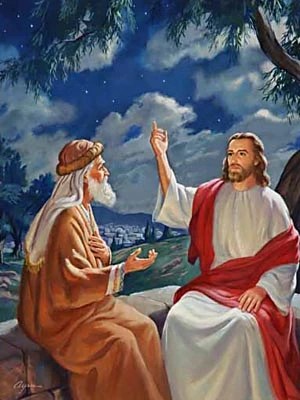
‘Jesus’ answer seems to have been given in response to an unrecorded question. We may wonder if Nicodemus first asked, “Rabbi, what must a man do in order to see the kingdom of God?” Christ responded that he must be born again, but there are two equally correct interpretations of Christ’s response. The first is that one must be baptized in order to enter the celestial kingdom. The second is that one must be born again in order to recognize the kingdom of God on earth. Christ preached, ‘the kingdom of God is at hand’ (Mark 1:15), but there were few who saw it. “Some have a certain spiritual awakening which makes it possible for them to ‘see’ the kingdom of God-that is, recognise that the gospel has been restored and the true Church has been re-established on the earth. Then, if they are ‘born of the water and of the Spirit,’ they are able to enter the Church; and, if they endure to the end, they can enter into their rest in God’s kingdom.” (Glenn L. Pearson and Reid E. Bankhead, Building Faith with the Book of Mormon [Salt Lake City: Bookcraft, 1986], 107.)’
To be born again implies a new birth, a new life, a new reformed person. We have shown faith, we have repented of our sins and we have committed to bury our old self and become a new creature. President David O McKay said that for Nicodemus to be born again “his manner of thinking, feeling, and acting with reference to spiritual things would have to undergo a fundamental and permanent change.” (General Conference, April 1960). That is the challenge for each of us.
We may have gone through the ordinances – we have risen from the water, we have had hands laid on our heads for the gift of the Holy Ghost – but have we gone through the transformation of self that truly constitutes being born of the water and of the spirit?
Heavenly Father shows His love for me through Jesus Christ.
‘My reassurance is this: the loving God who allowed these tests for you also designed a sure way to pass through them. Heavenly Father so loved the world that He sent His Beloved Son to help us. His Son, Jesus Christ, gave His life for us. Jesus Christ bore in Gethsemane and on the cross the weight of all our sins. He experienced all the sorrows, the pains, and the effects of our sins so that He could comfort and strengthen us through every test in life.’ (President Henry B Eyring, General Conference, October 2018).
How have you felt comforted and strengthened through Jesus Christ?
Is God a spirit?
‘I remember the occasion of more than fifty years ago when, as a missionary, I was speaking in an open-air meeting in Hyde Park, London. As I was presenting my message, a heckler interrupted to say, “Why don’t you stay with the doctrine of the Bible which says in John John 4:24 ‘God is a Spirit’?”
I opened my Bible to the verse he had quoted and read to him the entire verse:
“God is a Spirit: and they that worship him must worship him in spirit and in truth.”
I said, “Of course God is a spirit, and so are you, in the combination of spirit and body that makes of you a living being, and so am I.”
Each of us is a dual being of spiritual entity and physical entity. All know of the reality of death when the body dies, and each of us also knows that the spirit lives on as an individual entity and that at some time, under the divine plan made possible by the sacrifice of the Son of God, there will be a reunion of spirit and body. Jesus’ declaration that God is a spirit no more denies that he has a body than does the statement that I am a spirit while also having a body.’ (Gordon B Hinckley, General Conference, October 1986)
Christ offers me his living water.
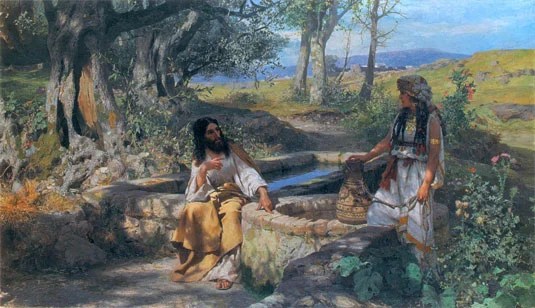
Spencer J. Condie:
“When Jesus encountered the Samaritan woman at Jacob’s well, the Savior said that if she knew who He was, she would have asked a drink of Him who would be able to give her living water which would be ‘a well of water springing up into everlasting life’ (John 4:5-14).
“In his vision of the Lord’s second coming Zechariah foresaw that the Savior shall stand upon the Mount of Olives and ‘living waters shall go out from Jerusalem: half of them toward the former sea, and half of them toward the hinder sea’ (Zech. 14:8). Of this same event, Ezekiel prophesied that these living waters would ‘go down into the desert, and go into the sea: which being brought forth into the sea, the waters [of the Dead Sea] shall be healed. … And every thing shall live whither the river cometh.’ (Ezek. 47:8-9.)
“These dual prophecies are profound not only in their geographical and geological implications but also because of their metaphorical promise. Of all the places on earth, the Dead Sea is one of the most inhospitable to life. Even burning deserts of sand provide a home for hardy insects and reptiles and for certain plants with extremely deep roots. Concrete sidewalks and asphalt tennis courts sometimes crack, allowing a brave weed or two to survive above the surface. But the Dead Sea, because of its extreme salinity, harbors no life of any kind.
“Thus, using the example of the Dead Sea, the Lord’s prophets have chosen the worst possible case to illustrate the power of the living waters to heal that which is dead. The living waters of the gospel of Jesus Christ and His atonement can heal dead marriages, dead relationships between parents and children, dead friendships between business partners and neighbors, and spiritual death from years of alienation from the Church. His promise is sure: ‘Learn of me, and listen to my words; walk in the meekness of my Spirit, and you shall have peace in me’ (D&C 19:23).” (Your Agency, Handle with Care [Salt Lake City: Bookcraft, 1996], 102-103.)
I was reminded of the well known story told by Elder Theodore A Tuttle in General Conference in 1975:
This difficulty of understanding about water recalls the story of a sailing ship that had become disabled in a storm. It drifted aimlessly for many days. The crew and passengers became famished and parched from lack of food and water. Finally another ship came into view. They signaled frantically for water. The other ship replied, “Let down your buckets where you are.” This communication made no sense at all, for they supposed they were far out to sea in typical ocean water. Again the famished ones requested water. Again the signal came, “Let down your buckets where you are.” They could not know that they had drifted into the mouth of a great river and that the water beneath them was fresh and could save their lives. The water of life lay just beneath them, yet they were dying for lack of this knowledge.
Like those passengers, multitudes of people are thirsting for “living water,” and they know not where to find it. Like the people on the other ship, we are signaling that we have found the “living water.” It has brought us the abundant life. It has made us happy, healthy, and serene. We who enjoy the abundant life want to share this happiness. You, too, may want to drink of this “living water.”
We can defend sacred places and things.
“Love of money had warped the hearts of many of Jesus’ countrymen. They cared more for gain than they did for God. Caring nothing for God, why should they care for his temple? They converted the temple courts into a marketplace and drowned out the prayers and psalms of the faithful with their greedy exchange of money and the bleating of innocent sheep. Never did Jesus show a greater tempest of emotion than in the cleansing of the temple. …
“The reason for the tempest lies in just three words: ‘My Father’s house.’ It was not an ordinary house; it was the house of God. It was erected for God’s worship. It was a home for the reverent heart. It was intended to be a place of solace for men’s woes and troubles, the very gate of heaven. ‘Take these things hence;’ he said, ‘make not my Father’s house an house of merchandise.’ (John 2:16.) His devotion to the Most High kindled a fire in his soul and gave his words the force that pierced the offenders like a dagger” (Howard W Hunter, “Hallowed Be Thy Name,”Ensign, Nov. 1977, 52–53).
How can we preserve the sanctity of the temple and other holy places?
“Before entering the temple, you will be interviewed by your bishop and stake president for your temple recommend. Be honest and candid with them. That interview is not a test to be passed but an important step to confirm that you have the maturity and spirituality to receive the supernal ordinances and make and keep the edifying covenants offered in the house of the Lord. Personal worthiness is an essential requirement to enjoy the blessings of the temple. Anyone foolish enough to enter the temple unworthily will receive condemnation” (Richard G Scott, “Receive the Temple Blessings,” Ensign, May 1999, 25).
 Latter-day Bloke