Lasting happiness comes from living the way Jesus Christ taught.
President Joseph Fielding Smith called the Sermon on the Mount “greatest [sermon] that was ever preached”.
Martin Luther called the Sermon on the Mount “the devil’s masterpiece” because in his opinion “the devil so masterfully distorts and perverts Christ’s true meaning through his Apostle [Matthew] especially in the fifth chapter.”
How could there be such widely divergent views of the Sermon on the Mount?
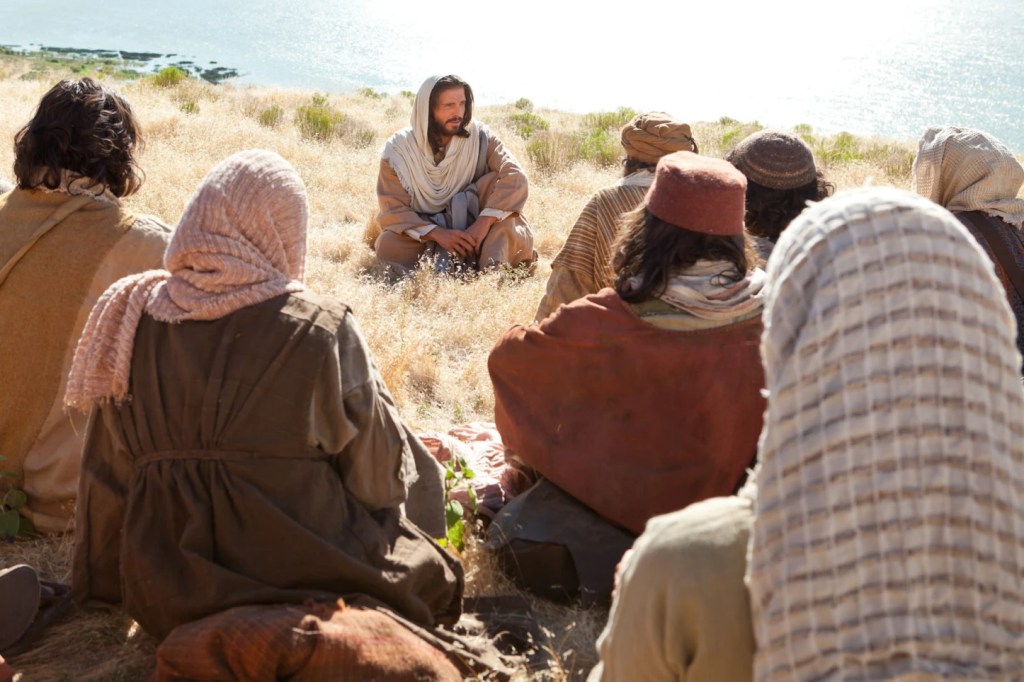
Matthew 5:3 Blessed are the poor in Spirit for theirs is the kingdom of heaven.
The footnotes tell us that blessed means happy or fortunate.
How can it be fortunate to be poor in spirit?
“…the Book of Mormon sermon added the phrase ‘who come unto me…’ Obviously in the 3 Nephi rendering, being poor in spirit is not in itself a virtue, but it will be so if such humility brings one to claim the blessings of the kingdom through the waters of baptism, making covenants, and moving toward all the promises given to covenant-making disciples. It is significant that the phrase ‘come unto me’ is used at least four more times in the twenty or so verses that follow this one.” (Jeffrey R Holland, Christ And The New Covenant, p. 263)
Robert E Wells wrote: “To be poor in spirit means to be humble, teachable, contrite, meek, obedient.
Verse 4 Blessed are they that mourn.
How can it be fortunate to mourn?
One reason is given in 2 Corinthians 7:10 For godly sorrow worketh repentance to salvation. Robert E. Wells suggests another reason:
“Since mourning is so universal, the Lord must have a purpose for having us experience it. There is no doubt but that he softens and molds us and touches us most deeply when we are mourning.” (The Mount and the Master, p. 20)
Verse 5 Blessed are the meek for they shall inherit the earth.
How will the meek inherit the earth? What does that mean?
Joseph Fielding Smith said:
“This earth is going to become a celestial body and is going to be a fit abode for celestial beings only; the others will have to go somewhere else, where they belong. This earth will be reserved for those who are entitled to exaltation, and they are the meek, spoken of by our Savior, who shall inherit the earth. When the Lord said the meek shall inherit the earth, He had reference to those who are willing to keep the commandments of the Lord in righteousness and thus receive exaltation.” (Conference Report, Apr. 1942, p. 28)
Verse 6 Blessed are they that hunger and thirst after righteousness for they shall be filled.
Filled with what? – 3 Nephi 12:6 tells us ‘with the Holy Ghost.’
Russell M. Nelson related:
“I was with Elder Mark E. Petersen in the Holy Land in October 1983, during his last mortal journey. Elder Petersen was not well. Evidences of his consuming malignancy were painfully real to him, yet he derived strength from the Savior he served. Following a night of intense suffering, exacerbated by pangs of his progressive inability to eat or to drink, Elder Petersen addressed throngs assembled at the Mount of the Beatitudes to hear his discourse on the Sermon on the Mount. After he recited ‘Blessed are they which do hunger and thirst after righteousness,’ he departed from the biblical text and pleaded this question: ‘Do you know what it is to be really hungry? Do you know what it is to really be thirsty? Do you desire righteousness as you would desire food under extreme conditions or drink under extreme conditions? [The Savior] expects us to literally hunger and thirst after righteousness and seek it with all our hearts!’
“I was one of the few present on that occasion who knew how hungry and thirsty Elder Petersen really was. His encroaching cancer had deprived him of relief from physical hunger and thirst, so he understood that doctrine. He withstood the trial. He thanked the Lord, who lent him power to preach his last major sermon at the sacred site where Jesus himself had preached.” (The Power Within Us, p. 21)
Verse 7 Blessed are the merciful for they shall obtain mercy
Our salvation rests upon the mercy we show to others (Harold B Lee)
Verse 8 Blessed are the pure in heart for they shall see God.
Bruce R. McConkie said:
“We have the power—and it is our privilege—so to live, that becoming pure in heart, we shall see the face of God while we yet dwell as mortals in a world of sin and sorrow.
“This is the crowning blessing of mortality. It is offered by that God who is no respecter of persons to all the faithful in his kingdom.‘Verily, thus saith the Lord: It shall come to pass that every soul who forsaketh his sins and cometh unto me, and calleth on my name, and obeyeth my voice, and keepeth my commandments, shall see my face and know that I am.’(D&C 93:1.)”(Conference Report, Oct. 1977, p. 52)
Verse 9 Blessed are the peacemakers for they shall be called the children of God
Bruce R. McConkie again:
“The gospel of peace makes men ! Christ came to bring peace-peace on earth and good will to men. His gospel gives peace in this world and eternal life in the world to come. He is the Prince of peace. How beautiful upon the mountains are the feet of them who preach the gospel of peace, who say unto Zion: The God reigneth! Let there be peace on earth, and let it begin with his saints. By this shall all men know the Lord’s disciples: They are peacemakers; they seek to compose difficulties; they hate war and love peace; they invite all men to forsake evil, overcome the world, flee from avarice and greed, stand in holy places, and receive for themselves that peace which passeth understanding, that peace which comes only by the power of the Spirit.” (The Mortal Messiah, Book 2, p. 123)
Verse 10 Blessed are they which are persecuted for righteousness sake for theirs is the kingdom of heaven
Joseph Smith taught:
“Those who cannot endure persecution, and stand in the day of affliction, cannot stand in the day when the Son of God shall burst the veil, and appear in all the glory of His Father, with all the holy angels.” (Teachings of the Prophet Joseph Smith, p. 42)
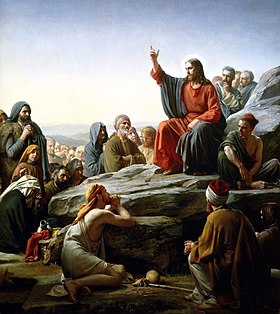
“Ye are the salt of the earth.”
‘The Savior taught: “Ye are the salt of the earth: but if the salt have lost his savour, wherewith shall it be salted? it is thenceforth good for nothing, but to be cast out, and to be trodden under foot of men.”
How do we lose our savor? One way is when we stop being different from the world. Many in the Church are drifting in the direction of the world and looking and becoming more and more like the world. We must stop drifting.’ (Elder Larry W Gibbons, General Conference, October 2006)
In what ways can we lose our savour?
The law of Christ supersedes the law of Moses.
“The law of Moses was the type, Jesus the antitype; he was that toward which all creation looked and waited. The law was the symbol, Jesus the ultimate reality toward which it pointed. The law was the means, Jesus the end. These simple but pertinent verities are all but lost in the Bible, particularly in the Old Testament. Only through the clarifying and illuminating lenses of the Book of Mormon do we come to know that the law was anything more than a schoolmaster or teaching device. The law of Moses-including the intricate system of animal sacrifices-was the prophecy; Jesus was the grand fulfillment of the prophecy.
“‘Behold,’ Nephi stated, ‘my soul delighteth in proving unto my people the truth of the coming of Christ; for, for this end hath the law of Moses been given; and all things which have been given of God from the beginning of the world, unto man, are the typifying of him’ (2 Nephi 11:4). After having explained the need for ‘the great and last sacrifice’ of the Son of God, Amulek said, ‘this is the whole meaning of the law [of Moses], every whit pointing to that great and last sacrifice; and that great and last sacrifice will be the Son of God, yea, infinite and eternal’ (Alma 34:14).” (McConkie and Millet, Doctrinal Commentary on the Book of Mormon, vol. 2, p. 34)
Does Heavenly Father really expect me to be perfect?
‘My brothers and sisters, except for Jesus, there have been no flawless performances on this earthly journey we are pursuing, so while in mortality let’s strive for steady improvement without obsessing over what behavioral scientists call “toxic perfectionism.”’ (Elder Jeffrey R Holland, General Conference, October 2017)
What does the command to be perfect actually mean?
Perfect – ‘This word commonly means “finished, complete, pure, holy.” ‘ (Barnes Notes on the Bible)
‘The Savior’s declaration to be perfect even as Father in Heaven is perfect would have reminded his Jewish audience of familiar concepts from the Old Testament. The most obvious example was Noah, described in Genesis as “a just man and perfect in his generations” (Genesis 6:9). The Hebrew word translated as “perfect” is tamim and means, among other things, “whole, sound, healthful” and “having integrity.” The Septuagint—the Greek translation of the Old Testament—uses the word teleios (the same word used in Matthew 5:48) to mean perfect in the sense of “complete” and “entire.” Neither the Hebrew word nor the Greek word carries the connotation that Noah had somehow achieved a state of flawlessness. Certainly the example of Noah’s drunkenness would argue against that interpretation (see Genesis 9:20–21). (Be Ye Therefore Perfect – The Elusive Quest for Perfection, Frank F Judd Jr)
How can we become more ‘whole’?
‘I love to hear my brethren speak. Their testimony yields joy and consolation to my heart. But notwithstanding the pleasure it would give me to sit and hear them continually, it is obligatory upon me to occupy the position I do, and let my voice be heard in connection with theirs.
We all occupy diversified stations in the world, and in the kingdom of God. Those who do right, and seek the glory of the Father in heaven, whether their knowledge be little or much, or whether they can do little or much, if they do the very best they know how, they are perfect.
It may appear strange to some of you, and it certainly does to the world, to say it is possible for a man or woman to become perfect on this earth. It is written “Be ye therefore perfect, even as your Father which is in heaven is perfect.” Matt. 5:48 Again, “If any man offend not in word, the same is a perfect man, and able also to bridle the whole body.” James 3:2 This is perfectly consistent to the person who understands what perfection really is.
If the first passage I have quoted is not worded to our understanding, we can alter the phraseology of the sentence, and say, “Be ye as perfect as ye can,” Matt. 5:48 for that is all we can do, though it is written, be ye perfect as your Father who is in heaven is perfect. To be as perfect as we possibly can, according to our knowledge, is to be just as perfect as our Father in heaven is. He cannot be any more perfect than He knows how, any more than we. When we are doing as well as we know how in the sphere and station which we occupy here, we are justified in the justice, righteousness, mercy, and judgment that go before the Lord of heaven and earth. Ps. 89:14 We are as justified as the angels who are before the throne of God. The sin that will cleave to all the posterity of Adam and Eve is, that they have not done as well as they knew how. James 4:17. (Brigham Young December 1853, Journal of Discourses)
The purpose of the Church is to help us incrementally improve:
‘How does His Church accomplish the Lord’s purposes? It is important to recognize that God’s ultimate purpose is our progress. His desire is that we continue “from grace to grace, until [we receive] a fulness” Doctrine and Covenants 93:13 of all He can give. That requires more than simply being nice or feeling spiritual. It requires faith in Jesus Christ, repentance, baptism of water and of the Spirit, and enduring in faith to the end.[See 2 Nephi 31:17–20)] One cannot fully achieve this in isolation, so a major reason the Lord has a church is to create a community of Saints that will sustain one another in the “strait and narrow path which leads to eternal life.”‘ (D Todd Christofferson, General Conference, October 2015)
The Savior’s disciples are to be the light of the world.
‘If we as a people will walk with integrity, will be honest and moral in our actions, will put into our lives the simple and basic and wonderful principle of the Golden Rule, others will be led to inquire and learn. We shall become as a city set upon a hill whose light cannot be hid. (See Matt. 5:14) We shall witness an ever-growing fulfillment of the promise of Isaiah: “And many people shall go and say, Come ye, and let us go up to the mountain of the Lord, to the house of the God of Jacob; and he will teach us of his ways, and we will walk in his paths.” (Isa. 2:3)′ (Gordon B Hinckley, General Conference, April 1982)
What does it mean to be a city set upon a hill?
“Setting an example is not the main means of influencing another, it is the only means. ” Albert Einstein
“You can be a good example or you can be a bad example, but you are always an example.” Hartman Rector, Jr.
“I challenge you to stand up to your peers as an example of righteous living.” Elder L. Tom Perry Ensign, Nov. 1996, 38, “Run and Not Be Weary”
How can we live in the world without being of the world?
Why is it important for us to stand for what is right?
 Latter-day Bloke