Jesus Christ delivers me from sin and death, strengthens me in my weaknesses, and comforts me in my trials.
‘I feel, and the Spirit seems to accord, that the most important doctrine I can declare, and the most powerful testimony I can bear, is of the atoning sacrifice of the Lord Jesus Christ.
His atonement is the most transcendent event that ever has or ever will occur from Creation’s dawn through all the ages of a never-ending eternity.’ (Bruce R McConkie’s final testimony).
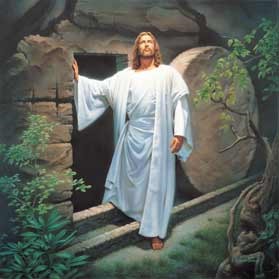
What are your feelings as you ponder the Savior’s sacrifice for you?
My brothers and sisters, it is my promise to you that increasing your faith in the Lord Jesus Christ will bring you added strength and greater hope. For you, the righteous, the Healer of our souls, in His time and His way, will heal all your wounds. No injustice, no persecution, no trial, no sadness, no heartache, no suffering, no wound—however deep, however wide, however painful—will be excluded from the comfort, peace, and lasting hope of Him whose open arms and whose wounded hands will welcome us back into His presence. (Elder Neil L Andersen, General Conference, October 2018)
How does it make you feel to know that Jesus Christ will heal all our wounds?
Many witnesses testify of the resurrection of Jesus Christ.
As we approach Easter when as Christians we celebrate and commemorate the resurrection of Jesus Christ, it is strange but true that to an increasing number of those who call themselves Christian, Christ’s resurrection is not to be taken literally. It has been described by a leading churchman from a different denomination as ‘a conjuring trick with bones’. One college textbook on the New Testament proclaims:
“We need to keep in mind that the empty tomb was an ambiguous witness to the resurrection. It attests the absence of the body, but not necessarily the reality or presence of the risen Jesus.” Robert A. Spivey and D. Moody Smith, Anatomy of the New Testament: A Guide to Its Structure and Meaning (New York: Macmillan, 1989), p. 239
The apostle Paul pointed out that if we do not accept the resurrection of Christ we miss the whole point of the Gospel:
“If Christ be not risen, then is our preaching vain, and your faith is also vain. … If in this life only we have hope in Christ, we are of all men most miserable” (1 Cor. 15:14, 19).
Without the atonement and resurrection of Christ there is no plan of salvation.
Those who hated Jesus thought they had put an end to Him forever when the cruel spikes pierced His quivering flesh and the cross was raised on Calvary. Those who loved Him placed His wounded, lifeless body in the new tomb of Joseph of Arimathea.
Each Gospel writer stresses that the Saviour truly died. John’s account states that a soldier pierced Jesus in the side with a spear to assure his death. Matthew notes that in addition to Joseph of Arimathaea, three women were present when the Lord was buried. John says that Nicodemus was also present. Joseph carefully wrapped the body in preparation for burial, placed it in the tomb, and personally rolled a large rock over the opening, after which some of the women lingered.
Matthew further relates that a delegation of Jewish rulers asked Pilate for permission to set a guard around the tomb,
“saying, Sir, we remember that that deceiver said, while he was yet alive, After three days I will rise again.
“Command therefore that the sepulchre be made sure until the third day, lest his disciples come by night, and steal him away, and say unto the people, He is risen from the dead: so the last error shall be worse than the first.
“Pilate said unto them, Ye have a watch: go your way, make it as sure as ye can.
“So they went, and made the sepulchre sure, sealing the stone, and setting a watch” (Matt. 27:63–66).
Here is a clear indication that these men remembered well and interpreted correctly the Lord’s statement made nearly three years earlier: “Destroy this temple, and in three days I will raise it up” Matthew’s account shows first, that there could have been no tampering with or removal of the body, and second, that the Lord did not somehow resuscitate and escape from the tomb on his own.
The Gospels leave no doubt that the Saviour actually died and was buried. The spear thrust, the wrapping of the body, the sealing of the tomb, the presence of more than one person at the time of and after the burial amply witness to the actual death of the Lord.
He had taught them of His eventual death and Resurrection, but Jesus’ followers had not understood. Now they were forlorn and dejected. They must have wept and wondered as the great stone was rolled to seal the burial place.
The Jewish Sabbath passed. Then came a new day, a day that ever after was to be the Lord’s day.
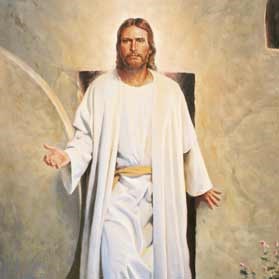
John 20:1-18
The Bible indicates that Jesus provided “many infallible proofs” of his resurrection (see Acts 1:3), appearing to many during the forty days before his final ascension. As well as Mary Magdalene, other women also saw him, including Mary the mother of James; Salome, the mother of James and John; and others. Jesus appeared also to two disciples on the road to Emmaus. Several times to the remaining Apostles, including at the time of his ascension, to seven of the Apostles as they fished; to Peter; to James ‘to five hundred brethren at once and “last of all” to Paul. Moreover,
“the graves were opened; and many bodies of the saints which slept arose,
“And came out of the graves after his resurrection, and went into the holy city, and appeared unto many” (Matt. 27:52–53).
Yet many do not believe- only 30% of British people according to a recent survey. Despite all the testimonies many respond as the apostles did when told that Jesus had risen from the dead:
Luke 24 : 10-11
10 It was Mary Magdalene, and Joanna, and Mary the mother of James, and other women that were with them, which told these things unto the apostles.
11 And their words seemed to them as idle tales, and they believed them not.
We cannot explain the Resurrection intellectually; it is beyond our human experience and comprehension.
“No man can describe it to you—no man can write it,” said the Prophet Joseph Smith
Yet millions bear witness and testify by the power of the Holy Ghost, of the truth and validity of this most remarkable event.
To many of the honorable men and women of the world, including increasing numbers of those who call themselves Christian, Christ’s resurrection is not to be taken literally. Some say Jesus was a great teacher, an inspired moralist, an outstanding philosopher, a healer, and miracle worker. But his unique role as the atoning, resurrected Saviour receives increasingly less attention. Yet, as Paul said,
“If Christ be not risen, then is our preaching vain, and your faith is also vain. … If in this life only we have hope in Christ, we are of all men most miserable” (1 Cor. 15:14, 19).
What do we mean by resurrection? As a missionary I used to explain it by using my hand and a glove with the hand representing the spirit and the glove the body. When we lived in the pre-existence we lived as spirits (the hand without the glove). When we come to this mortal life our spirit is clothed in a body (the hand in the glove). When we die, the body is laid in the grave but the spirit lives on (the hand is taken out of the glove). Resurrection is the reuniting of the spirit with the body in an immortal state, no longer subject to disease or death. (The hand is placed back in the glove forever.)
The scriptures give us examples of people who were raised from the dead – for example Lazarus, Jairus’ daughter and the widow’s son at Nain but each of these was still eventually subject to death. The Saviour was the first person to be resurrected.
Right from the beginning of his ministry, the Lord tried to make it clear that he would die and then rise from the dead.
Luke 18:31¶ Then he took unto him the twelve, and said unto them, Behold, we go up to Jerusalem, and all things that are awritten by the prophets concerning the Son of man shall be accomplished.
32 For he shall be delivered unto the Gentiles, and shall be amocked, and spitefully entreated, and spitted on:
33 And they shall scourge him, and put him to death: and the third day he shall arise again.
To us, looking back through history, this teaching may seem clear and unambiguous, yet Jesus’ disciples “understood none of these things: and this saying was hid from them, neither knew they the things which were spoken” (v. 34).
So after his resurrection, Jesus made sure that his disciples witnessed that he had a physical body and was not some sort of spiritual manifestation or vision.
Luke 24:36 And as they thus spake, Jesus himself stood in the midst of them, and saith unto them, Peace be unto you.
37 But they were terrified and affrighted, and supposed that they had seen a spirit.
38 And he said unto them, Why are ye troubled? and why do athoughts arise in your hearts?
39 Behold my hands and my feet, that it is I myself: handle me, and see; for a spirit hath not flesh and bones, as ye see me have.
40 And when he had thus spoken, he shewed them his hands and his feet.
41 And while they yet believed not for joy, and wondered, he said unto them, Have ye here any meat?
42 And they gave him a piece of a broiled fish, and of an honeycomb.
43 And he took it, and did eat before them.
So:
He was not a spirit
He had flesh and bones
He could eat.
The doctrine of the resurrection is not just of academic interest – the New Testament teaches us that everyone who has lived will be resurrected:
1 Corinthians 15:21 For since by man came death, by man came also the resurrection of the dead.
22 For as in Adam all die, even so in Christ shall all be made alive.
Bruce R McConkie explained it this way:
“As Adam is the father of mortality, so Christ is the father of immortality.”
It was part of our Heavenly Father’s plan that death and mortality would come into the word through Adam and that immortality and eternal life would come to all through Jesus Christ.
Gordon B Hinckley said:
“I have stood at the tomb of Napoleon in Paris, at the tomb of Lenin in Moscow, and before the burial places of many others of the great leaders of the earth. In their time they commanded armies, they ruled with almost omnipotent power, their very words brought terror into the hearts of people. I have reverently walked through some of the great cemeteries of the world. I have reflected quietly and thoughtfully as I have stood in the military cemetery in Manila in the Philippines where are buried some 17,000 Americans who gave their lives in the Second World War and where are remembered another 35,000 who died in the terrible battles of the Pacific and whose remains were never found. I have walked with reverence through the British cemetery on the outskirts of Rangoon, Burma, and noted the names of hundreds of young men who came from the villages, towns, and great cities of the British Isles and gave their lives in hot and distant places. I have strolled through old cemeteries in Asia and Europe and yet other places and reflected on the lives of those who were once buoyant and happy, who were creative and distinguished, who gave much to the world in which they lived. They have all passed into the oblivion of the grave. All who have lived upon the earth before us are now gone. They have left all behind as they have stepped over the threshold of silent death. None has escaped. All have walked their way to “the undiscovered country from whose bourn no traveler returns” (Hamlet, act 3, scene 1, lines 79–80). Shakespeare so described it.
But Jesus the Christ changed all that. Only a God could do what He did. He broke the bonds of death. He too had to die, but on the third day, following His burial, He rose from the grave, “the firstfruits of them that slept” (1 Cor 15:20) and in so doing brought the blessing of the Resurrection to every one of us.”
Jesus Christ gives me hope and joy.
Hope
In the Encyclopaedia of Mormonism we read:
“The concept of hope plays a vital role in Latter-day Saint thought. Firmly centered in Christ and his resurrection, it is the ‘hope of eternal life’ (Titus 1:2) repeatedly alluded to by Paul. It is the opposite of the despair found among those who are ‘without Christ, having no hope, and without God in the world’ (Eph. 2:12). As the Book of Mormon prophet Moroni writes, ‘If ye have no hope, ye must needs be in despair’ (Moro. 10:22). For those, however, who accept Christ’s Atonement and resurrection, there comes a ‘brightness of hope’ (2 Ne. 31:20) through which all who believe in God ‘might with surety hope for a better world’ (Ether 12:4).”
Note that hope must be firmly centred in Christ – we are not using hope in the everyday sense of something that we would like to come true but we are not sure of, like we hope that it will be sunny tomorrow. Preach my Gospel defines hope thus:
‘Hope is an abiding trust that the Lord will fulfill His promises to you. It is manifest in confidence, optimism, enthusiasm, and patient perseverance. It is believing and expecting that something will occur. When you have hope, you work through trials and difficulties with the confidence and assurance that all things will work together for your good. Hope helps you conquer discouragement. The scriptures often describe hope in Jesus Christ as the assurance that you will inherit eternal life in the celestial kingdom.’
In the gospel sense, hope is linked to Christ and the atonement. So faith (or more accurately faith in Jesus Christ), hope and charity (the pure love of Christ) are all rooted in the Saviour and his atoning sacrifice. President Uchtdorf goes further in explaining the links between hope, faith and charity:
‘Hope is critical to both faith and charity. When disobedience, disappointment, and procrastination erode faith, hope is there to uphold our faith. When frustration and impatience challenge charity, hope braces our resolve and urges us to care for our fellowmen even without expectation of reward. The brighter our hope, the greater our faith. The stronger our hope, the purer our charity.
The things we hope for lead us to faith, while the things we hope in lead us to charity. The three qualities—faith, hope, and charity —working together, grounded on the truth and light of the restored gospel of Jesus Christ, lead us to abound in good works.’ (General Conference, October 2008).
So, hope supports and sustains and leads to faith and charity.
In Romans 8:24 Paul says that we are ‘saved by hope’. It is clearly not hope for a sunny day tomorrow that saves us but the quiet assurance that comes to us through Christ’s atonement. Neal A Maxwell wrote:
“Christ-centered hope, however, is a very specific and particularized hope. It is focused on the great realities of the resurrection, eternal life, a better world, and Christ’s triumphant second coming ‘things as they really will be.’ (Jacob 4:13.)
“Moroni asked rhetorically, ‘What should we hope for?’ and, responding, said: ‘Behold I say unto you that ye shall have hope through the atonement of Christ and the power of his resurrection, to be raised unto life eternal, and this because of your faith in him according to the promise.’ (Moroni 7:41.)” (Notwithstanding My Weakness [Salt Lake City: Deseret Book Co., 1981], 41.)
How do we gain this hope? President Uchtdorf said:
‘We learn to cultivate hope the same way we learn to walk, one step at a time. As we study the scriptures, speak with our Heavenly Father daily, commit to keep the commandments of God, like the Word of Wisdom, and to pay a full tithing, we attain hope. We grow in our ability to “abound in hope, through the power of the Holy Ghost,” (Romans 15:13) as we more perfectly live the gospel.’ (General Conference, October 2008)
Joy
‘My dear brothers and sisters, the joy we feel has little to do with the circumstances of our lives and everything to do with the focus of our lives.
When the focus of our lives is on God’s plan of salvation, which President Thomas S. Monson just taught us, and Jesus Christ and His gospel, we can feel joy regardless of what is happening—or not happening—in our lives. Joy comes from and because of Him. He is the source of all joy.’ (President Russell M Nelson, General Conference, October 2016)
 Latter-day Bloke