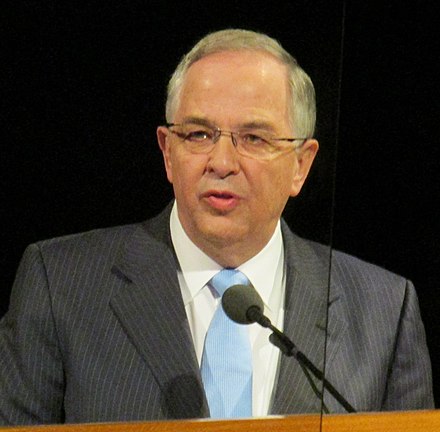
You can read or watch Elder Andersen’s full talk here
Elder Andersen began by sharing an experience of Brother Roger Parra, the owner of a small bakery in Venezuala.
What lessons did you take from this story?
Prove Me Now Herewith
All that we have and all that we are comes from God. As disciples of Christ, we willingly share with those around us.
With all the Lord gives to us, He has asked us to return to Him and His kingdom on earth 10 percent of our increase. He has promised us that as we are honest in our tithes, He will “open … the windows of heaven, and pour … out a blessing, that there shall not be room enough to receive it.” He has promised us that He will protect us from evil. These promises are so certain, the Lord declares, “Prove me now herewith,” a phrase found nowhere else in the scriptures but when quoting Malachi.
The windows of heaven open in many ways. Some are temporal, but many are spiritual. Some are subtle and easy to overlook. Trust in the Lord’s timing; the blessings always come.
What has been your experience as you have put this promise to the test?
A Matter of Faith
The Apostle Paul warned that the wisdom of men understands the things of men but has difficulty understanding the things of God. The world speaks of tithing in terms of our money, but the sacred law of tithing is principally a matter of our faith. Being honest in our tithes is one way we show our willingness to put the Lord first in our lives, above our own cares and interest. I promise you that as you trust in the Lord, the blessings of heaven will follow.
‘The payment of tithing helps us develop a submissive and humble heart and a grateful heart that tends to “confess … his hand in all things” D&C 59:21 Tithe-paying fosters in us a generous and forgiving heart and a charitable heart full of the pure love of Christ. We become eager to serve and bless others with an obedient heart, submissive to the Lord’s will. Regular tithe payers find their faith in the Lord Jesus Christ strengthened, and they develop a firm, abiding testimony of His gospel and of His Church. None of these blessings are monetary or material in any way, but surely they are the Lord’s richest blessings.’ (Carl B Pratt, General Conference, April 2011)
In what ways has the payment of tithes increased your faith?
Jesus said to give “unto Caesar the things which are Caesar’s; and unto God the things that are God’s.” The resurrected Savior asked the Nephites to write into their record His promises found in Malachi. In our day, the Lord reconfirmed the divine law of tithing, declaring: “This shall be the beginning of the tithing of my people. And [they] shall pay one-tenth of all their interest annually; and this shall be a standing law unto them forever.”
‘Tithing is so simple and straightforward a thing. The principle, as it applies to us, is actually set forth in one verse of section 119 of the Doctrine and Covenants. That fourth verse consists of thirty-five words. Contrast that with the cumbersome and complex tax codes enacted and enforced by governments. In the one case it is a brief statement from the Lord, the payment left to the individual and motivated by faith. With the other it is a tangled web created by men and enforced by law. ‘(Gordon B Hinckley, “The Miracle Made Possible by Faith,” Ensign, May 1984, 47)
The Lord clearly directed how tithing should be disbursed, saying, “Bring ye all the tithes into the storehouse,” meaning bring the tithes into His restored kingdom, The Church of Jesus Christ of Latter-day Saints. He directed that the use of these sacred tithes would be prayerfully considered by a council of the First Presidency, the Quorum of the Twelve Apostles, the Presiding Bishopric, “and by mine own voice unto them, saith the Lord.”
‘Before my call to serve as a member of the Quorum of the Twelve, I read many times in the Doctrine and Covenants about the council appointed to oversee and disburse sacred tithing funds. The Council on the Disposition of the Tithes was established by revelation and consists of the First Presidency, the Quorum of the Twelve Apostles, and the Presiding Bishopric (see D&C 120). As I prepared in December of 2004 to attend my first meeting of this council, I eagerly anticipated a most remarkable learning opportunity.
I still remember the things I experienced and felt in that council. I gained a greater appreciation and reverence for the Lord’s laws of finance for individuals, for families, and for His Church. The basic financial program of The Church of Jesus Christ of Latter-day Saints—for both income and disbursement—is defined in sections 119 and 120 of the Doctrine and Covenants. Two statements found in these revelations provide the foundation for the fiscal affairs of the Church.
Section 119 simply states that all members “shall pay one-tenth of all their interest annually; and this shall be a standing law unto them forever, … saith the Lord” (verse 4).The Lord’s Sacred Funds.
Then, concerning the authorized disbursement of the tithes, the Lord said, “It shall be disposed of by a council, composed of the First Presidency of my Church, and of the bishop and his council, and by my high council; and by mine own voice unto them, saith the Lord” (D&C 120:1). The “bishop and his council” and “my high council” referred to in this revelation are known today as the Presiding Bishopric and the Quorum of the Twelve Apostles, respectively. These sacred funds are used in a rapidly growing church to spiritually bless individuals and families by constructing and maintaining temples and houses of worship, supporting missionary work, translating and publishing scriptures, fostering family history research, funding schools and religious education, and accomplishing many other Church purposes as directed by the Lord’s ordained servants.
I marvel at the clarity and brevity of these two revelations in comparison to the complicated financial guidelines and administrative procedures used in so many organizations and governments around the world. How can the temporal affairs of an organization as large as the restored Church of Jesus Christ possibly operate throughout the entire world using such succinct instructions? To me the answer is quite straightforward: this is the Lord’s work, He is able to do His own work (see 2 Nephi 27:20), and the Savior inspires and directs His servants as they apply His directions and labor in His cause.
In that first council meeting I was impressed by the simplicity of the principles that guided our deliberations and decisions. In the financial operations of the Church, two basic and fixed principles are observed. First, the Church lives within its means and does not spend more than it receives. Second, a portion of the annual income is set aside as a reserve for contingencies and unanticipated needs. For decades the Church has taught its membership the principle of setting aside additional food, fuel, and money to take care of emergencies that might arise. The Church as an institution simply follows the same principles that are taught repeatedly to the members.These sacred funds do not belong to the leaders of the Church. They belong to the Lord. His servants are painstakingly aware of the sacred nature of their stewardship.
As the meeting progressed, I found myself wishing that all members of the Church could observe the simplicity, the clarity, the orderliness, the charity, and the power of the Lord’s own way (see D&C 104:16) for conducting the temporal affairs of His Church. I have now participated in the Council on the Disposition of the Tithes for many years. My gratitude and reverence for the Lord’s pattern has grown each year, and the lessons learned have become even more profound.(David A Bednar, “The Windows of Heaven,” Ensign, November 2013)
President Gordon B. Hinckley recounted this childhood experience: “When I was a boy I raised a question with my father … concerning the expenditure of Church funds. He reminded me that mine is the God-given obligation to pay my tithes and offerings. When I do so, [my father said,] that which I give is no longer mine. It belongs to the Lord to whom I consecrate it.” His father added: “What the authorities of the Church do with it need not concern [you, Gordon]. They are answerable to the Lord, who will require an accounting at their hands.”
We deeply feel the weight of being “answerable to the Lord.”
How do you feel about Brother Hinckley’s statement ‘that which I give is no longer mine’?
Your Generous Tithes and Offerings
From the generous tithes and offerings you have consecrated to the Lord, last year more than a billion US dollars were used to bless those in need.
In our momentous responsibility to take the restored gospel across the world, we have more than 71,000 missionaries serving in 414 missions. Because of your tithes and offerings, missionaries, regardless of their family financial situation, are able to serve.
Temples are being built across the world in unprecedented numbers. Currently, 177 temples are in operation, 59 are currently under construction or renovation, and 79 more are in planning and design. Your tithes are allowing the blessings of the temple to be in places only the Lord could foresee.
There are more than 30,000 congregations housed in thousands of chapels and other facilities in 195 countries and territories. Because of your faithful tithes, the Church is being established in faraway places you may never visit among righteous Saints you may never know.
The Church currently sponsors five institutions of higher learning. These serve more than 145,000 students. One hundred and ten thousand classes are being taught each week in our seminaries and institutes.
These blessings and so many more come in large measure from the young and old of every economic circumstance who pay an honest tithe.
How have you benefited from tithing paid by others?
The spiritual power of the divine law of tithing is not measured by the amount of money contributed, for both the prosperous and the poor are commanded by the Lord to contribute 10 percent of their income.The power comes from placing our trust in the Lord.
How would you explain to a non-member the spiritual power that comes from paying tithing?
God’s Important Work
My brothers and sisters, The Church of Jesus Christ of Latter-day Saints is “out of obscurity,” bringing remarkable blessings across the earth. There will be those who cheer us forward and those who do not. I have thought of the words of the wise Gamaliel, who, upon hearing of the miracles of the Apostles Peter and John, warned the council in Jerusalem:
“Let [these men] alone: for if … this work be of men, it will come to nought:
“But if it be of God, ye cannot overthrow it; lest … ye be found even to fight against God.”
You and I are part of God’s important work upon the earth. It will not come to naught but will continue to move across the world, preparing the way for the Savior’s return. I testify to the words of President Russell M. Nelson: “In coming days, we will see the greatest manifestations of the Savior’s power that the world has ever seen. Between now and the time He returns … , He will bestow countless privileges, blessings, and miracles upon the faithful.”
This is my witness. Jesus is the Christ. This is His holy work. He will come again. In the name of Jesus Christ, amen.
What connections do you see between tithing and President Nelson’s prophecy that in coming days we will see the greatest manifestations of the Saviour’s power that the world has ever seen?
NB: Passages in italics are direct excerpts from Elder Andersen’s talk.
 Latter-day Bloke