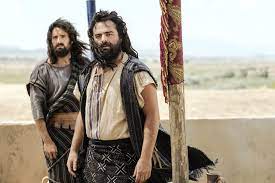
Laman and Lemuel
Religious differences in Lehi’s family
How are we to understand the dynamics of Lehi’s family, in particular the attitude of Laman and Lemuel to Lehi and Nephi?
Lehi and his family lived in a time in Jerusalem when religious reforms were being implemented following the reign of King Josiah and the discovery of the book of the law (2 Kings 22). One of the unfortunate results of Josiah’s reforms was the de-emphasis of the Messiah and his atoning mission. Lehi appears to have positioned himself against some of these religious forms and against the hierarchy in Jerusalem.
Brant A Gardner (The Book of Mormon as History page 74) writes:
“Lehi’s family becomes a microcosmic picture of what must have been divisiveness in the general population. The tensions that were present in Judahite society can be guessed at from hints in the Bible but are explicit inside Lehi’s family. The picture of Lehi (and Nephi) as opposed to certain elements of the Josianic reform is highlighted by the way in which Laman and Lemuel appear to support the Jerusalem establishment (and therefore the reforms). As Kevin Christensen noted: ‘Laman and Lemuel demonstrate sympathy for the Jerusalem party, the same group of people who caused problems for Jeremiah and Ezekiel.’”
Grant Hardy in Understanding the Book of Mormon page 39 writes:
“Whatever else they may have been, Laman and Lemuel appear to have been orthodox, observant Jews.”
Brant A Gardner again:
“Laman and Lemuel identify with Jerusalem, a Jerusalem that had very recently been religiously reformed. Their personal association with that city and its ruling elite would plausibly make them believers but believers in a different version of Israelite religion from Lehi’s – rather than simple non-believers.”
This different religious view is behind Laman and Lemuel’s complaint that Levi was ‘a visionary man’ (I Nephi 2:11).
An Arab view of Laman and Lemuel
Ehab Abunuwara, an Arab convert to the Church wrote about his experience with the Book of Mormon and how he is able to relate to the stories within its pages because of his cultural origins. He talked about his response to Laman and Lemuel:
“The first few chapters of 1 Nephi has always left me with many questions concerning the motives and emotions of the main characters. This is probably due to the psychologist in me seeking for the deeper meaning behind the actions, especially when those actions seem to defy common sense. Such is the behavior of Nephi’s elder brothers Laman and Lemuel, who in spite of witnessing miracles and angels resisted their father’s wishes and fought against their brother Nephi.
The most sympathy these two characters receive from the average Book of Mormon reader is a shake of the head at their “stiffneckedness.” But I read their story as a tragedy and overturning of the family structure. The status of eldest brother within a Middle Eastern family is culturally entrenched and derives its strength from the culture’s patriarchal structure. The eldest brother is the father-in-waiting and demands equal respect with the father. I think that it would have been even more so in the preindustrial society of Lehi’s time, when the first son would most likely have followed his father’s career as he grew into the family’s business or trade.
Lehi was surely troubled by the tensions between his sons. He understood his elder sons’ need for respect, especially Laman’s need in that regard. After leaving Jerusalem and traveling in the wilderness near the Red Sea for three days, the group camped. Lehi named the river there “Laman” after his oldest son and the valley “Lemuel” after his second son. I see this as a sign of Lehi’s offering proper respect to these brothers as well as trying to subdue their resistance to his plans.
Laman and Lemuel’s resistance to Nephi’s leadership is disastrous to them and their children for generations to come, but is it much different from the conflicts between Cain and Abel, Esau and Jacob, and Joseph and his brothers? I wonder whether those stories of earlier sibling rivalry did not weigh heavily on Laman and Lemuel and fuel their sense of injustice and resentment as they saw themselves evolving into the role of the rejected, displaced elder brothers.” (Rehab Abunwara, Into the Desert: An Arab View of the Book of Mormon, Journal of Book of Mormon Studies, Volume 11, Number 1, July 2002)
 Latter-day Bloke