You can read/watch Elder Uchtdorf’s full talk here
A Certain Man Had Two Sons
It has been called by some the greatest short story ever told. Since it has been translated into thousands of languages across the world, it is quite possible that during the past two millennia, the sun has not set without the story being referenced somewhere in the world.
It was told by Jesus Christ, our Savior and Redeemer, who came to earth “to save that which was lost.” He begins with these simple words: “A certain man had two sons.”
I suspect that ‘The Prodigal Son’ is a favourite parable for many. Where do you think it’s appeal lies?
Immediately we learn of a heartbreaking conflict. One son tells his father he is through with life at home. He wants his freedom. He wants to leave behind the culture and teachings of his parents. He asks for his share of the inheritance—now.
Can you imagine what the father felt when he heard this? When he realized that what his son wanted more than anything else was to leave the family and perhaps never return?
How DO you think the father felt?
The Great Adventure
The son must have felt a thrill of adventure and excitement. At long last, he was on his own. Free from the principles and rules of the culture of his youth, he could finally make his own choices without being influenced by his parents. No more guilt. He could bask in the acceptance of a like-minded community and live life on his own terms.
Arriving in a faraway country, he quickly made new friends and began living the life he had always dreamed of. He must have been a favorite of many, for he spent money freely. His new friends—beneficiaries of his prodigality—did not judge him. They celebrated, applauded, and championed his choices.
Had there been social media in that time, surely he would have filled pages with animated photos of laughing friends: #Livingmybestlife! #Neverhappier! #Shouldhavedonethislongago!
It would appear that the son soon fell in with ‘the wrong crowd’. What impacts, negative or positive can our circle of friends have on us?
The Famine
But the party did not last—it rarely does. Two things happened: first, he ran out of money, and second, a famine swept through the land.
As the problems worsened, he panicked. The once unstoppable, jubilant high roller now could not afford a single meal, let alone a place to stay. How would he survive?
Elder Bruce D Porter in October 1995 said:
‘Like him, we learn through painful experience that worldly pleasures and pursuits are of no more worth than the husks of corn that swine eat. We yearn to be reconciled with our Father and return to his home.
How long we have wandered
As strangers in sin,
And cried in the desert for thee!
(“Redeemer of Israel,” Hymns, 1985, no. 6)’
He had been generous to his friends—would they help him now? I can see him asking for a little support—just for now—until he got back on his feet.
The scriptures tell us, “No man gave unto him.”
Desperate to remain alive, he found a local farmer who hired him to feed swine.
Extremely hungry now, abandoned and alone, the young man must have wondered how things could have gone so terribly, dreadfully wrong.
The Pharisees would strongly object to the son’s squandering his wealth and wild living. The distant country was probably outside of Jewish territory, so the son was living with Gentiles. In addition, he was feeding pigs, animals which Jews were forbidden to eat and which no self-respecting Jew would ever own as livestock. Finally, the son sank so low that he even ate the ‘pigs’ food himself! The Pharisees would have expected the father to reject his son.
It wasn’t just an empty stomach that troubled him. It was an empty soul. He had been so sure that giving in to his worldly desires would make him happy, that moral laws were obstacles to that happiness. Now he knew better. And oh, what a price he had to pay for that knowledge!
As the physical and spiritual hunger grew, his thoughts returned to his father. Would he help him after all that had happened? Even the humblest of his father’s servants had food to eat and shelter from the storms.
But return to his father?
Never.
Confess to his village that he had squandered his inheritance?
Impossible.
Face the neighbors who surely had warned him that he was disgracing his family and breaking his parents’ hearts? Return to his old friends after boasting of how he was breaking free?
Unbearable.
But the hunger, loneliness, and remorse simply wouldn’t go away—until “he came to himself.”
He knew what he needed to do.
Elder Neal A. Maxwell taught: “Of course, it is better if we are humbled ‘because of the word’ rather than being [humbled] by circumstances, yet the latter may do! (see Alma 32:13–14). Famine can induce spiritual hunger” (“The Tugs and Pulls of the World,” Ensign, Nov. 2000, 36; Liahona, Jan. 2001, 45).
The Return
Now let us go back to the father, the brokenhearted master of the house. How many hundreds, perhaps thousands, of hours had he spent worrying about his son?
How many times had he looked down the very road his son had taken and relived the penetrating loss he had felt as his son walked away? How many prayers had he offered in the deep of night, pleading with God that his son would be safe, that he would discover truth, that he would return?
Many faithful man and women can empathise with the father. How can we continue to have hope for family and friends who have strayed?
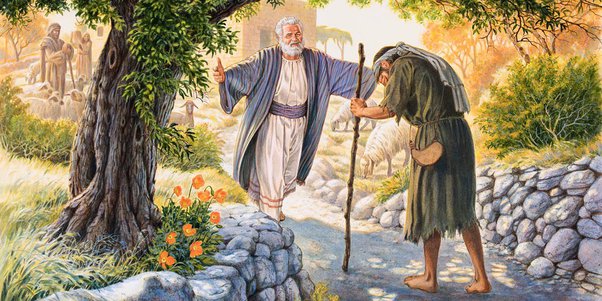
And then one day, the father looks out on that lonely road—the road that leads home—and sees a distant figure walking toward him.
Is it possible?
Though the individual is a great way off, the father knows in an instant it is his son.
He runs to him, throws his arms around him, and kisses him.
Elder Gerrit W Gong in October 2021 said:
‘My message today is, whether we are coming home or going home, God is coming to meet us. In Him we can find faith and courage, wisdom and discernment to trust again. Likewise, He asks us to keep the light on for each other, to be more forgiving and less judgmental of ourselves and each other, so His Church can be a place where we feel at home, whether we are coming for the first time or returning.’
“Father,” the son cries out, in words he must have rehearsed a thousand times, “I have sinned against both heaven and you. I am no longer worthy to be called your son. All I ask is that you take me in as a hired servant.”
But the father scarcely lets him finish. Tears in his eyes, he commands his servants: “Bring the finest robe in the house and place it on my son’s shoulders. Put a ring on his finger and sandals on his feet. Make a feast to celebrate. My son has returned!”
The parable shows us that God has extraordinary love and mercy for each of us. He longs to be with us and is joyful when we are close to him.
The Celebration
While almost everyone is overjoyed at the son’s return, one is not—his older brother.
He is carrying some emotional baggage.
He was there when his brother demanded his inheritance. He witnessed firsthand the massive weight of grief on his father.
Ever since his brother left, he has tried to lift his father’s burden. Every day, he has worked to restore his father’s broken heart.
And now the reckless child is back, and people can’t stop lavishing attention on his rebellious brother.
“All these years,” he tells his father, “never once have I refused to do a single thing you asked. Yet in all that time, you never celebrated me.”
The loving father responds, “Dear son, all that I have is yours! This is not about comparing rewards or celebrations. This is about healing. This is the moment we have been hoping for all these years. Your brother was dead and is alive again! He was lost but now he is found!”
Notice that the father also extends his mercy to the older son despite his attitude.
A Parable for Our Time
My beloved brothers and sisters, dear friends, like all of the Savior’s parables, this one is not just about people living long ago. It’s about you and me, today.
Who among us has not departed from the path of holiness, foolishly thinking we could find more happiness going our own self-centered way?
Who among us has not felt humbled, brokenhearted, and desperate for forgiveness and mercy?
Perhaps some may even have wondered, “Is it even possible to go back? Will I be labeled forever, rejected, and avoided by my former friends? Is it better to just stay lost? How will God react if I try to return?”
This parable gives us the answer.
Perhaps this is why this parable is so popular – it strikes a chord with so many of us.
Our Heavenly Father will run to us, His heart overflowing with love and compassion. He will embrace us; place a robe around our shoulders, a ring on our finger, and sandals on our feet; and proclaim, “Today we celebrate! For my child, who once was dead, has come back to life!”
Heaven will rejoice at our return.
Do you think the father treated the two sons in unfairly different ways? Does the elder son have a justified grievance?
Joy Unspeakable and Full of Glory
May I take a moment now and speak to you individually?
No matter what may have happened in your life, I echo and proclaim the words of my beloved friend and fellow Apostle Elder Jeffrey R. Holland: “It is not possible for you to sink lower than the infinite light of Christ’s [atoning sacrifice] shines.”
Though choices may have taken you far away from the Savior and His Church, the Master Healer stands at the road that leads home, welcoming you. And we as members of the Church of Jesus Christ seek to follow His example and embrace you as our brothers and sisters, as our friends. We rejoice and celebrate with you.
Your return will not diminish the blessings of others. For the Father’s bounty is infinite, and what is given to one does not in the slightest diminish the birthright of others.
What do you think “Your return will not diminish the blessings of others” means?
I do not pretend that coming back is an easy thing to do. I can testify of that. It may, in fact, be the toughest choice you will ever make.
But I bear witness that the moment you decide to return and walk in the way of our Savior and Redeemer, His power will enter your life and transform it.
What encouragement would you give to someone who wanted to return?
Angels in heaven will rejoice.
And so will we, your family in Christ. After all, we know what it’s like to be a prodigal. We all rely daily on the same atoning power of Christ. We know this path, and we will walk with you.
No, our path will not be free from grief, sorrow, or sadness. But we came this far “by the word of Christ with unshaken faith in him, relying wholly upon the merits of him who is mighty to save.” And together we will “press forward with a steadfastness in Christ, having a perfect brightness of hope, and a love of God and of all [people].” Together we will “rejoice with joy unspeakable and full of glory,” for Jesus Christ is our strength!
It is my prayer that each one of us may hear, in this profound parable, the Father’s voice calling us to enter the road that leads home—that we may have the courage to repent, receive forgiveness, and follow the path that leads back to our compassionate and merciful God. Of this I bear witness and leave you my blessing in the name of Jesus Christ, amen.
What will you take away from Elder Uchtdorf’s talk?
NB: All passages in italics are direct quotes from Elder Uchtdorf’s talk.
 Latter-day Bloke