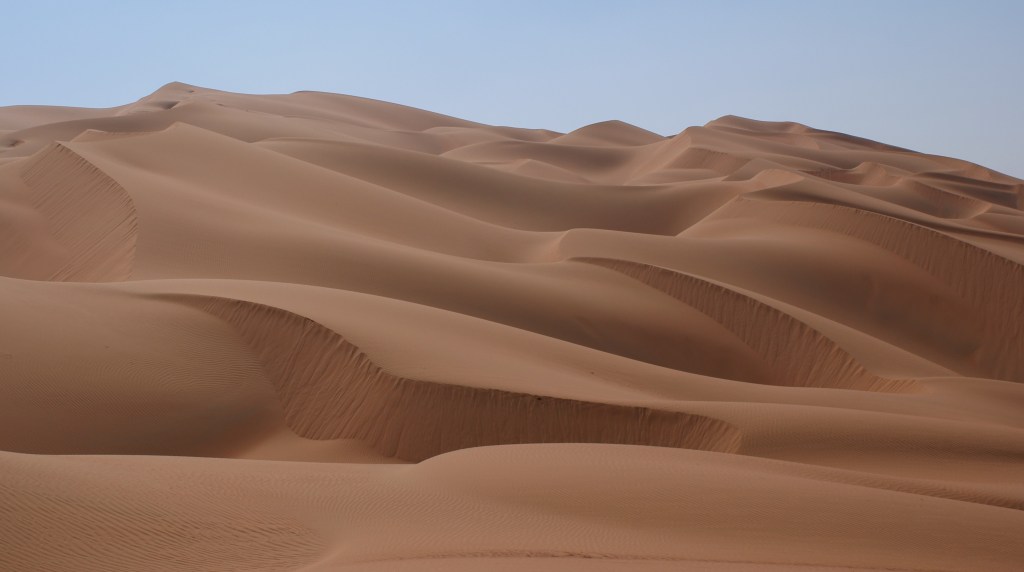
1 Nephi Chapter 17 verse 1 sees Lehi and his group ‘travel nearly eastward from that time forth.’ This would take them away from the established trade routes and across the Rub’ Al Khaki – Empty Quarter of Arabia. The Empty Quarter is a desert which is 1,000 kilometres (620 miles) long, and 500 kilometres (310 miles) wide.
The geography of this turn eastwards provides the explanatory background for the increased difficulties described in verses 1 and 6.
Verse 2 says that they lived on raw meat. This may not have been as disgusting as it sounds to us. Joseph L Allen in ‘Exploring the Lands of the Book of Mormon’ says that the Arabs today still eat an air dried spicy meat called ‘bastern’.
Lynn and Hope Hilton in ‘In Search of Lehi’s trail Part 2’ wrote:
“Nephi’s mention of eating “raw meat” (1 Ne. 17:2) intrigued—and repelled—us, so we were surprised to find ourselves eating it in Cairo when our friend Angie Chukri served us this local delicacy. It was not dripping with blood as we had imagined it, but spicy with garlic and other flavorings. It had been allowed to dry in the sun until it was dark brown on the outside. But it was pinkish-red on the inside and soft to chew, not tough like jerky. Garlic was the dominant flavor, of course, but it left a sweet taste that changed our impression of the hardship of eating raw meat. Later, we saw raw meat for sale in Egyptian, Jordanian, and Saudi Arabian markets; it was formed in large loaves like bologna and spiced much like the pieces served us by Angie. Of special interest to us was the name the Arabs gave it—basterma, meaning “raw meat”—suggesting that Nephi’s terminology was not merely descriptive but the proper name. Was this process, or something similar, the method the Lord showed Nephi to make their food “sweet” so that they would not need a fire in the perilous passage overland from the Red Sea coast to Bountiful?”
Verse 12 tells us that they did not make many fires while in this wilderness. The reason for that was to avoid attracting marauding raiders. In more well-travelled areas the making of a fire would not have presented a problem.
 Latter-day Bloke