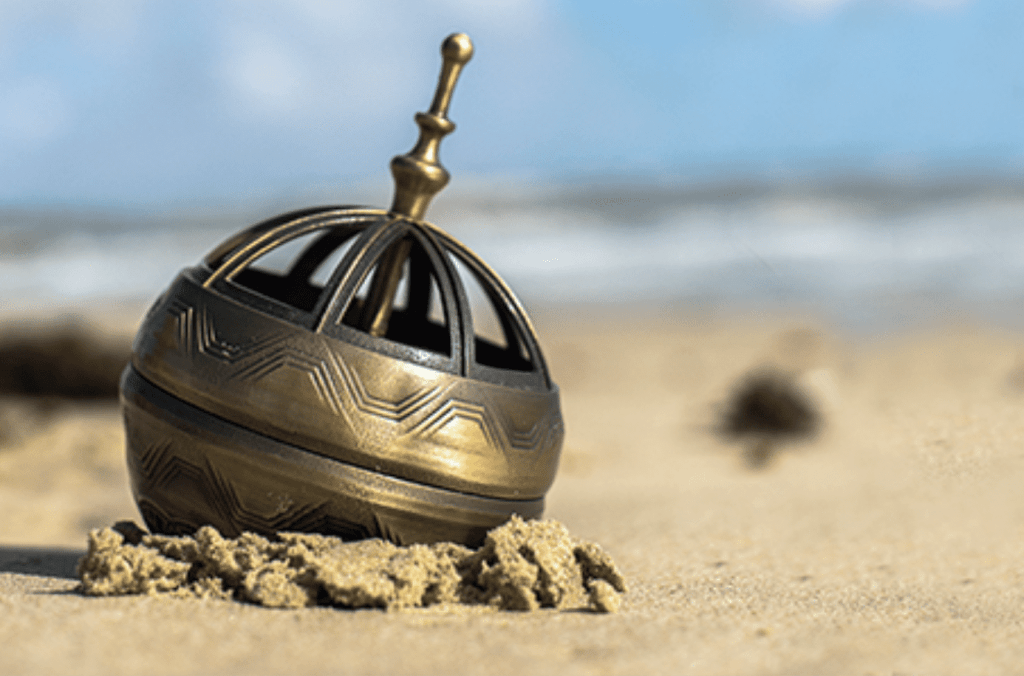
1 Nephi 16:10 tells us how Lehi discovered the Liahona at his tent door one morning. Actually, the name Liahona does not appear until Alma 37:38. 1 Nephi 16:10 doesn’t give it a name – it just describes it as ‘a round ball of curious workmanship and it was of fine brass.’
Webster’s 1828 dictionary includes as one of its definitions of the word ‘curious’ – “wrought with care and art, elegant, neat, finished.”
Alma 37:38 calls it a ‘ball, or director’, gives it the name Liahona ‘which is, being interpreted, a compass.’
When we think of the word compass we think of the geomagnetic device that points north and is used still today in navigation. However, the Oxford English Dictionary says that the noun “compass” can mean “a crafty contrivance or artifice.”
Hugh Nibley thought that Liyahhona might be translated “To God is the guidance” while Jonathan Curci suggested that the word means “the direction of the Lord”.
The Liahona is described a having two spindles one of which pointed the direction that they should travel. But what was the other spindle for? There seems to be two theories. The first is that the other spindle was, in fact, a compass. The argument for this is that after the Liahona had been received the Book of Mormon text gives some precise travel directions, for example in 1 Nephi 16 verse 13 we read that the group ‘traveled for the space of four days, nearly a south-southeast direction’ and 1 Nephi 17:1 ‘and we did travel nearly eastward from that time forth.’
If this is the case, then the Liahona operated similar to devices in modern aircraft which have both a compass and a direction indicator.
However, the existence of a magnetic compass could be anachronistic. As far as we currently know magnetic compasses were not invented until about 400 years after Lehi. Of course, the current knowledge about the invention of compasses may be wrong and God can do miracles!
Another theory is that the second spindle indicated whether the Liahona was functioning correctly. So, when the Lehites were faithful the second pointer would align with the directional spindle. When they were not faithful the second spindle would be crosswise to the directional spindle giving an immediate visible signal that the device was not working.
Next question – where did the Liahona come from? 1 Nephi 16:10 only tells us that Lehi found it at his tent door. In 2 Nephi 5:12 Nephi says that it ‘was prepared for my father by the hand of the Lord.’ Does that mean that God necessarily made it himself? Maybe. Maybe not. 1 Nephi 17:5 says that when the group reached Bountiful they named it Bountiful because of ‘its much fruit and also wild honey; and all these things were prepared of the Lord.’ So, the Lord can ‘prepare’ things without actually physically moulding them Himself.
Some scholars (“By Small Means”: Rethinking the Liahona by Timothy Gervais and John L Joyce) hypothesised that because the verses before the account of Lehi finding the Liahona (ie 1 Nephi 16:7-9) are about the marriage of Lehi’s sons to Ishmael’s daughters that the Liahona may have belonged to Ishmael and been a wedding dowry for Lehi.
These scholars also postulate that the Liahona may have actually been an astrolabe, or something similar. Astrolabes were ancient devices that used the position of the stars to provide navigational information. Astrolabes are believed to have existed from at least 650BC and possibly earlier.
However the Liahona was made and however it came into Lehi’s possession, it was the means by which Lehi and his party were directed through the wilderness and across the ocean to the Americas. It worked “according to the faith and diligence” (1 Nephi 16:28) with which they heeded its direction, and stopped working when the members of the party demonstrated a loss of faith in God’s commandments. The Lord will guide us through our mortal journey as we exercise faith and diligence and give heed to the Lord’s words.
 Latter-day Bloke