12:1
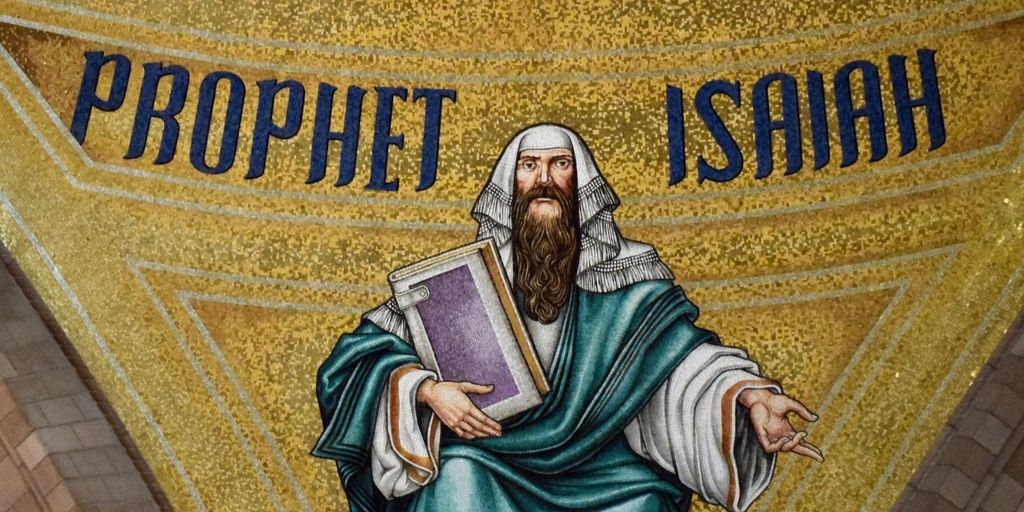
Isaiah was born about 770 BC. His name means ‘Jehovah Saves’ or ‘The Lord is Salvation’. Isaiah’s wife was called ‘The Prophetess’ and they had two sons: Shearjashub and Mahershalalhashbaz.
Verses 2-5 The Lord will judge among nations and bring peace.
12:2
Isaiah sees the latter-day temple and the gathering of Israel. The “mountain of the Lord” in the last dispensation refers to the restoration of the Church. President Harold B. Lee said: “The coming forth of his church in these days was the beginning of the fulfillment of the ancient prophecy when ‘the mountain of the Lord’s house shall be established in the top of the mountains’” (in Conference Report, Apr. 1973, p. 5). On another occasion President Lee observed that “with the coming of the pioneers to establish the Church in the tops of the mountains, our early leaders declared this to be the beginning of the fulfillment of that prophecy” (“The Way to Eternal Life,” Ensign, Nov. 1971, p. 15). (Old Testament Institute Manual)
12:3
Elder LeGrand Richards said: “How literally [Isaiah 2:3] has been fulfilled, in my way of thinking, in this very house of the God of Jacob right here on this block! This temple [Salt Lake], more than any other building of which we have any record, has brought people from every land to learn of his ways and walk in his paths.” (In Conference Report, Apr. 1971, p. 143.)
‘In the ever-increasing number of temples dotting the earth, we learn of Jesus Christ and His role in the Father’s plan as the Creator of this world, as our Savior and Redeemer, and as the source of our peace.’ Bishop W Christopher Waddell, General Conference, April 2016.
“Let us be a temple-attending people. Attend the temple as frequently as personal circumstances allow. Keep a picture of a temple in your home that your children may see it. Teach them about the purposes of the house of the Lord. Have them plan from their earliest years to go there and to remain worthy of that blessing.
“…As we become more removed from the lifestyle of the world, the Church becomes more the welcome refuge for hundreds of thousands who come each year and say, ‘Let us go up to the mountain of the Lord, to the house of the God of Jacob; and he will teach us of his ways, and we will walk in his paths: for out of Zion shall go forth the law, and the word of the Lord from Jerusalem’ (Isa. 2:3).” (Howard W Hunter, “Exceeding Great and Precious Promises,” Ensign, Nov. 1994, 8-9)
12:4
Isaiah sees the Millennial judgement and peace. They shall change the arts of war to those of peace; they shall abandon the pursuit of war for the useful arts of farming.
Isaiah now switches from the future back to his own time.
“There will be wicked men on the earth during the thousand years. The heathen nations who will not come up to worship will be visited with the judgments of God, and must eventually be destroyed from the earth.” (Teachings of the Prophet Joseph Smith, selected and arranged by Joseph Fielding Smith [Salt Lake City: Deseret Book Co., 1976], 268.)
12:5
The house of Jacob = the house of Israel.
An invitation for the house of Israel to obey the commandments of God.
“As you appropriately seek for and apply unto the spirit of revelation, I promise you will ‘walk in the light of the Lord.’ Sometimes the spirit of revelation will operate immediately and intensely, other times subtly and gradually, and often so delicately you may not even consciously recognise it. But regardless of the pattern whereby this blessing is received, the light it provides will illuminate and enlarge your soul, enlighten your understanding and direct and protect you and your family.” (David A Bednar, “The Spirit of Revelation”.
Verses 6-22 The Lord has forsaken His people, the house of Jacob, and they will be brought down.
12:6
They were “replenished from the east,” or in other words, they looked to the religious philosophies and the gods of the Assyrians and other heathen countries for power and sustenance and sought to follow after their evil practices. Today people look to many other religions and philosophies of men for wisdom and guidance instead of to the gospel.
They “hearken unto soothsayers”, those false prophets who claimed to be able to foretell the future. Today, true prophets are largely ignored, and all kinds of false religionists and counselors are looked to for guidance.
“They please themselves in the children of strangers” or, as C. F. Keil and F. Delitzsch translated the phrase, “and with the children of foreigners they go hand in hand” (Commentary on the Old Testament, 7:1:118). In short, ancient Israel was joining the heathen nations in all their wickedness, and modern society is joining with the influences of the world rather than looking to the Lord. (Institute Old Testament Manual)
Please = strike hand with or make covenants with.
12:7
The land was “full of silver and gold,” that is, the people were wealthy and materialistic. Their hearts were set on the things of the world. Again in the last days, materialism runs rampant.
Brigham Young said:
“The worst fear I have about this people is that they will get rich in this country, forget God and His people, wax fat, and kick themselves out of the Church and go to hell. This people will stand mobbing, robbing, poverty, and all manner of persecution, and be true. But my greater fear for them is that they cannot stand wealth; and yet they have to be tried with riches, for they will become the richest people on this earth.”
The land was “full of horses, neither is there any end of their chariots.” The horse was a symbol of warfare, as was the chariot.
12:8
“The land was filled with idolatry then, and people still turn to false gods today, though not necessarily to idols made of wood or stone.” (Institute Old Testament Manual)
12:9
“The “mean man boweth not down, and the great man humbleth himself not” (2 Nephi 12:9; emphasis added). The differences in the Book of Mormon account of Isaiah’s writings, noted by the italics, show that Isaiah was not making further reference to idolatry but was referring to the fact that men would not worship the true God. In the preface to the Doctrine and Covenants, the Lord indicated this failure would be a major concern of the last days. (see D&C 1:16.)
Because of her sins, ancient Israel brought upon herself the judgments of God, and because of the same problems the people of the last days will likewise bring sorrow and problems upon themselves. “(Institute Old Testament Manual)
Mean man = ordinary man
Verses 10-22 – Christ’s Second Coming
12:10
The prophet warns them to flee from danger. The people will not be able to stand the brightness of the Lord’s glory at the Second Coming.
12:11
The proud and the wicked shall be brought low at the Second Coming. Because they proudly trust in their own achievements, God will bring them low.
12:12
The Lord will inflict severe punishment upon every one that is lofty ie proud and arrogant.
12:13
“What Were the “Cedars of Lebanon” and the “Oaks of Bashan”? They were the loftiest and most impressive trees in the ancient Middle East. They therefore symbolized not only the great beauty of the land that would be destroyed but also the proud and lofty people of the earth (see Keil and Delitzsch, Commentary, 7:1:122–23).” (Old Testament Institute Manual).
The cedars can also represent the groves of trees in which idol worshippers participated in sexual immorality with temple prostitutes as part of their idolatrous worship.
12:14
High mountains and hills are not only objects of beauty or grandeur, but also places of defence and protection. It would be easy for the people to find refuge in such places when the land was invaded. However, the day of God’s vengeance will be upon the places of refuge and strength.
12:15
All their places of protection will be overturned.
12:16
“Trade with other nations would cease. Such trade had been established and had prospered during the reign of kings Uzziah and Jotham.” (Old Testament Institute Manual)
‘Pleasant pictures’ refers not just to paintings but to all luxurious ormnaments.
12:17
Their arrogant self confidence will not save them.
12:18
Their idols shall not save them.
12:19
They shall hide in caves and holes in the rock.
12:20
People will see the worthlessness of the things in which they have trusted, and will flee in a last desperate effort for safety when the day of God’s judgment comes.
12:21
Reiterates verse 19.
12:22
Don’t trust in man. He is of little power compared to God.
 Latter-day Bloke