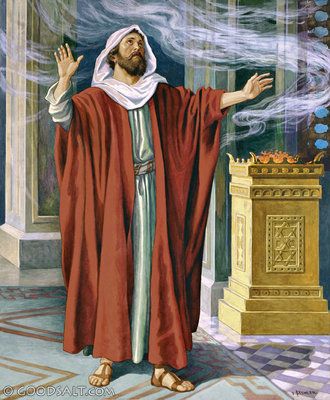
Verses 1-4 Vision of the Lord and the celestial realms
A vision of the celestial sphere would be difficult if not impossible to describe. That was the dilemma of the prophet Isaiah. He endeavored in these verses to portray something of the power and glory of his experience, using images and terms with which his readers could identify. Even then he sensed how much he fell short of communicating the reality of the experience. Later in his writing, Isaiah described the inadequacy of words and even of the senses of mortal man to comprehend heavenly things. He wrote: “For since the beginning of the world men have not heard, nor perceived by the ear, neither hath the eye seen, O God, beside thee, what he hath prepared for him that waiteth for him” (Isaiah 64:4). (Old Testament Institute Manual).
16.1
In the year King Uzziah died – about 740 BC.
The Lord = the premortal Jesus Christ.
The train = the hem of his garment or the skirts thereof
‘Earlier, Nephi had remarked that he, Jacob and Isaiah had all seen their redeemer (2 Nephi 11:2–3). Here we see that Isaiah was given the privilege of seeing the throne of God. This is a helpful scripture if one is faced with the common Christian doctrine that man cannot see the face of God. This is based on erroneous interpretations of the passage in John, ‘No man hath seen God at any time; the only begotten son, which is in the bosom of the Father, he hath declaredhim’ (Jn 1:18). The Joseph Smith translation makes a condition on this all exclusive statement, adding, ‘except he hath borne record of the Son.’ Later in John’s record we get another, less exclusive statement, ‘Not that any man hath seen the Father, save he which is of God, he hath seen the Father’ (Jn 6:46).
In the Old Testament, there is ample evidence that the righteous saw God. Seventy of the elders of Israel were privileged to see God, ‘And they saw the God of Israel: and there wasunder his feet as it were a paved work of sapphire stone, and as it were the body of heaven in his clearness’ (Ex 24:10). Moses spoke with the Lord, ‘face to face, as a man speaketh unto his friend’ (Ex 33:11). In this instance, it is apparent that Isaiah also was given the same privilege, ‘for mine eyes have seen the King’ (v. 5). Modern scripture helps us understand that this is only possible if one has become sufficiently purified and has exhibited sufficient faith. See DC 88:68, DC 93:1, and DC 97:16.’ (gospeldoctrine.com)
16.2
“Seraphs are angels who reside in the presence of God, giving continual glory, honor, and adoration to him. ‘Praise ye him, all his angels: praise ye him, all his hosts.’ (Ps. 148:2.) It is clear that seraphs include the unembodied spirits of pre-existence, for our Lord ‘looked upon the wide expanse of eternity, and all the seraphic hosts of heaven, before the world was made.’ (D. & C. 38:1.) Whether the name seraphs also applies to perfected and resurrected angels is not clear. While petitioning on behalf of the saints, the Prophet prayed that ‘we may mingle our voices with those bright, shining seraphs around thy throne, with acclamations of praise, singing Hosanna to God and the Lamb!’ (D. & C. 109:79.)
“In Hebrew the plural of seraph is seraphim or, as incorrectly recorded in the King James Version of the Bible, seraphims . Isaiah saw seraphim in vision and heard them cry one to another ‘Holy, holy, holy, is the Lord of hosts; the whole earth is full of his glory.’ ([JST], Isa. 6:1–8.) The fact that these holy beings were shown to him as having wings was simply to symbolize their ‘power, to move, to act, etc.’ as was the case also in visions others had received. (D. & C. 77:4.)” (Bruce R. McConkie, Mormon Doctrine, pp. 702–3.)
16.3
His glory not only appears in the heavens but through all the world, and therefore all creatures are bound to praise him.
16.4
The posts of the door moved = the foundations of the thresholds trembled.
Smoke is symbolic of the presence of God.
‘“The posts of the door moved … , and the house was filled with smoke” (2 Nephi 16:4). The shaking and the smoke are symbols of the presence of the Lord (see Revelation 15:8).’ (Institute Book of Mormon Student Manual)
16.5
Isaiah was not expecting to have this experience in the temple and became aware of his unworthiness.
Undone = cut off ie he was overwhelmed by the consciousness of the sins of himself and his people.
“I’ve been struck by the fact that when Isaiah received his charge from the Lord, he bemoaned that he was ‘a man of unclean lips’ (Isa. 6:5). This sin too had to be purged from Isaiah if he was to bear the word of the Lord….
“We need to eliminate from our conversations the immodest and the lewd, the violent and the threatening, the demeaning and the false.” (Robert S Wood, Ensign, Nov. 1999)
16.6
Live coal = a symbol of his cleansing. The altar is the altar of burnt offerings.
‘According to Hoyt Brewster, the “live coal” (2 Nephi 16:6) was a symbol of God’s cleansing power. Through its touch, Isaiah’s sins were “purged” and he was sanctified to perform God’s work… . The Hebrew word for “live coal” is ritzpah, translated as a “glowing (incandescent) stone.” (See Isaiah: Prophet, Seer, and Poet, 131) [ Hoyt W. Brewster, Jr., Isaiah Plain & Simple, p. 46]’ (Alan C Miner, Step by step through the Book of Mormon)
16.7
In verse 5 Isaiah had complained that he was a man of unclean lips. The lips are now symbolically cleansed. Note that the cleansing was accomplished by a coal from an altar of sacrifice – symbol of the atonement of Christ.
16.8
Now that he is cleansed, for the first time, Isaiah hears the word of God. Whom shall I send and who will go for us indicates that Jehovah sits in a council of Gods.
Here am I; send me – previously Isaiah had felt unworthy; now he has the confidence to go and represent the Lord.
2 Nephi 16:8 Whom shall I send?
‘At the moment of purification, Isaiah hears and responds to Yahweh’s call for a messenger. This scene is eerily similar to the Savior’s response to the premortal call for a redeemer: “And the Lord said: Whom shall I send? And one answered like unto the Son of Man: Here am I, send me. And another answered and said: Here am I, send me. And the Lord said: I will send the first” (Abr. 3:27).
Yahweh’s call is not a lack of knowledge about who his special messengers will be. Rather it is an affirmation of the principle of agency. Yahweh so fully respects agency that such calls are not commands but invitations. The prophet’s acceptance is his free-will offering of service.’ (Brant Gardner, Second Witness: Analytical and Contextual Commentary on the Book of Mormon)
Verses 9-13 Prophecy of the rejection of spiritual things
16.9
Note ‘this people’ not ‘my people’. They may hear and see but they will not understand.
16.10
The effect of truth is often to harden people’s hearts and make them more wicked. The truth must, nevertheless, be proclaimed.
16.11
The prophet wonders how long men will be so, and the Lord answers until mortal man is no more.
16.12
The men shall be taken to a distant land.
16.13
“This verse records the prophecy that the house of Israel would survive the coming devastation as does a tree that is stripped of its leaves in winter but still remains alive. “(Old Testament Institute Manual)
 Latter-day Bloke