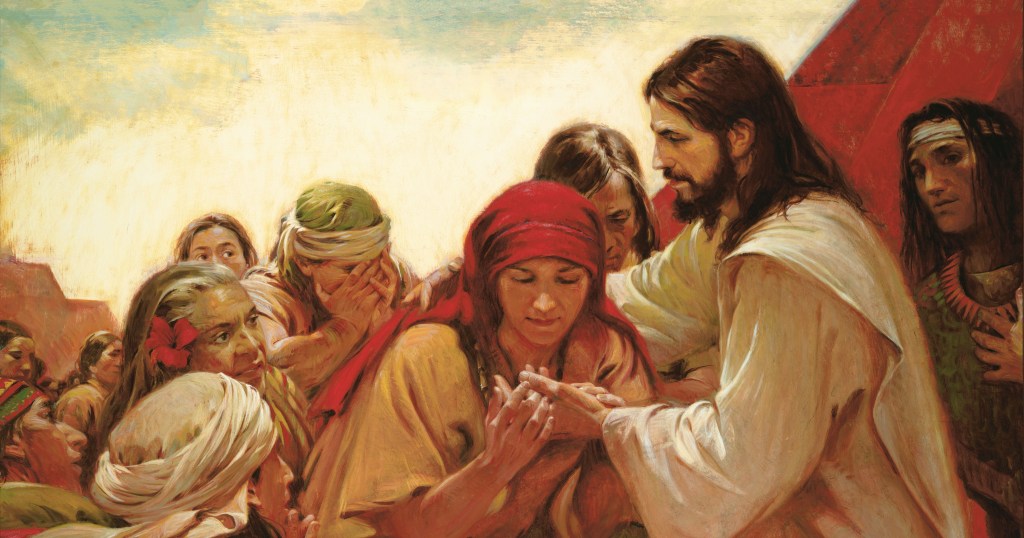
2 Nephi 26:1-2 After Christ shall have risen from the dead he shall show himself unto you.
‘Nephi is not only predicting Christ’s appearance to the Nephites but notes that, at that future time, the law that governs their lives will change. The Nephites will keep the law of Moses until that time. Nephi therefore explains clearly not only the person of the Christ, but also the meaning of Christ in fulfilling the law of Moses. He looks forward to the day when the Messiah will provide a new law. It is interesting that it will be “the law which ye shall do.” Nephi expects that one must act according to the law. Now his people act under and according to the law of Moses. After the Messiah comes, they will act under and according to Christ’s law.’ (Brant Gardner, Second Witness: Analytical and Contextual Commentary on the Book of Mormon)
2 Nephi 26:11 For the Spirit will not always strive with man
“When the Spirit of the Lord is withdrawn…darkness, like the blackness of night surges through the soul of man, and the sun of righteousness seems set for him, he is then made to feel what it means to sin against the law of God as it has been revealed unto his soul. When you think of the bitterness of that personal suffering, you will not marvel that when the heavy burden of a world’s sin rested down upon the Son of God in Gethsemane–you certainly will not marvel that he sweat great drops of blood in his agony; nor wonder at his suffering on the cross.” (BH Roberts, Defense of the Faith and the Saints, p. 514)
2 Nephi 26:22 He leadeth them by the neck by a flaxen cord
“The first wrongdoing is like a single strand of flaxen thread; it is easily broken and thrown aside. But each time the wrong is repeated another strand is intertwined around the first, and on and on it goes until an almost unbreakable cord of multi-strands is woven. ‘The chains of habit,’ said Samuel Johnson, ‘are too small to be felt until they are too strong to be broken.’” (Carlos E Asay, The Road to Somewhere: A Guide for Young Men and Women [Salt Lake City: Bookcraft, 1994], 94.)”
“We are children of God with a majestic destiny. We can be changed to become like Him and have “a fulness of joy.”[ Doctrine and Covenants 93:33] Satan, on the other hand, would have us be miserable like he is.[See 2 Nephi 2:18] We have the ability to choose whom we follow.[See 2 Nephi 2:27] When we follow Satan, we give him power.[See 2 Nephi 26:22 28:22 Mosiah 16:5 Alma 34:39 3 Nephi 7:5 Doctrine and Covenants 29:40] When we follow God, He gives us power.” (Elder Paul V Johnson, General Conference, October 2022)
2 Nephi 26:25 Without money and without price
‘When earth life is over and things appear in their true perspective, we shall more clearly see and realize what the Lord and his prophets have repeatedly told us, that the fruits of the gospel are the only objectives worthy of life’s full efforts. Their possessor obtains true wealth-wealth in the Lord’s view of values….
‘I conceive the blessings of the gospel to be of such inestimable worth that the price for them must be very exacting, and if I correctly understand what the Lord has said on the subject, it is. The price, however, is within the reach of us all, because it is not to be paid in money nor in any of this world’s goods but in righteous living. What is required is whole hearted devotion to the gospel and unreserved allegiance to the Church of Jesus Christ of Latter-day saints….A half-hearted performance is not enough.’” (Marion G Romney, Conference Report, Oct. 1949)
2 Nephi 26:29 Priestcrafts
“Focusing on the needs of the students, a gospel teacher will never obscure their view of the Master by standing in the way or by shadowing the lesson with self-promotion or self-interest. This means that a gospel teacher must never indulge in priestcrafts, which are ‘that men preach and set themselves up for a light unto the world, that they may get gain and praise of the world’ (2 Ne 26:29. A gospel teacher does not preach ‘to become popular’ (Alma 1:3) or ‘for the sake of riches and honor’ (Alma 1:16). He or she follows the marvelous Book of Mormon example in which ‘the preacher was no better than the hearer, neither was the teacher any better than the learner’ (Alma 1:26). Both will always look to the Master.” (Dallin H Oaks, Conference Report, Oct. 1999)
2 Nephi 26:30 The Lord hath forbidden this thing
‘Nephi states strongly that Yahweh has “forbidden this thing,” by which he means the exclusion generated by priestcraft. The reference reaches past the word’s limited meaning (priestcraft as a profession) to its effects (excluding people from the gospel). In contrast, Nephi explains what Yahweh does want—charity, or love. Obeying this commandment eradicates any attitude or behavior that would lead to exclusion. Love is perforce inclusive.’ (Brant Gardner, Second Witness: Analytical and Contextual Commentary on the Book of Mormon)
2 Nephi 26:31 The laborer in Zion shall labor for Zion
‘Nephi declares that the motivation for preaching the gospel must be for the love of the Father’s children. God’s servants are those who go forth in a spirit of charity. Nephi says that those who labor for money shall perish.’ (Cleon Skousen, Treasures from the Book of Mormon)
2 Nephi 26:33 He inviteth them all to come unto him
My dear friends, I can assure you that the light of a new day shines brighter in our lives when we see and treat our fellow beings with respect and dignity and as true brothers and sisters in Christ.
During His earthly ministry, Jesus so perfectly exemplified this principle as He “went about doing good”[ Acts 10:38] unto all people, inviting them to come unto Him and partake of His goodness regardless of their origin, social class, or cultural characteristics. He ministered, healed, and was always attentive to everyone’s needs, especially those who at the time were considered different, belittled, or excluded. He denied none but treated them with equity and love, for He saw them as His brothers and sisters, sons and daughters of the same Father. (Elder Ulisses Soares, General Conference, October 2023)
 Latter-day Bloke