“Note that the main story in the book of Mosiah is told in the third person rather than in the first person as was the custom in the earlier books of the Book of Mormon. The reason for this is that someone else is now telling the story, and that “someone else” is Mormon. With the beginning of the book of Mosiah we start our study of Mormon’s abridgment of various books that had been written on the large plates of Nephi. (3 Nephi 5:8-12.) The book of Mosiah and the five books that follow — Alma, Helaman, 3 Nephi, 4 Nephi, and Mormon — were all abridged or condensed by Mormon from the large plates of Nephi, and these abridged versions were written by Mormon on the plates that bear his name, the plates of Mormon. These are the same plates that were given to Joseph Smith by the angel Moroni.” (Daniel Ludlow, A Companion to Your Study of the Book of Mormon, p.173)
When the Book of Mosiah opens the descendants of Nephi have provided two generations of successful kings to a population consisting of a majority of Mulekites (the people of Zarahemla) and a number of Nephites. The two groups have maintained separate ethnic identities but Benjamin regards them all as his subjects.
Mosiah 1:10 And the people of Mosiah who dwell in the land
Suggests that the people of Mosiah are still regarded as incomers and a minority people.
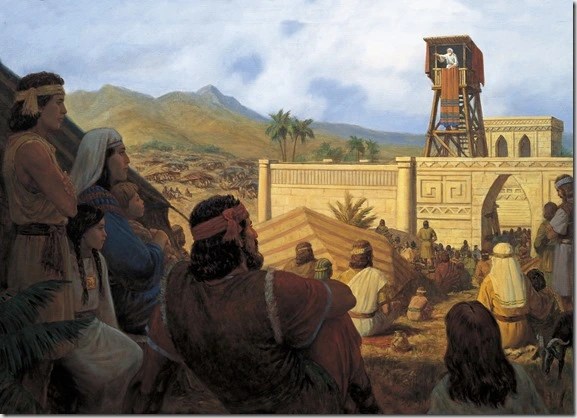
Mosiah 2:5-6 And they pitched their tents round about the temple
‘I love the imagery of these verses. Figuratively speaking, brethren, are the doors of our homes pitched towards the temples we so love? Do we attend as often as we can, showing our children through our example the importance of these sacred and special places?
As recorded in Mosiah, families received the word of the Lord through their prophet with enthusiasm and commitment. The people were so moved by King Benjamin’s teachings that they entered into a new covenant to follow the Lord Jesus Christ.’ (Ronald A Rasband, General Conference, April 2006)
Mosiah 2:9 Open your ears that you may hear
‘This admonition to open our ears to listen does not always receive the same response. While some people indicate a willingness to listen attentively and to be obedient to the words of the Lord, others seem to close their ears, not wanting to hear nor to obey. There are others who are slow to hear but who eventually do listen and become obedient. For all of these people, the result of their attitudes concerning the voice of the Lord will bring into their lives consequences which, in many instances, may be of an eternal nature.’ (Francisco J Vinas, General Conference, October 1996)
Mosiah 2:17 Service
“When we understand why we serve we will not worry about where we serve.” (Howard W Hunter, BYU Devotional, Sept. 2, 1990)
Mosiah 3:7 Blood cometh from every pore
“Note 6. The Bloody Sweat. — Luke, the only Gospel-writer who mentions sweat and blood in connection with our Lord’s agony in Gethsemane, states that ‘his sweat was as it were great drops of blood falling down to the ground’ (22:44). Many critical expositors deny that there was an actual extrusion of blood, on the grounds that the evangelist does not positively affirm it, and that the three apostles, who were the only human witnesses, could not have distinguished blood from sweat falling in drops, as they watched from a distance in the night, even if the moon, which at the passover season was full, had been unobscured. Modern scripture removes all doubt. See D&C 19:16-19, also 18:11. See further a specific prediction of the bloody sweat, Mosiah 3:7.” (James E Talmage, Jesus the Christ, pp. 613-4, 620)
Mosiah 3:10 The resurrection of Christ
‘The detail that Jesus would rise on the third day is new in Benjamin’s speech although both Jesus’s resurrection (2 Ne. 26:1) and his role as a judge were already known (1 Ne. 13:33, 22:21; 2 Ne. 9:15; etc).’ (Brant Gardner, Second Witness: Analytical and Contextual Commentary on the Book of Mormon)
Mosiah 3:19 The natural man
“One of the most disputed issues among so-called Christian theologians has been the question of the basic nature of man. Some of these theologians have argued that man is born evil into this world as an infant; thus the only way this evil can be removed is by receiving the sacrament of baptism. Still other theologians have argued that man is born innocent and remains basically good; some of them thus conclude that inasmuch as man is basically good he has no need for a redeemer to atone for his sins.
“It should be clear to students of the Book of Mormon that the prophets definitely reject both the doctrine of the natural depravity of man and the doctrine that man is so good by nature he has no need for a redeemer. Benjamin, the prophet and king of the Nephites, said that ‘an angel from God’ taught him that although infants are born in a state of innocence, after they become accountable they can become enemies to God if they do not accept the saving principles and ordinances of the gospel.” (Daniel Ludlow, A Companion to Your Study of the Book of Mormon, pp. 177-8)
 Latter-day Bloke