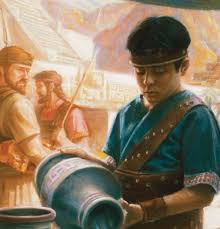
Mormon 1:2 I perceive that thou art a sober child
“We know that ‘every man who has a calling to minister to the inhabitants of the world was ordained to that very purpose’ in his premortal existence. (Teachings of the Prophet Joseph Smith, p. 365.) Perhaps that call has an effect on those men even in their earliest mortal years, for Mormon was recognized by his predecessor Ammaron as being ‘a sober child’ and one ‘quick to observe.’ (Morm. 1:2.)” (Jeffrey R Holland, Ensign, Mar. 1978, “Mormon: The Man & The Book”)
Mormon 1:16 I did endeavour to preach unto this people
“The maturing Mormon, by then fifteen years of age, stood beyond the sinfulness around him and rose above the despair of his time. Consequently, he ’was visited of the Lord, and tasted and knew of the goodness of Jesus,’ trying valiantly to preach to his people. But as God occasionally does when those with so much light reject it, Mormon literally had his mouth shut. He was forbidden to preach to a nation that had wilfully rebelled against their God. These people had rejected the miracles and messages delivered them by the three translated Nephite disciples, who had now also been silenced in their ministry and been taken from the nation to whom they had been sent.
“Remaining among those people but silenced in his testimony.” (Jeffrey R Holland,Christ And The New Covenant, p. 318)
Mormon 2:13 Sorrowing of the damned
“After recognition, real remorse floods the soul. This is a ‘godly sorrow,’ not merely the ‘sorrow of the world’ nor the ‘sorrowing of the damned’ when we can no longer ‘take happiness in sin’ (2 Corinthians 7:10;Mormon 2:13). False remorse instead is like fondling our failings. In ritual regret, we mourn our mistakes but without mending them” (Neal A Maxwell, in Conference Report, Oct. 1991).
Mormon 2:19 I know that I shall be lifted up at the last day
‘Those members of the Church who devote themselves wholly to righteousness, living by every word that proceedeth forth from the mouth of God, make their calling and election sure. That is, they receive the more sure word of prophecy, which means that the Lord seals their exaltation upon them while they are yet in this life…
..The more sure word of prophecy means a man’s knowing that he is sealed up unto eternal life, by revelation and the spirit of prophecy through the power of the Holy Priesthood.’ (D. & C. 131:5.)…The prophet, for one, had this seal placed upon him…To him Deity said: ‘I am the Lord thy God, and will be with thee even unto the end of the world, and through all eternity; for verily I seal upon you your exaltation, and prepare a throne for you in the kingdom of my Father with Abraham your father.’ (D. & C. 132:49.)’ (Bruce R. McConkie, Mormon Doctrine, pp. 109-110)”
Mormon 3:3 The Lord granted unto them a chance for repentance
‘Agency is a tremendous tool, allowing our souls to be re-formed in God’s image. When agency is coupled with humility, we can turn our life experiences into divine understanding. This process absolutely requires repentance. Repentance is the mechanism that turns experience into expansion—that alters the sin from barrier to springboard. But using agency to refuse to repent or continue to make negative choices can have the exact opposite effect spiritually.
The Nephites’ sin was a barrier, not only to their spiritual progress, but also to their very existence. Rather than humbly turning to their God, they refused to hear him. They believed in defenses of earth and wood rather than the defense offered by Yahweh’s infinite power. Of this sad human tendency, Nephi lamented: “Cursed is he that putteth his trust in man, or maketh flesh his arm, or shall hearken unto the precepts of men, save their precepts shall be given by the power of the Holy Ghost” (2 Ne. 28:31).’ (Brant Gardner, Second Witness)
Mormon 3:12 Notwithstanding their wickedness I had led them many times to battle
‘Mormon’s decision does not affect his love for his people. In spite of their imprudent actions and decisions, he still loves them and sorrows for the actions that would lead them to destruction. Many parents have similar feelings for their children, without the ability to resign their particular commission.’ (Brant Gardner, Second Witness)
Mormon 3:15 Vengeance is mine
“…men are not called upon to curse mankind; that is not our mission; it is our mission to preach righteousness to them. It is our business to love and to bless them, and to redeem them from the fall and from the wickedness of the world. This is our mission and our special calling. God will curse and will exercise his judgment in those matters. ‘Vengeance is mine,’ saith the Lord, ‘and I will repay.’ We are perfectly willing to leave vengeance in the hands of God and let him judge between us and our enemies, and let him reward them according to his own wisdom and mercy.” (Joseph F Smith, Conference Report, Oct. 1904, p. 5)
Mormon 4:5 It is by the wicked that the wicked are punished
“Of one thing I am sure, God never institutes war; God is not the author of confusion or of war; they are the results of the acts of the children of men. Confusion and war necessarily come as the results of the foolish acts and policy of men; but they do not come because God desires they should come. If the people, generally, would turn to the Lord, there would never be any war. Let men turn from their iniquities and sins, and instead of being covetous and wicked, turn to God and seek to promote peace and happiness throughout the land, and wars would cease. We expect to see the day when swords shall be turned into ploughshares, spears into pruning hooks, and when men shall learn war no more. This is what we want. We are for peace, plenty and happiness to all the human family.” (Discourses of Brigham Young, pp. 366-367.)
Mormon 5:1-2 Never cease to labour
‘In this crucible of wickedness the true greatness of Mormon shines like a star as he calls his son to action, telling him that no matter how bad things are, we must never stop trying to do what we can to improve matters, ‘for if we should cease to labor, we should be brought under condemnation; for we have a labor to perform whilst in this tabernacle of clay.’ (Moroni 9:6.) In this spirit Mormon took over command of the army even when he knew that all was lost, ‘… for they looked upon me as though I could deliver them from their afflictions. But behold, I was without hope… .’ (Mormon 5:1.)
His is the predicament of the true tragic hero: ‘… I had led them notwithstanding their wickedness … and had loved them … with all my heart; and my soul had been poured out in prayer unto my God all the day long for them; nevertheless, it was without faith, because of the hardness of their hearts.’ (Mormon 3:12.) However it might appeal to our own age of violence, Mormon found little consolation in the fact that his people were wonderfully tough and proud of it—‘for so exceedingly do they anger that it seemeth to me that they have no fear of death.’ (Moroni 9:5.) ‘… they repented not of their iniquities, but did struggle for their lives without calling upon that Being who created them.’ (Mormon 5:2.) They could take care of themselves, thank you—and they did. ‘ (Hugh Nibley, Since Cumorah: The Book of Mormon in the Modern World, pp. 437–38)
Mormon 5:10 The Gentiles who have care for the house of Israel
“A loving father does not despise his children. These [Lamanites] are a chosen people, and this Church has an important part in restoring them to their rightful inheritance. The chasm between what they are and what they will be is opportunity. The gospel furnishes that opportunity; it is ours to give.” (Spencer W Kimball, Ensign, Dec. 1975)
Mormon 6:16-22 Don’t reject the open arms of Christ
“We long for the ultimate blessing of the Atonement—to become one with Him, to be in His divine presence, to be called individually by name as He warmly welcomes us home with a radiant smile, beckoning us with open arms to be enfolded in His boundless love. How gloriously sublime this experience will be if we can feel worthy enough to be in His presence! The free gift of His great atoning sacrifice for each of us is the only way we can be exalted enough to stand before Him and see Him face-to-face. The overwhelming message of the Atonement is the perfect love the Savior has for each and all of us. It is a love which is full of mercy, patience, grace, equity, long-suffering, and, above all, forgiving.
“The evil influence of Satan would destroy any hope we have in overcoming our mistakes. He would have us feel that we are lost and that there is no hope. In contrast, Jesus reaches down to us to lift us up. Through our repentance and the gift of the Atonement, we can prepare to be worthy to stand in His presence” (James E Faust, in Conference Report, Oct. 2001).
 Latter-day Bloke