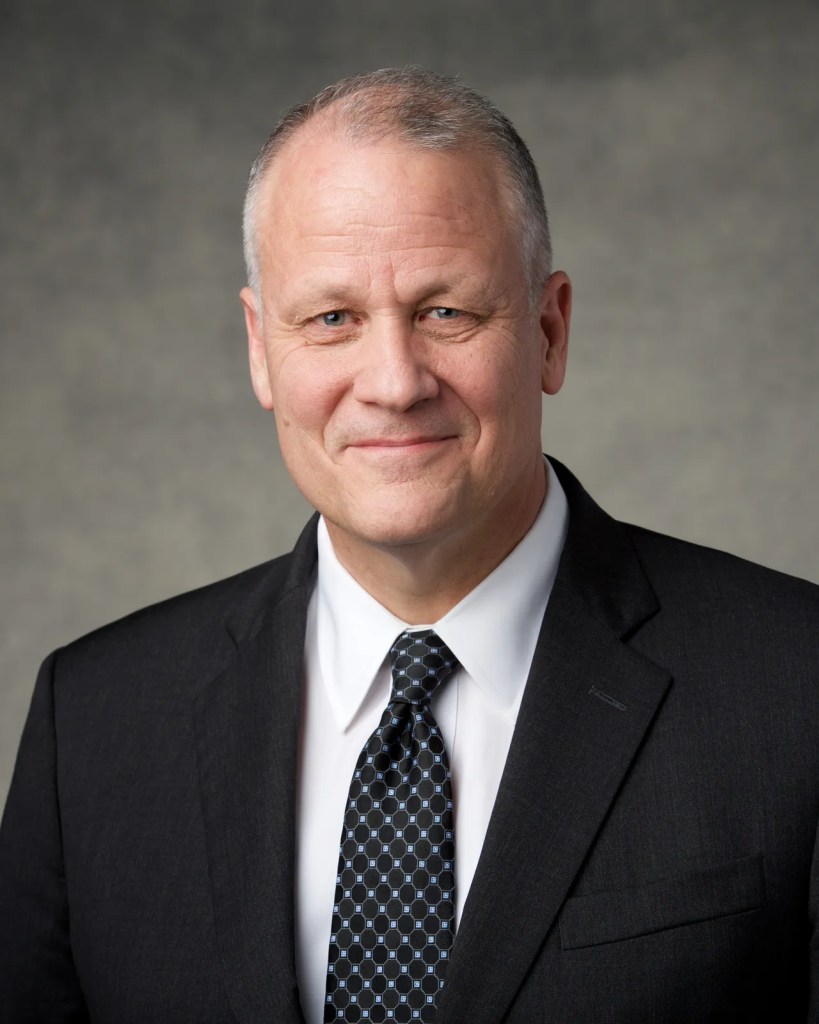
Elder Homer Bio:
Elder David P. Homer was sustained as a General Authority Seventy of The Church of Jesus Christ of Latter-day Saints on March 31, 2018. At the time of his call, he had been serving as a member of the Third Quorum of the Seventy in the Europe Area. He previously served as a member of the Sixth Quorum of the Seventy in the North America Northeast Area from 2013 to 2014. He currently serves as a member of the Seventy with assignments at Church headquarters in Salt Lake City.
Elder Homer has served in a number of Church callings, including full-time missionary in the China Hong Kong Mission, bishop, stake president, and regional welfare chairman.
Elder Homer received a bachelor of science degree in economics from the University of Utah in 1985. In 1987 he received a master’s degree in business administration from the University of Pennsylvania. For 31 years he worked at General Mills, Inc., including assignments in the United States, Latin America, Australasia, Canada, and Europe. When he retired, he was CEO of Cereal Partners Worldwide, a global joint venture between General Mills and Nestlé S.A.
On June 1, 1843, Addison Pratt left Nauvoo, Illinois, to preach the gospel in the Hawaiian Islands, leaving his wife, Louisa Barnes Pratt, to care for their young family.
In Nauvoo, as persecutions intensified, forcing the Saints to leave, and later at Winter Quarters as they prepared to migrate to the Salt Lake Valley, Louisa faced the decision of whether to make the journey. It would have been easier to stay and to wait for Addison to return than to travel alone.
On both occasions, she sought guidance from the prophet, Brigham Young, who encouraged her to go. Despite the great difficulty and her personal reluctance, she successfully made the journey each time.
Initially, Louisa found little joy in traveling. However, she soon began to welcome the green prairie grass, colorful wildflowers, and patches of ground along the riverbanks. “The gloom on my mind wore gradually away,” she recorded, “and there was not a more mirthful woman in the whole company.”
Louisa’s story has deeply inspired me. I admire her willingness to set aside her personal preferences, her ability to trust God, and how exercising her faith helped her to see the situation differently.
What inspiration do you draw from Louisa’s story?
She has reminded me that we have a loving Father in Heaven, who cares for us wherever we are, and that we can trust Him more than anyone or anything else.
In the footnotes to his talk, Elder Homer writes:
‘After all, He is our Father. He loves us. And, as Elder Patrick Kearon taught, “[He] is in relentless pursuit of [us]. He ‘wants all of His children to choose to return to Him’ [General Handbook: Serving in The Church of Jesus Christ of Latter-day Saints, 1.1, Gospel Library], and He employs every possible measure to bring [us] back” (“God’s Intent Is to Bring You Home,” Liahona, May 2024, 87).’
‘God is in relentless pursuit of you.’ Isn’t that a wonderful phrase? What images does that phrase convey to you?
The Source of Truth
God trusts us to make many important decisions, and in all matters He asks us to trust Him. This is especially difficult when our judgment or public opinion differs from His will for His children.
Some suggest that we should redraw the lines between what is right and what is wrong because they say that truth is relative, reality is self-defined, or God is so generous that He does not actually care about what we do.
As we seek to understand and accept God’s will, it is helpful to remember that the boundaries between right and wrong are not for us to define. God has established these boundaries Himself, based on eternal truths for our benefit and blessing.
This is often called the information age. We have more information at our fingertips than at any other time in the history of the world but not all information has the same value, and much information that is not true. In a world filled with conflicting opinions, ideologies, and information overload, it can be challenging to discern truth from falsehood.
The good news is that we can turn to our Heavenly Father in prayer and ask for guidance and clarity.
Dieter F Uchtdorf said: ‘There is one source of truth that is complete, correct, and incorruptible. That source is our infinitely wise and all-knowing Heavenly Father.’
Through sincere and humble prayer, we can receive personal revelation that will help us discern truth from error. desire to change God’s eternal truth has a long history.
It started before the world began, when Satan rebelled against God’s plan, seeking selfishly to destroy human agency. Following this pattern, people like Sherem, Nehor, and Korihor have argued that faith is foolish, revelation is irrelevant, and whatever we want to do is right. Sadly, so very often these deviations from God’s truth have led to great sorrow.
We meet Sherem in Jacob Chapter 7. He taught that faith is not in accordance with the Law of Moses, that he Nephites were introducing a new God and that belief in Christ is based on unreliable prophecy. These beliefs were brought to the New World by Laman and Lemuel in contrast to the belief on Christ and His atonement which was brought by Lehi and Nephi. Nehor crops up in Alma Chapter 1. He taught that all mankind will be saved and all will receive eternal life. We can read about Korihor in Alma 13-18, 23-28. Korihor makes several claims: 1. Prophecy is impossible. 2. Knowledge only comes through the senses. 3. Our mental state is affected by tradition which affects our judgement. 4. There are no supernatural forces that reward or punish. 5. The intelligent and the strong succeed. 6. Individuals are justified in acting in their own self interest. 7. There is no life after death and no accountability.
Do any of these teachings sound familiar?
While some things may depend on context, not everything does. President Russell M. Nelson has consistently taught that God’s saving truths are absolute, independent, and defined by God Himself.
Our Choice
Whom we choose to trust is one of life’s important decisions. King Benjamin instructed his people, “Believe in God; believe that he is … ; believe that he has all wisdom … ; believe that man doth not comprehend all the things which the Lord can comprehend.”
What constitutes a belief in God?
In Mosiah 4:9-10 King Benjamin invites his people to believe in 7 truths about God and then to match their actions to those beliefs.
Fortunately, we have the scriptures and guidance from living prophets to help us understand God’s truth. If clarification beyond what we have is needed, God provides it through His prophets. And He will respond to our sincere prayers through the Holy Ghost as we seek to understand truths we do not yet fully appreciate.
Elder Neil L. Andersen once taught that we should not be surprised “if at times [our] personal views are not initially in harmony with the teachings of the Lord’s prophet. These are moments of learning,” he said, “of humility, when we go to our knees in prayer. We walk forward in faith, trusting in God, knowing that with time we will receive more spiritual clarity from our Heavenly Father.”
We are blessed with living prophets and apostles who receive revelation and guidance for our day. Their teachings and counsel can help us navigate the challenges and confusion of the world. By studying their words and following their guidance, we can find truth and direction in our lives. These inspired leaders are a source of wisdom and clarity amidst the noise and confusion of the world.
At all times, it is helpful to remember Alma’s teaching that God gives His word according to the attention and effort we devote to it. If we heed God’s word, we will receive more; if we ignore His counsel, we will receive less and less until we have none.
Grant Hardy writes in the Annotated Book of Mormon with reference to Alma 12:9-11: ‘God’s granting of revelation, either directly or through his representatives, varies with the receptivity of listeners. Hardened hearts lead to ignorance, then to spiritual captivity and destruction.’
This loss of knowledge does not mean that the truth was wrong; rather, it shows that we have lost the capacity to understand it.
Look to the Savior
In Capernaum, the Savior taught about His identity and mission. Many found His words difficult to hear, leading them to turn their backs and “[walk] no more with him.”
Why did they walk away?
Because they did not like what He said. So, trusting their own judgment, they walked away, denying themselves blessings that would have come had they stayed.
Why do some people walk away from the Lord and his Church today?
It is easy for our pride to come between us and eternal truth. When we don’t understand, we can pause, let our feelings settle, and then choose how to respond. The Savior urged us to “look unto [Him] in every thought; doubt not, fear not.” When we focus on the Savior, our faith can start to overcome our concerns.
As President Dieter F. Uchtdorf encouraged us to do: “Please, first doubt your doubts before you doubt your faith. We must never allow doubt to hold us prisoner and keep us from the divine love, peace, and gifts that come through faith in the Lord Jesus Christ.”
What does doubt your doubts mean?
Blessings Come to Those Who Stay
As the disciples walked away from the Savior that day, He then asked the Twelve, “Will ye also go away?”
Peter answered:
“Lord, to whom shall we go? thou hast the words of eternal life.
“And we believe and are sure that thou art that Christ, the Son of the living God.”
Now, the Apostles lived in the same world, and they faced the same social pressures as the disciples who walked away. However, in this moment, they chose their faith and trusted God, thus preserving blessings God gives to those who stay.
Perhaps you, like me, sometimes find yourself on both sides of this decision. When we find it difficult to understand or embrace God’s will, it is comforting to remember that He loves us as we are, wherever we are. And He has something better for us. If we reach out to Him, He will assist us.
What can we do when we find it difficult to understand or embrace God’s will?
While reaching out to Him can be difficult, just as the father who sought healing for his son was told by the Savior, “All things are possible to him that believeth.” In our moments of struggle, we too can cry out, “Help thou [my] unbelief.”
Submitting Our Will to His
Elder Neal A. Maxwell once taught that “the submission of one’s will is really the only uniquely personal thing we have to place on God’s altar.” No wonder King Benjamin was so eager that his people become “as a child, submissive, meek, humble, patient, full of love, willing to submit to all things which the Lord seeth fit to inflict upon him, even as a child doth submit to his father.”
As always, the Savior set the perfect example for us. With a heavy heart, and knowing the painful work He had to do, He submitted to His Father’s will, fulfilling His messianic mission and opening the promise of eternity to you and me.
The choice to submit our will to God’s is an act of faith that lies at the heart of our discipleship. In making that choice, we discover that our agency is not diminished; rather, it is magnified and rewarded by the presence of the Holy Ghost, who brings purpose, joy, peace, and hope we can find nowhere else.
How does submitting our will to God’s magnify our agency?
Several months ago, a stake president and I visited a sister in his stake and her young adult son. After years away from the Church, wandering difficult and unfriendly paths, she had returned. During our visit, we asked her why she had come back.
“I had made a mess of my life,” she said, “and I knew where I needed to be.”
I then asked her what she had learned in her journey.
With some emotion, she shared that she had learned that she needed to attend church long enough to break the habit of not coming and that she needed to stay until it was where she wanted to be. Her return was not easy, but as she exercised faith in the Father’s plan, she felt the Spirit return.
And then she added, “I have learned for myself that God is good and that His ways are better than mine.”
I bear witness of God, our Eternal Father, who loves us; of His Son, Jesus Christ, who saved us. They know our hurts and challenges. They will never forsake us and know perfectly how to succor us. We can be of good cheer as we trust Them more than anyone or anything else. In the sacred name of Jesus Christ, amen.
NB: Passages in italics are direct quotes from Elder Homer’s talk.
You can watch Elder Homer’s talk here.
If this post has been helpful in any way, please leave a ‘like’ or a comment. Thank you!
 Latter-day Bloke