Ether 12:4 Hope
“The concept of hope plays a vital role in Latter-day Saint thought. Firmly centered in Christ and his resurrection, it is the ‘hope of eternal life’ (Titus 1:2) repeatedly alluded to by Paul. It is the opposite of the despair found among those who are ‘without Christ, having no hope, and without God in the world’ (Eph. 2:12). As the Book of Mormon prophet Moroni writes, ‘If ye have no hope, ye must needs be in despair’ (Moro. 10:22). For those, however, who accept Christ’s Atonement and resurrection, there comes a ‘brightness of hope’ (2 Ne. 31:20) through which all who believe in God ‘might with surety hope for a better world’ (Ether 12:4).” (James K. Lyon in Encyclopedia of Mormonism, p. 656)
Ether 12:6 The trial of your faith
“Thus there ought to be expectations that in this laboratory of life we will actually see each other in the process of being remodeled, sometimes succeeding and sometimes failing. We will obviously be aware of others who are also in the ‘furnace of affliction.’ However, we will not always have a smooth, ready answer to the question, ‘Why me?’ ‘Why now?’ ‘Why this?’-for as Moroni observed, ‘Ye receive no witness until after the trial of your faith.’ (Ether 12:6. Italics added.)
“As we see ourselves, and others, passing through fiery trials, the wisdom of Peter, who had his own share of fiery trials, is very useful: ‘Beloved, think it not strange concerning the fiery trial which is to try you, as though some strange thing happened unto you.’ (1 Peter 4:12.)” (Neal A Maxwell, All These Things Shall Give Thee Experience, p. 44)
Ether 12-8-22 Faith and Miracles
“Faith is not only the principle of action, but of power also, in all intelligent beings, whether in heaven or on earth. …
“… It was by faith that the worlds were framed. God spake, chaos heard, and worlds came into order by reason of the faith there was in Him. So with man also; he spake by faith in the name of God, and the sun stood still, the moon obeyed, mountains removed, prisons fell, lions’ mouths were closed, the human heart lost its enmity, fire its violence, armies their power, the sword its terror, and death its dominion; and all this by reason of the faith which was in him” (Joseph Smith, Lectures on Faith).
Ether 12:27 Weakness
“When we read in the scriptures of man’s ‘weakness,’ this term includes the generic but necessary weakness inherent in the general human condition in which the flesh has such an incessant impact upon the spirit (see Ether 12:28–29). Weakness likewise includes, however, our specific, individual weaknesses, which we are expected to overcome (see D&C 66:3; Jacob 4:7). Life has a way of exposing these weaknesses” (Neal A Maxwell, Lord, Increase Our Faith [1994], 84).
Ether 12:41 Seek this Jesus
‘You too can seek our Heavenly Father and “this Jesus of whom the prophets and apostles have [testified]” (Ether 12:41) in the scriptures and in this general conference. As you seek a personal witness—your personal revelation—you will discover that Heavenly Father has provided a special way for you to know the truth for yourself: through the third member of the Godhead, a personage of spirit we know as the Holy Ghost.’ (Robert D Hales, General Conference, October 2014)
Ether 13:3 The New Jerusalem
‘The establishment of Zion and the New Jerusalem will come “down out of heaven” (Ether 13:3) in both a literal and a symbolic way. In the symbolic way, the New Jerusalem will be built upon heavenly principles and under the influence of revelation to the Lord’s chosen officers. . . . There is, however, an additional meaning–a very literal meaning–to this phrase. Enoch’s city–the city of Holiness that was taken up into heaven (see Moses 7:13–21) will come down from heaven and be united with the earthly New Jerusalem.’ ([Joseph F. McConkie, Robert L. Millet, Brent L. Top, Doctrinal Commentary on the Book of Mormon, Vol. IV, p. 307]
Ether 13:9 A new heaven and a new earth
“At the Second Coming of the Lord, the earth will be changed once again. It will be returned to its paradisiacal state and be made new. There will be a new heaven and a new earth.” (Russell M Nelson, The Creation)
Ether 13:13 Cast him out
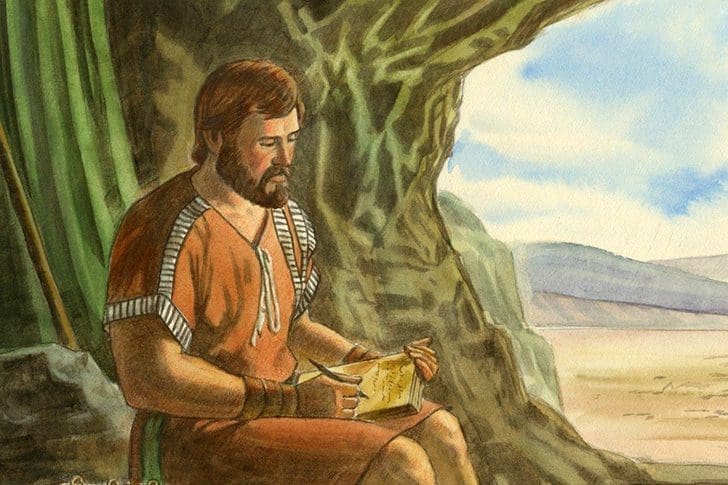
“Ether was deprived of social status whereas Mormon was granted it by the Nephites. Ether, the heir apparent to the Jaredite throne, was rejected by the people in power, and they even tried to kill him. The fact that Ether was the grandson of a deposed king and that he was making accusations against king Coriantumr must have created a strong bias against him. Because both his person and his message were unwelcome in Coriantumr’s court, Ether had to flee for his life (Ether 13:20-22). He lived without influence among the people rather than as a king in a castle. In fact, he was considered to be an enemy, and lived as a recluse in a cave. He warned the people, observed the war by night, and recorded the tragic events (Ether 13:13-14).” (E. Dale LaBaron, Book of Mormon Symposium Series, 4 Nephi – Moroni, edited by PR Cheesman, MS Nyman, and CD Tate, Jr., 1988, p. 154)
Ether 14:9 The murder of Gilead
“The success of any conspiracy against such watchful royalty depends…on secrecy and surprise…,and so we have as the unfailing adjunct and nemesis of Asiatic kingship the secret society, investing all life with a paralysing sense of insecurity…overthrowing dynasties and empires in a single night…The case of the brother of Shared (Ether 14:9), is, then thoroughly typical, and that by no mere coincidence. For we are…told that the system was inherited ‘from them of old’ and perpetuated by the same methods of secret societies, family compacts, bribes, oaths, assassinations etc…as in the Old World.” (Hugh Nibley, Lehi in the Desert)
Ether 14:17 Shiz
“Our first encounter with Shiz in the scriptures introduces his insensitivity, for he ‘did slay both women and children, and he did burn the cities.’ (Ether 14:17). We see in the rivalry of Shiz and Coriantumr, as in other Book of Mormon episodes, an awful cycle of family vengeance. Thos who are caught up in revenge lose all perspective concerning the sanctity of life.
Shiz swore to ‘avenge himself upon Coriantumr of the blood of his brother (Ether 14:24). That Shiz was an intimidating individual is made perfectly clear by the equaling question, ‘Who can stand before the army of Shiz?’ (Ether 14:18)” (Neal A Maxwell, Three Jaredites.)
Ether 15:29 All had fallen…save it were Coriantumr and Shiz
‘Two circumstances peculiar to Asiatic warfare explain why the phenomenon is by no means without parallel: (1) Since every war is strictly a personal contest between kings, the battle must continue until one of the kings falls or is taken. (2) And yet things are so arranged that the king must be the very last to fall, the whole army existing for the sole purpose of defending his person. . . . As long as the war went on, the king could not die, for whenever he did die, the war was over, no matter how strong his surviving forces. Even so, Shiz was willing to spare all of Coriantumr’s subjects if he could only behead Coriantumr with his own sword.’ [Hugh Nibley, The World of the Jaredites, pp. 235-236].
Ether 15:33 the Faithfulness of Ether
“A great prophet, Ether, prophesied great things ‘unto the people’ but ‘they did not believe because they saw them not.’ Such is the recurring and fatal flaw of the faithless. Such, also, is the love of prophets, like Ether, who nevertheless continue to strive lovingly with their fellow men ‘from the morning, even until the going down of the sun’ (Ether 12:3).” (Neal A Maxwell, Three Jaredites.)
 Latter-day Bloke