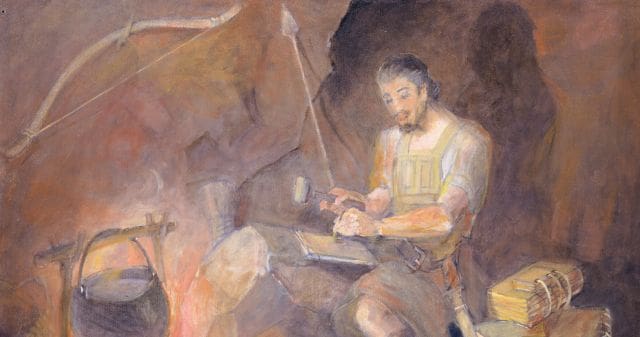
Moroni 7:3 The peaceable followers of Christ
“In chapter 7 you notice that Mormon is sick to death of violence. He wants rest and peace. He’s just obsessed with it now. He said right at the beginning that since he was old enough to observe the ways of men, he had seen nothing but this restless violence (Mormon 2:18)…[Now he says] “I want to talk of peace for a change with some peaceable people.” He wants a peaceable world and he wants a rest. He’s sick and tired….Peace and rest are foremost in his mind here, and it comes out throughout this chapter.” (Hugh Nibley, Teachings of the Book of Mormon, Lecture 112, p. 277)
Moroni 7:5 By their works ye shall know them
‘We invite all to study the fruits and the works of this Church.
Those who are interested in the truth will be able to recognize the difference that the Church and its members make in the communities where they are established. They will also note the improvement in the lives of those who follow its teachings. Those who examine these fruits will discover that the fruits of The Church of Jesus Christ of Latter-day Saints are delicious and desirable.’ (Marcos A Adukaitis, General Conference, April 2014)
Moroni 7:8-9 Giving a gift grudgingly
‘Mormon is setting a very high requirement for church members. Tithing paid with a grudging heart is counted as though we had never paid it at all. Attending church meetings without the right spirit is the same as staying away. Of course, there is value in practice, repetition, and working dutifully through low points in our lives. Certainly there is a point to praying even when our heart is not completely in the right place. Brigham Young said of such occasions: “If I do not feel like praying, and asking my Father in heaven to give me a morning blessing, and to preserve me and my family and the good upon the earth through the day, I should say, ‘Brigham, get down here, on your knees, bow your body down before the throne of Him who rules in the heavens, and stay there until you can feel to supplicate at that throne of grace erected for sinners.’”
But this is not the message Mormon is stressing. Rather, he emphasizes the need to achieve the state where we not only act the right way, but we are the right way. Mormon’s context is the Savior’s Sermon at the Temple, where the Messiah used several examples to show that one’s intent should be toward God and not for the accolades of men (3 Ne. 13:1–6, 16). Mormon’s sermon follows that theme. God does not receive prayer whose purpose is to communicate a message for other men. It might well achieve that purpose; but for the higher function of communicating with God, we need to have true intent.
Brigham Young’s instructions are not addressed to those who are praying to impress others, but rather to those who are neglecting prayers that they know they should offer. He is telling us that at times we must work to pray with full intent, even if it is not there when we begin our prayers.’ (Brant Gardner, Second Witness)
Moroni 7:12-19 The light of Christ
“Regardless of whether this inner light, this knowledge of right and wrong, is called the Light of Christ, moral sense, or conscience, it can direct us to moderate our actions—unless, that is, we subdue it or silence it. …
“Every man, woman, and child of every nation, creed, or color—everyone, no matter where they live or what they believe or what they do—has within them the imperishable Light of Christ” (Boyd K Packer, “The Light of Christ,” Ensign, Apr. 2005, 8, 10).
Moroni 7:25 Men began to exercise faith in Christ
“It is interesting that though we exercise faith and so can increase it, we have faith but we never read of receiving it; we ask for and receive health, wisdom, protection, the necessities of life, and life itself, but we do not ask for faith; it is a principle that we seem to generate in ourselves, being dependent on some auxiliary source, for it is stimulated by hope. We can ‘lay hold’ of these things only if we are ‘meek and lowly’ (Matthew 11:29), for we cannot create power by an act of will; if that were possible Satan would be all-powerful.” (Hugh Nibley, Approaching Zion, p. 604)
Moroni 7:29-31 Ministering angels
“I am convinced that one of the profound themes of the Book of Mormon is the role and prevalence and central participation of angels in the gospel story. …
“One of the things that will become more important in our lives the longer we live is the reality of angels, their work and their ministry. I refer here not alone to the angel Moroni but also to those more personal ministering angels who are with us and around us, empowered to help us and who do exactly that (see 3 Ne. 7:18; Moro. 7:29–32, 37; D&C 107:20). …
“I believe we need to speak of and believe in and bear testimony to the ministry of angels more than we sometimes do. They constitute one of God’s great methods of witnessing through the veil, and no document in all this world teaches that principle so clearly and so powerfully as does the Book of Mormon” (Jeffrey R Holland, “For a Wise Purpose,” Ensign, Jan. 1996, 16–17).
Moroni 7:32-39 Faith in Jesus Christ
“To gain unshakable faith in Jesus Christ is to flood your life with brilliant light. You are no longer alone to struggle with challenges you know you cannot resolve or control yourself, for He said, ‘If ye will have faith in me ye shall have power to do whatsoever thing is expedient in me’ (Moroni 7:33; italics added).
“If you are despondent, racked by transgression, are ill, alone, or desperately in need of comfort and support, I solemnly testify that the Lord will help you when you carefully obey the spiritual law upon which that help is predicated. He is your Father. You are His child. He loves you. He will never let you down. I know He will bless you” (Richard G Scott, in Conference Report, Oct. 1991, 118; or Ensign, Nov. 1991, 86).
Moroni 7:45 Charity suffereth long
‘Now, understanding charity or being charitable is not easy. And our scriptures have not indicated that it would be. Even “charity suffereth long” ( Moro. 7:45 1 Cor. 13:4) requires our thoughtful interpretation. The “suffering” that may come from loving is the result of our great caring. It comes because another matters to us so much.
To avoid that kind of suffering, we would have to avoid what gives us life and hope and joy—our capacity to love deeply. As an antidote against the suffering that will surely come as we have loved ones die, or see them struggle or be misled, or have them misunderstand us or even betray us, we can find relief in charity to others. We accepted bearing one another’s burdens and mourning with those who mourn, as we accepted Christ in our baptism. (See Mosiah 18:8–9) His spirit and power will comfort us as we extend ourselves in help and love to those who need us.
If charity is not always quick to our understanding, it may occasionally be quick to our misunderstanding. It is not charity or kindness to endure any type of abuse or unrighteousness that may be inflicted on us by others. God’s commandment that as we love him, we must respect ourselves, suggests we must not accept disrespect from others. It is not charity to let another repeatedly deny our divine nature and agency. It is not charity to bow down in despair and helplessness. That kind of suffering should be ended, and that is very difficult to do alone. There are priesthood leaders and other loving servants who will give aid and strength when they know of the need. We must be willing to let others help us.’ (Aileen H Clyde, General Conference, October 1991)
Moroni 7:47 Charity is the pure love of Christ
“The phrase ‘love of Christ’ might have meaning in three dimensions: …First, love for Christ. This concept proclaims Jesus as the object of our love, and our lives should be an external expression of our gratitude for him…A second dimension of the meaning of charity is love from Christ. (Ether 12:33-34) The Savior’s act of redemption for our sins is of no effect without our willingness to comply with the conditions of his atonement…A third perception of charity is to possess a love that is like Christ. (2 Ne 33:7-9; Jn 13:34). Charity is not just…a word to describe actions or attitudes. Rather, it is an internal condition that must be developed and experienced in order to be understood…People who have charity have a love for the Savior, have received of his love, and love others as he does.” (C. Max Caldwell, Ensign, Nov. 1992, pp. 29-30)
Moroni 8:5-8 Little children
“We’re born good; we learn to sin as we grow older. And if you need evidence of the truth of that doctrine, lease see your nearest infant. Look deeply into the child’s eyes. Have you ever seen such sweetness and purity? It’s like you can look through a baby’s eyes right into heaven.
Of course, that changes a little later in their lives when wide-eyed innocence turns into wild-eyed mischievousness. That’s when children become accountable and capable of sin – when they know and understand the difference between right and wrong. Through the Prophet Joseph Smith the Lord revealed that the age of accountability is eight years old.” (M Russell Ballard, Our Search for Happiness.)
Moroni 8:9-10 Humble themselves as their little children
“In the pattern set by the Savior’s own teachings, it is telling that both [Mormon and King Benjamin] invite adults – Mormon said specifically ‘parents’ – to become more like little children, not the other way around. An infant’s purity and innocence, a baby’s sense of wonder, a little one’s willingness to believe, a toddler’s inherent trust in a Father and Mother, a child’s ability to instantly forgive and forget, to laugh again and see the very best in the world – these are just a few of the ways adults need to be more like children.” (Jeffrey R Holland, Christ and the New Covenant).
Moroni 9:6 Labor diligently
“After we have done all we could for the cause of truth and withstood the evil that men have brought upon us. And we have been overwhelmed by their wrongs, it is still our duty to stand. We cannot give up; we must not lie down…To stand firm in the face of overwhelming opposition, when you have done all you can, is the courage of faith.” (Joseph F Smith, Gospel Doctrine.)
Moroni 9:20 They are without principle
“When people proceed ‘without principle’, erelong they will be ‘without civilisation’, ‘without mercy’, and ‘past feeling’.” (Neal A Maxwell, Deny Yourselves of All Ungodliness.)
 Latter-day Bloke