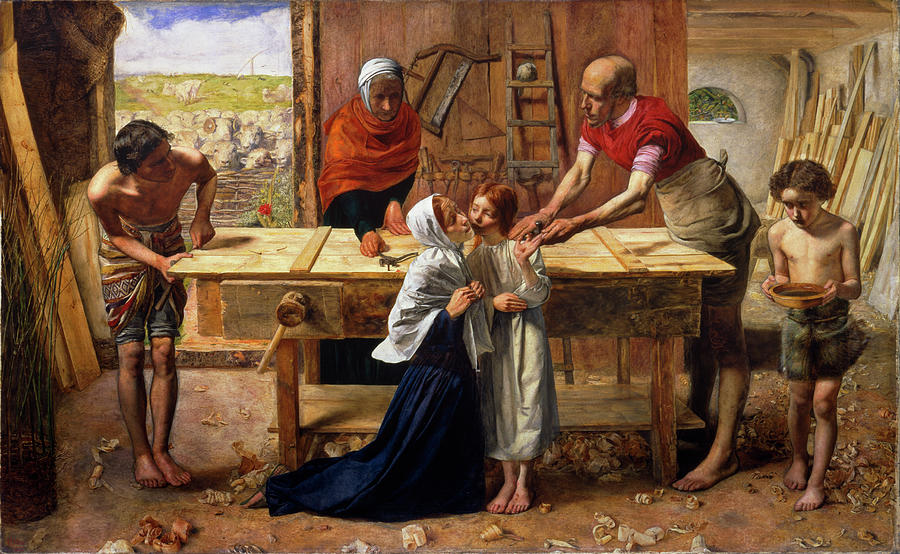
A few years ago I visited the Tate Britain Gallery . When I saw a Pre-Raphaelite painting depicting Jesus in the carpenter shop my eyes lit up. This painting was John Everett Millais’ ‘Christ in the House of His Parents’.
Jesus is shown as a young boy. He appears to have injured his hand while trying to extract a nail from a door using some pincers (there is a smudge of the blood on the door on the workbench). The wound in the palm of his hand and the drop of blood that has fallen onto his foot clearly foreshadow his crucifixion and the prints of the nails in his hands and feet. To draw attention to this, the painting was displayed with a quotation from the Bible – Zechariah 13:6: ‘And one shall say unto him, What are these wounds in thine hands? Then he shall answer, Those with which I was wounded in the house of my friends.’ He is dressed in white, symbolising his purity.
Mary is depicted kneeling beside the Saviour, foreshadowing her sorrowful kneeling beneath the cross. She is not embracing Jesus but is instead offering her cheek to him to kiss – perhaps representing her submission to his divine nature.
Joseph has paused in his work, tool still in hand, to reach out and comfort the boy. His physique is lean and wiry and was modelled by Millais on a real carpenter. Joseph is very much a mortal father.
To the right of Jesus, another slightly older boy is coming forward with a bowl of water to wash the wound. This is John the Baptist, Jesus’ cousin, and the bowl of water symbolises John’s baptism of Jesus. John is wearing clothing made of some sort of animal skin – a reference to the New Testament description that ‘John was clothed with camel’s hair, and with a girdle of a skin about his loins’. (Mark 1:6). John appears to have a rather guilty expression on his face – perhaps referring to his own statement ‘but one mightier than I cometh, the latchet of whose shoes I am not worthy to unloose’ (Luke 3:16).
Also in the picture are an older woman representing Anne, the mother of Mary and an older youth, said to represent the apostles.
In the centre of the table is a large workbench. This represents the Sacrament table. On it is a large door that Joseph and Jesus have been working on. This reminds us of the verse in Revelation: ‘Behold, I stand at the door, and knock: if any man hear my voice, and open the door, I will come in to him, and will sup with him, and he with me.’ (Revelation 3:20)
At the back of the room painting are lengths of wood and carpentry tools. These are the tools with which Jesus would make his living but which would also facilitate his death. Amongst them is a triangle – a traditional symbol of the Godhead. There is also a ladder. This may represent the ladder up to Calvary’s cross or, as some scholars think, Jacob’s ladder. Perched on the ladder is a dove, representing, of course, the Holy Ghost.
Through the door at the rear of the room can be seen a flock of sheep symbolising Christ’s role as the Good Shepherd. In the far distance, beyond the sheep is a shadoof (or irrigation machine) reminding us that Christ is the Living Water.
At the front left of the painting is a partially woven basket symbolising that Christ’s work on earth has only just begun.
At the far right is (halo-shaped?) window. Beyond can be seen a garden, reminding us that Christ’s atonement is necessary because of the Fall, and on the window sill a bird is drinking or bathing in a dish of water – a symbol of spiritual refreshment.
The picture was first exhibited in 1850 and caused outrage. The Times objected to the way in which Jesus and his family were portrayed as ordinary, lowly people. Many observers felt that the realistic depiction was almost blasphemous. Charles Dickens was particularly incensed by it and claimed that it depicted Mary as ‘horrible in her ugliness’.
For me, the realistic portrayal (Millais based it on a real carpenter’s shop), including the wood shavings on the floor and the dirty feet is not blasphemous but is instead a powerful symbol of the condescension of the Saviour in coming to this mortal world and of His mission to atone for the sins of the world.
 Latter-day Bloke