Last week we attended Zone Conferences and one of the teaching missionaries referenced 2 Samuel 24:24:
“24 And the king said unto Araunah, Nay; but I will surely buy it of thee at a price: neither will I offer burnt offerings unto the Lord my God of that which doth cost me nothing. So David bought the threshingfloor and the oxen for fiftyshekels of silver.”
We learn here that David made a sacrifice to purchase the threshing floor from Araunah the Jebusite in order to make offerings to the Lord.
This set me off on a trail……
2 Chronicles 3:1 reads:
1 Then Solomon began to build the house of the Lord at Jerusalem in mount Moriah, where the Lord appeared unto David his father, in the place that David had prepared in the threshingfloor of Ornan the Jebusite.
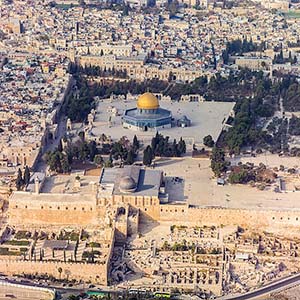
So, Solomon built his temple on the site of the threshing floor that his father David bought and that the Lord appeared to David there. This was evidently a sacred space. The temple was located on Mount Moriah and became the centre of offerings and sacrifice for the Jews.
What else do we know about Mount Moriah?
Genesis 22: 1 And it came to pass after these things, that God did temptAbraham, and said unto him, Abraham: and he said, Behold, here I am.
2 And he said, Take now thy son, thine only son Isaac, whom thou lovest, and get thee into the land of Moriah; and offer him there for a burnt offering upon one of the mountains which I will tell thee of.
3 ¶ And Abraham rose up early in the morning, and saddled his ass, and took two of his young men with him, and Isaac his son, and clave the wood for the burnt offering, and rose up, and went unto the place of which God had told him.
Mount Moriah was the place where God instructed Abraham to go and sacrifice his son, Isaac. There is a theme of sacrifice and offerings developing around Mount Moriah.
Jewish tradition also states that Moriah was the place where Melchizedek administered the sacrament to and blessed Abraham (Genesis 14:18) and where Jacob dreamt of a ladder reaching up into Heaven”
Genesis 28:16 ¶ And Jacob awaked out of his sleep, and he said, Surely the Lord is in this place; and I knew it not.
17 And he was afraid, and said, How dreadful is this place! this is none other but the house of God, and this is the gate of heaven.
Solomon’s temple lasted around 400 years until it was destroyed by Nebuchadnezzar’s armies. 70 years later the temple was rebuilt on the same spot and then extended by Herod in the first century AD. This was the temple that Jesus cleansed.
The scriptures tell us that Christ was crucified at Golgotha (Aramaic name) also known as Calvary (Latin name). There are two contenders for the crucifixion site. The traditional site is the Church of the Holy Sepulchre. The other site is a skull shaped hill (Golgotha means skull) which seems to fit the Biblical and Jewish ritual requirements better than the Church of the Holy Sepulchre. LDS scholar Jeffrey Chadwick concluded:
“In summary, when geographical, cultural, archaeological, and geological evidences are taken together—the skull feature’s location outside the northern wall of Jerusalem in Jesus’ day, the fact that it was just west of an area permissible for tomb construction at the time, its position in relation to the main roads leading north and east, and the plausibility that because of its natural appearance the Jews of the day would have called it golgotha (“the skull”)—the skull feature was very likely the location of the Crucifixion.”
If Chadwick is right, this is symbolically significant as this skull shaped hill is located on Mount Moriah!
In AD 70 the temple was destroyed by Titus’ Roman armies – all that remains now is part of the retaining wall – known as the Wailing Wall – and the Dome of the Rock now stands on Mount Moriah where the temple stood. This piece of real estate is now sacred to Jews, Christians and Muslims! It certainly has a long symbolic association with sacrifice, offerings and redemption.
 Latter-day Bloke