My dear brothers and sisters, last October, President Russell M. Nelson taught, “Now is the time for you and for me to prepare for the Second Coming of our Lord and Savior, Jesus the Christ.” When President Nelson speaks about the Second Coming, it is always with joyful optimism. However, a girl in Primary recently told me that she becomes anxious whenever the Second Coming is mentioned. She said, “I’m scared because bad things are going to happen before Jesus comes again.”
We are surrounded by challenges on all sides (see 2 Corinthians 4:8–9). But with faith in God, we trust the blessings He has promised those who keep His commandments. We have faith in the future, and we are preparing for that future. To borrow a metaphor from the familiar world of athletic competitions, we do not know when this game will end, and we do not know the final score, but we do know that when the game finally ends, our team wins. We will continue to go forward “till the purposes of God shall be accomplished, and the Great Jehovah shall say the work is done” (History of the Church, 4:540).
It is not just children who may feel this way. The best advice for her, for you, and for me is to follow the Savior’s teachings. His instructions are neither mysterious nor complex. When we follow them, we do not need to fear or be anxious.
Why should we not fear or be anxious about the Second Coming?
In the footnotes to his talk, Elder Renlund writes:
‘We need not feel anxious, because Jesus Christ will transform us so that we are ready to meet Him. As we consistently honor our covenants and keep the commandments, we gradually become, through His grace and blessings, more and more like the Savior. And as we do, we will be prepared for His Second Coming. As stated in 1 John 3:2–3:
“Beloved, now are we the sons of God, and it doth not yet appear what we shall be: but we know that, when he shall appear, we shall be like him; for we shall see him as he is.
“And every man that hath this hope in him purifieth himself, even as he is pure.”’
Toward the end of His mortal ministry, Jesus Christ was asked when He would come again. In answering, He taught three parables, recorded in Matthew 25, about how to prepare to meet Him—whether at His Second Coming or whenever we leave this world. These teachings are crucial because personal preparation to meet Him is central to life’s purpose.
The Savior first told the parable of the ten virgins. In this parable, ten virgins went to a wedding feast. Five wisely brought oil to fill their lamps, and five foolishly did not. When the bridegroom’s imminent arrival was announced, the foolish virgins left to buy oil. When they returned, it was too late; the door to the feast was shut.
How would you apply this parable to us today?
Jesus identified three aspects of the parable to help us. He explained:
“And at that day, when I shall come in my glory, shall the parable be fulfilled which I spake concerning the ten virgins.
“For they that are wise and have received the truth, and have taken the Holy Spirit for their guide, and have not been deceived—verily I say unto you, they shall … abide the day.”
In other words, they did not need to fear or be anxious, because they would survive and prosper. They would prevail.
If we are wise, we receive the truth by accepting the gospel of Jesus Christ through priesthood ordinances and covenants. Next, we strive to remain worthy of having the Holy Ghost always with us. This capability must be acquired individually and personally, drop by drop. Consistent, personal, private acts of devotion invite the Holy Ghost to guide us.
What sort of acts invite the Holy Ghost to guide us?
The third element that Jesus highlighted is avoiding deception. The Savior warned:
“Take heed that no man deceive you.
“For many shall come in my name, saying, I am Christ; and shall deceive many.”
One of the signs of the times is that many people will be deceived about the second coming of the Lord. Even some Latter-day Saints are and will be deceived. Yet this deception need not be the case. If we follow the living prophet and feast upon the words of Christ as found in the holy scriptures, we can avoid being deceived (see 2 Nephi 31:20).
The Savior knew pretenders would try to deceive the very elect and that many disciples would be duped. We should neither believe those who falsely claim divine sanction nor venture into metaphorical deserts or secret chambers to be taught by counterfeits.
How can we make sure we don’t get deceived?
The Book of Mormon teaches us how we can differentiate deceivers from disciples. Disciples always promote believing in God, serving Him, and doing good. We will not be deceived when we seek and take counsel from trusted individuals who are themselves faithful disciples of the Savior.
From the footnotes to Elders Renlund’s talk:
‘President Nelson also taught: “Don’t pollute [your testimony] with false philosophies of unbelieving men and women” (“Overcome the World and Find Rest,” Liahona, Nov. 2022, 97). “Take your questions to the Lord and to other faithful sources. … Stop increasing your doubts by rehearsing them with other doubters” (“Christ Is Risen; Faith in Him Will Move Mountains,” Liahona, May 2021, 103). As the Book of Mormon prophet Alma the Elder counseled, “Trust no one to be your teacher nor your minister, except he be a man of God, walking in his ways and keeping his commandments” (Mosiah 23:14). In this dispensation, the Savior taught us to rely only on those “whose spirit is contrite, … whose language is meek and edifieth, … [who] trembleth under my power … and … bring forth fruits of praise and wisdom, according to the revelations and truths which I have given you” (see Doctrine and Covenants 52:14–19).’
We can also avoid deception by worshipping regularly in the temple. This helps us maintain an eternal perspective and protects us from influences that might distract or divert us from the covenant path.
How does temple worship help us avoid deception?
The essential lesson of this parable of the ten virgins is that we are wise when we accept the gospel, seek to have the Holy Ghost with us, and avoid deception. The five wise virgins could not help those without oil; no one can accept the gospel, take the Holy Ghost as a guide, and avoid deception on our behalf. We have to do this for ourselves.
The Savior then told the parable of the talents. In this parable, a man gave differing amounts of money, referred to as talents, to three servants. To one servant he gave five talents, to another he gave two, and to a third he gave one.
From the footnotes:
‘See Guide to the Scriptures, “Talent.” A talent was an ancient unit of weight and monetary value in Greek and Roman times. It is estimated that one talent was worth about 6,000 denarii, and since a denarius was roughly a day’s wage for a laborer, a single talent would be equivalent to about 20 years of wages for an average worker.’
Over time, the first two servants doubled what they had received. But the third servant simply buried his single talent. To both servants who had doubled their talents, the man said, “Well done, … good and faithful servant: thou hast been faithful over a few things, I will make thee ruler over many things: enter thou into the joy of thy lord.”
The man then chided the servant who had buried his talent for being “wicked and slothful.” This servant’s talent was taken away, and he was banished. Yet, had this servant doubled his talent, he would have received the same commendation and reward as the other servants.
In the footnotes Elder Renlund writes:
‘Extending the parable, in the eternal scheme of things, once each servant enters the joy of his lord and becomes an heir to all that the lord has, the apparent, minor differences in what each servant had at the beginning become negligible.’
One message of this parable is that God expects us to magnify the abilities we have been given, but He does not want us to compare our abilities to those of others.
What are the dangers of comparison?
Consider this insight provided by the 18th-century Hasidic scholar Zusya of Anipol. Zusya was a renowned teacher who began to fear as he approached death. His disciples asked, “Master, why do you tremble? You’ve lived a good life; surely God will grant you a great reward.”
Zusya said: “If God says to me, ‘Zusya, why were you not another Moses?’ I will say, ‘Because you didn’t give me the greatness of soul that you gave Moses.’ And if I stand before God and He says, ‘Zusya, why were you not another Solomon?’ I will say, ‘Because you didn’t give me the wisdom of Solomon.’ But, alas, what will I say if I stand before my Maker and He says, ‘Zusya, why were you not Zusya? Why were you not the man I gave you the capacity to be?’ Ah, that is why I tremble.”
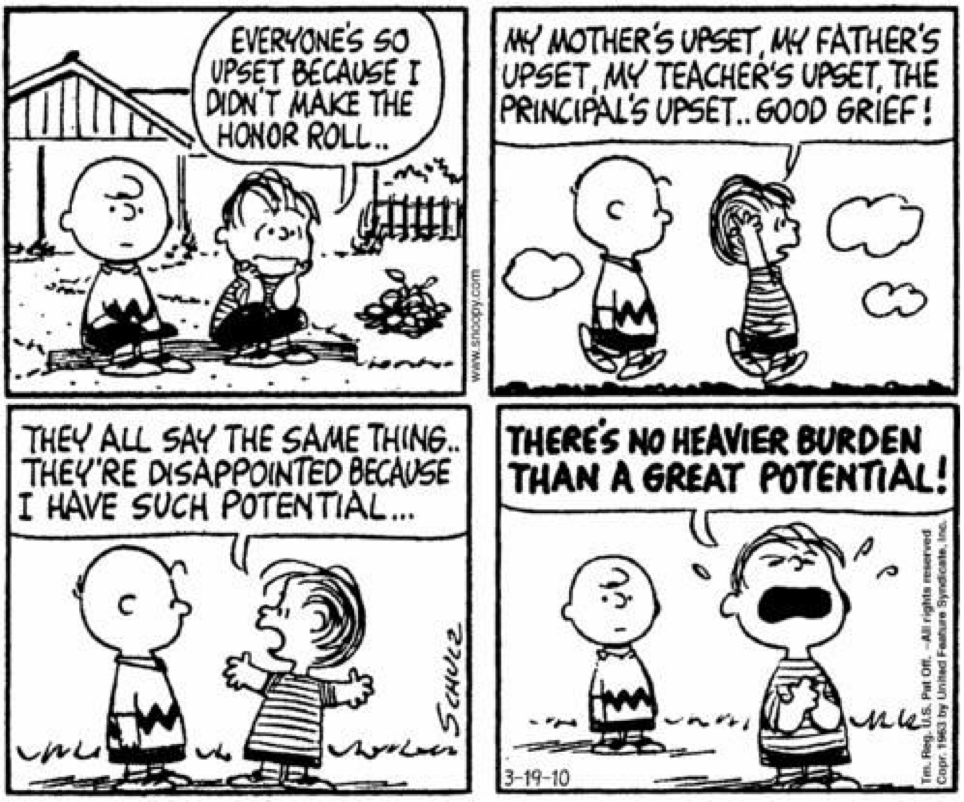
Indeed, God will be disappointed if we do not rely upon the merits, mercy, and grace of the Savior to magnify the God-given abilities we have received. With His loving assistance, He expects us to become the best version of ourselves. That we may start with differing abilities is irrelevant to Him. And it should be to us.
What does it mean to be the best version of ourselves? Where does grace come into it?
Finally, the Savior told the parable of the sheep and goats. When He returns in His glory, “before him shall be gathered all nations: and he shall separate them one from another, as a shepherd divideth his sheep from the goats: and he shall set the sheep on his right hand, but the goats on the left.”
Those on His right became heirs in His kingdom, and those on His left received no inheritance. The distinguishing characteristic was whether they fed Him when He was hungry, gave Him drink when He was thirsty, housed Him when He was a stranger, clothed Him when He was naked, and visited Him when He was sick or imprisoned.
Everyone was perplexed, both those on the right hand and those on the left hand. They asked when they had, or when they had not, given Him food, drink, and clothing or helped Him when He was vulnerable. In response, the Savior said, “Verily I say unto you, Inasmuch as ye have done it unto one of the least of these my brethren, ye have done it unto me.”
The message of the parable is clear: when we serve others, we serve God; when we don’t, we disappoint.
Sister Cristina B Franco in the October 2018 General Conference said:
‘…are we giving our all to the Lord without reservation? Are we sacrificing of our time and talents so the rising generation can learn to love the Lord and keep His commandments? Are we ministering both to those around us and to those we are assigned with care and with diligence—sacrificing time and energy that could be used in other ways? Are we living the two great commandments—to love God and to love His children? Often that love is manifest as service.’
What does it mean to give our all to the Lord without reservation?
He expects us to use our gifts, talents, and abilities to bless the lives of Heavenly Father’s children. The divine impulse to serve others is illustrated in a poem written in the 19th century by the Finnish poet Johan Ludvig Runeberg. My siblings and I repeatedly heard the poem “Farmer Paavo” throughout our childhoods. In the poem, Paavo was a poor farmer who lived with his wife and children in the lake region of central Finland. Several years in a row, most of his crops were destroyed, whether through the runoff from the spring snowmelt, summer hailstorms, or an early autumn frost. Each time the meager harvest came in, the farmer’s wife lamented, “Paavo, Paavo, you unfortunate old man, God has forsaken us.” Paavo, in turn, stoically said, “Mix bark with the rye flour to make bread so the children won’t go hungry. I’ll work harder to drain the marshy fields. God is testing us, but He will provide.”
Each time the crops were destroyed, Paavo directed his wife to double the amount of bark that she mixed into the flour to ward off starvation. He also worked harder, digging trenches to drain the ground and decrease his fields’ susceptibility to a spring runoff and an early autumn frost.
After years of hardship, Paavo finally harvested a rich crop. His wife exulted, “Paavo, Paavo, these are happy times! It is time to throw away the bark, and bake bread made only with rye.” But Paavo solemnly took his wife’s hand and said, “Mix half the flour with bark, for our neighbor’s fields have frosted over.” Paavo sacrificed his and his family’s bounty to help his devastated and destitute neighbor.
What is the lesson of this story?
The lesson of the Savior’s parable of the sheep and goats is that we are to use the gifts we have been given—time, talents, and blessings—to serve Heavenly Father’s children, especially the most vulnerable and needy.
My invitation to the anxious Primary child I mentioned earlier, and to each of you, is to follow Jesus Christ and to trust the Holy Ghost as you would a cherished friend. Rely on those who love you and who love the Savior. Seek God’s guidance to develop your unique abilities, and help others, even when it isn’t easy. You will be ready to meet the Savior, and you can join President Nelson in being joyfully optimistic.
From the footnotes:
President Nelson taught, “One crucial element of this gathering is preparing a people who are able, ready, and worthy to receive the Lord when He comes again, a people who have already chosen Jesus Christ over this fallen world, a people who rejoice in their agency to live the higher, holier laws of Jesus Christ” (“Overcome the World and Find Rest,” 98).
In doing so, you help the world prepare for the Second Coming of Jesus Christ, and you will be blessed with sufficient hope to enter the rest and joy of the Lord, now and in the future.
From the footnotes:
‘President Joseph F. Smith taught: “The rest … referred to is not physical rest. … [It is] the spiritual rest and peace which are born from a settled conviction of the truth. … We may thus enter into the rest of the Lord today, by coming to an understanding of the truths of the gospel. … [Those who have entered this rest are those] whose minds have become satisfied, and who have set their eyes upon the mark of their high calling with an invincible determination in their hearts to be steadfast in the truth, and who are treading in humility and righteousness the path marked out for … followers of Jesus Christ. But there are many who, not having reached this point of determined conviction, are driven about by every wind of doctrine, thus being ill at ease, unsettled, restless. These are they who are discouraged over incidents that occur in the Church, and in the nation, and in the turmoils of men. … They harbor a feeling of suspicion, unrest, uncertainty. Their thoughts are disturbed, and they become excited with the least change, like one at sea who has lost his bearings” (Gospel Doctrine, 5th ed. [1939], 126).’
As we sing in one of our new hymns:
Rejoice! And prepare for that day! …
No one knows the day and hour when He will come again,
But He’ll return as scriptures say; it will be a joyful day
When our beloved Savior comes again.
In the name of Jesus Christ, amen.
NB: Passages in italics are direct excerpts from Elder Renlund’s talk.
You can watch Elder Renlund’s talk here
If this post has been helpful, please leave a ‘like’ or a comment!
 Latter-day Bloke