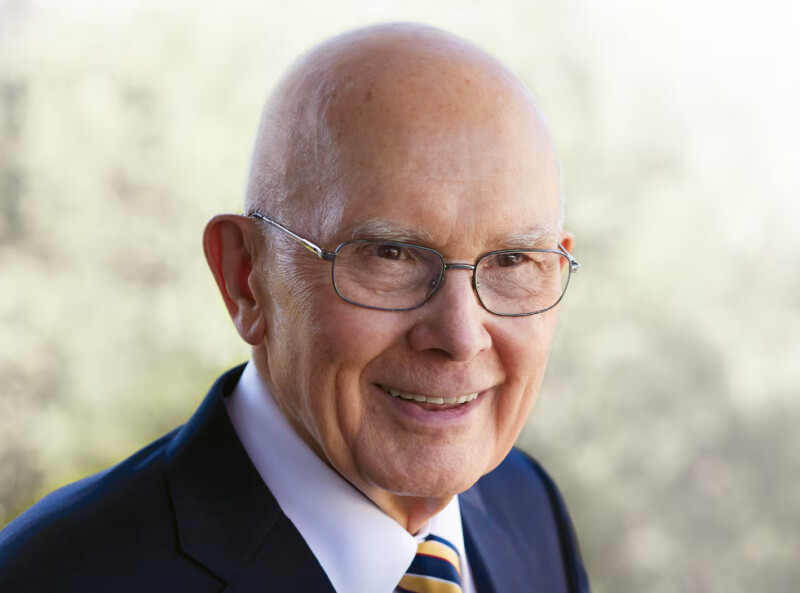
President Oaks’ message centres on how the Resurrection of Jesus Christ transforms our entire view of life and how that belief should shape the way we treat others.
- The Resurrection changes everything
- Living “alive in Christ” means living differently now
- The commandment to love includes everyone—even adversaries
- Becoming peacemakers is central to discipleship
- Peacemaking does not mean abandoning truth
You can watch President Oaks’ talk here.
Key Quotes:
‘The conviction that death is not the conclusion of out identity changes the whole perspective of our mortal life.’ (Paragraph 5)
‘…mortal deficiencies are only temporary.’ (Paragraph 5)
‘Our belief in the Resurrection also encourages us to fulfil our family responsibilities in mortality.’ (Paragraph 6)
‘Today we may say that we are commanded to love our adversaries.’ (Paragraph 12)
‘In a democratic government we should seek fairness for all.’ (Paragraph 19)
Questions to discuss or ponder:
Why do you think this talk is entitled ‘Alive in Christ’?
How has your testimony of the Resurrection given you strength and perspective? (Paragraph 5)
Why should our belief in the resurrection encourage us to fulfil our family responsibilities in mortality? (Paragraph 6)
Who might we consider as our adversaries today? (Paragraph 12) How can we show love towards them?
What lessons do you take from the story related in paragraphs 13-16?
How can focusing on others as “children of God” change our reactions to them? (Paragraph 19)
How can we live peaceably with those with whom we disagree? (Paragraphs 19-21)
What are some small, daily ways we can be peacemakers? (Paragraphs 21-27)
In what ways are our missionaries peacemakers? (Paragraph 27)
How can we avoid contention? (Paragraph 27)
Invitations and applications:
‘Each of us can strive to follow our Savior in His teachings about how to relate to one another. This does not mean surrendering our values.’ (Paragraph 18)
‘…as followers of Christ , we should seek to live peaceably and lovingly with other children of God who do not share our values and do not have the covenant obligations we have assumed.’ (Paragraph 19)
‘We can follow the example of Jesus Christ, who is our role model, by choosing to love others – even if they show little or no love towards us.’ (Paragraph 20)
‘How it would change the world if followers of Christ would forgo harsh and hurtful words in all their communications.’ (Paragraph 21)
‘My brothers and sisters, as followers of Christ, let us follow Him by forgoing contention and using the language and methods of peacemakers.’ (Paragraph 28)
‘In our families and other personal relationships , let us avoid what is harsh and hateful.’ (Paragraph 28)
Additional thoughts:
‘It is strange but true that to an increasing number of those who call themselves Christian, Christ’s resurrection is not to be taken literally. It has been described by a leading churchman from a different denomination as ‘a conjuring trick with bones’. One college textbook on the New Testament proclaims: “We need to keep in mind that the empty tomb was an ambiguous witness to the resurrection. It attests the absence of the body, but not necessarily the reality or presence of the risen Jesus.” ‘ Robert A. Spivey and D. Moody Smith, Anatomy of the New Testament: A Guide to Its Structure and Meaning (New York: Macmillan, 1989), p. 239.
Why is it important to understand the true doctrine of resurrection?
The apostle Paul pointed out that if we do not accept the resurrection of Christ we miss the whole point of the Gospel: “If Christ be not risen, then is our preaching vain, and your faith is also vain. … If in this life only we have hope in Christ, we are of all men most miserable” (1 Cor. 15:14, 19). Without the atonement and resurrection of Christ there is no plan of salvation.
‘Peacemaking is a Christlike attribute. Peacemakers are sometimes labeled naive or weak—from all sides. Yet, to be a peacemaker is not to be weak but to be strong in a way that the world may not understand. Peacemaking requires courage and compromise but does not require sacrifice of principle. Peacemaking is to lead with an open heart, not a closed mind. It is to approach one another with extended hands, not clenched fists. Peacemaking is not a new thing, hot off the press. It was taught by Jesus Christ Himself, both to those in the Bible and the Book of Mormon. Peacemaking has since been taught by modern-day prophets from the earliest days of the Restoration even to this day.’ Elder Gary E Stevenson, General Conference, October 2025).
‘As we dread any disease that undermines the health of the body, so should we deplore contention, which is a corroding canker of the spirit…My concern is that contention is becoming accepted as a way of life. From what we see and hear in the media, the classroom, and the workplace, all are now infected to some degree with contention…’ (Elder Russell M Nelson, General Conference, April 1989).
If this post has been helpful, please leave a ‘like’ or a comment. Thank you!
 Latter-day Bloke