1. The Lord calls Moses to deliver Israel from bondage.
Exodus 3:1-10 The Lord appears to Moses at the burning bush
“A manifestation was given to Moses by a messenger of light, causing a bush to appear to burn; it was really not afire and was not consumed. The word ‘angel’ could better have been rendered ‘messenger’ which is the basic meaning of the Hebrew word malakh. A flame in a bush, a mighty wind, a small voice, a great thundering, or other phenomena may herald a message from God, as a malakh of God. After Moses’ attention was drawn to the bush, the voice of the Lord Himself spoke to Moses; Moses responded in awe and reverence.” (Rasmussen, Introduction to the Old Testament, 1:74.)

Exodus 3:11 Who am I..?
‘He does not fully disobey God, but acknowledges his own weakness.’ (Geneva Study Bible)
Exodus 3:11–18. What Is the Significance of the Title I Am?
‘When the Lord appeared to Moses in the burning bush He used the name I am to identify Himself as the God of Israel, the same God who had appeared to Abraham, Isaac, and Jacob. Although this is the first time this name appears in the Bible, it is obvious that if the name had not been known to the Israelites, its value for identifying the Lord would have been useless. Correct identification was crucial to Moses in authenticating his call to the Israelites. This name does not appear frequently in the Bible; however, Jesus (the Jehovah of the Old Testament) used it on other occasions to identify Himself to Abraham (see Abraham 1:16), to the Jews (see John 8:58), and to modern Israel (see D&C 29:1).
Etymologically, the title I am is directly related to the most frequently used name of deity in the Old Testament—YHWH. How often the name YHWH appears in the Bible may not always be evident in the King James Version, since the translators substituted the title Lordor God almost every place it appeared in the Hebrew. This practice shows deference to the reverential feelings of the Jews who never pronounced the name, substituting instead their word for Lord—Adonai. (Read Genesis 18:1–3 where this distinction between Lord and Lord makes a significant difference in the interpretation. Also see Reading A-2 for a full discussion of this subject.)
I am is the first person singular form of the verb to be.Therefore, YHWH (which can also be the third person singular) would mean “He is” or “He exists.” The first or third person of the same verb was used by the Lord in the Hebrew text of the Old Testament, depending upon whether He wanted to emphasize His own or our own perspective.’ (Institute Old Testament Manual)
Exodus 4:10–17. Why Was Moses So Reluctant to Be God’s Spokesman?
‘There is some evidence that Moses may have had a mild speech impediment (see Reading 9-22), although some scholars think Moses may only have been suggesting that his facility in both the Hebrew and Egyptian languages was poor after having lived forty years with the Midianites. Whatever the outward cause, the Lord answered Moses with reasoning so simple and yet so profound that it was difficult to refute. Moses’ feelings of inadequacy were so strong, however, that he still insisted he needed help. The Lord became angry at this continued lack of confidence and gave Aaron to Moses as a spokesman. Anyone with normal feelings of his own unworthiness can sympathize with Moses, but all must learn to trust in the power of the Lord. Moroni taught that the Lord specifically gives individuals weaknesses so that they will be humble. But if they have enough faith in God, His grace is sufficient to “make weak things become strong” for them (Ether 12:27). Enoch had a similar response to his own feelings of inadequacy, and yet great things eventually came out of that weakness when he turned to God (see Moses 6:31–32, 47; 7:13).’ (Institute Old Testament Manual)
2. The Lord sends plagues upon Egypt.
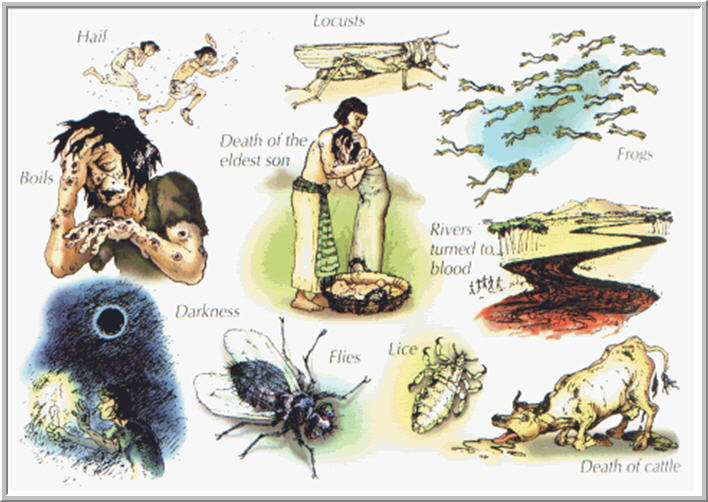
Exodus 5 Moses and Aaron ask Pharoah to free Israel
‘Freedom was requested from Pharoah, but he naturally responded: ‘Who is the Lord, that I should obey his voice?’ Pharoah would learn the answer to his question by much sad experience. In the meantime, he sought to show who was boss by increasing Israel’s burdens and expectations.
Disappointed and embittered because they only received increased burdens instead of freedom, the people of Israel complained to Moses, and Moses complained to the Lord.’ (Andrew C Skinner, D Kelly Ogden, Verse by Verse, The Old Testament)
Exodus 6:1–8 I have also established my covenant with them
‘The eternal gospel covenant that the Lord God established with Adam and all the patriarchs, including Noah, Abraham, Isaac, and Jacob, was, at the time of Moses, established with the whole house of Israel.’ (Institute Old Testament Manual)
Exodus 6:9 They hearkened not unto Moses
‘That is, [1.] They were so taken up with their troubles that they did not heed him. [2.] They were so cast down with their late disappointment that they did not believe him. [3.] They had such a dread of Pharaoh’s power and wrath that they durst not themselves move in the least towards their deliverance. Note, First, Disconsolate spirits often put from them the comforts they are entitled to, and stand in their own light. See Isa. 28:12. Secondly, Strong passions oppose strong consolations. By indulging ourselves in discontent and fretfulness, we deprive ourselves of the comfort we might have both from God’s word and from his providence, and must thank ourselves if we go comfortless.’ (Matthew Henry, Commentary on the Whole Bible)
3. The Lord instructs Moses in the preparation of the Passover.
‘After receiving his commission from the Lord, Moses returned to Egypt to lead the children of Israel out of captivity. Plague after plague failed to secure their freedom, leading to the 10th and final plague: “For I will pass through the land of Egypt this night, and will smite all the firstborn in the land of Egypt” Exodus 12:12
For protection against “the destroyer” verse 23 the Lord instructed His people to offer a sacrifice, a lamb “without blemish” verse 5 and to collect the blood from the sacrifice. They were then to “take of the blood” and apply it to the entrance of each home—“the two side posts and … the upper door post” verse 7with this promise: “And when I see the blood, I will pass over you, and the plague shall not be upon you to destroy you” verse 13
“The children of Israel went away, and did as the Lord had commanded” verse 28 They offered the sacrifice, collected the blood, and applied it to their homes. “And it came to pass, that at midnight the Lord smote all the firstborn in the land of Egypt” verse 29 Moses and his people, according to the promise of the Lord, were protected.
The blood used by the Israelites, symbolic of the Savior’s future Atonement, was a product of the sacrifice they had offered. Nevertheless, the sacrifice and the blood alone would not have been sufficient to obtain the promised blessing. Without the application of the blood to the door posts, the sacrifice would have been in vain.’ (W Christopher Waddell, General Conference, October 2011)
Exodus 12:14. In What Way Is the Passover An Ordinance Forever?
“The Feast of the Passover was fulfilled in that form in the crucifixion of Jesus Christ. The Passover was a law given to Israel which was to continue until Christ, and was to remind the children of Israel of the coming of Christ who would become the sacrificial Lamb. After he was crucified the law was changed by the Savior himself, and from that time forth the law of the sacrament was instituted. We now observe the law of the sacrament instead of the Passover because the Passover was consummated in full by the death of Jesus Christ. It was a custom looking forward to the coming of Christ and his crucifixion and the lamb symbolized his death. …
“The word forever used in the Old Testament does not necessarily mean to the end of time but to the end of a period.” (Smith, Answers to Gospel Questions, 5:153–54.)
Exodus 12:24-27 What mean ye by this service?
‘Fathers have been leaving memorials for their children, and children have been raising them to their fathers, since time began. Here on Temple Square we have consciously surrounded ourselves with such memorials—the old Nauvoo bell, the Seagull Monument, statues of the Restoration, Thorvaldsen’s Christus, to name just a few. These serve to unite generation with generation, preserving in a long, unbroken chain the important events of our common heritage. The passage of time and the growth of our institutions often tend to separate us not only from each other but also from our common purposes. Down through history we have been commanded to construct memorials, or hold Passover feasts, or convene general conferences to preserve the power of our united faith and to remember the commandments of God in achieving our eternal, unchanging goals.’ (Howard W Hunter, “That We May Be One,” Ensign, May 1976, 105)
Exodus 12:18–20. What Is the Symbolic Meaning of the Unleavened Bread and Bitter Herbs?
‘Leaven, or yeast, was seen anciently as a symbol of corruption because it so easily spoiled and turned moldy. Jesus used this imagery when He warned the disciples of the “leaven of the Pharisees” (Matthew 16:6), meaning their corrupt doctrine (see Matthew 16:6–12). In the law of Moses no leaven could be offered with the trespass offering (see Leviticus 6:17), suggesting that the offering must be without any corruption. For the Israelites, eating the unleavened bread symbolized that they were partaking of the bread which had no corruption or impurity, namely, the Bread of Life, who is Jesus Christ (see John 6:35). The careful purging of the household of all leaven (see Exodus 12:19) was a beautiful symbol of putting away all uncleanliness from the family. Paul drew on this imagery of the unleavened bread when he called upon the Corinthian Saints to put away sin from their lives (see 1 Corinthians 5:7–8). (Note: Christ’s comparison of the kingdom of heaven to leaven does not refer to yeast’s tendency to spoil but to the fact it causes dough to rise or swell [see Matthew 13:33].)
The bitter herbs served to remind Israel of the bitter and severe bondage they had endured in Egypt.’ (Institute Old Testament Manual)
4. The children of Israel cross the Red Sea.
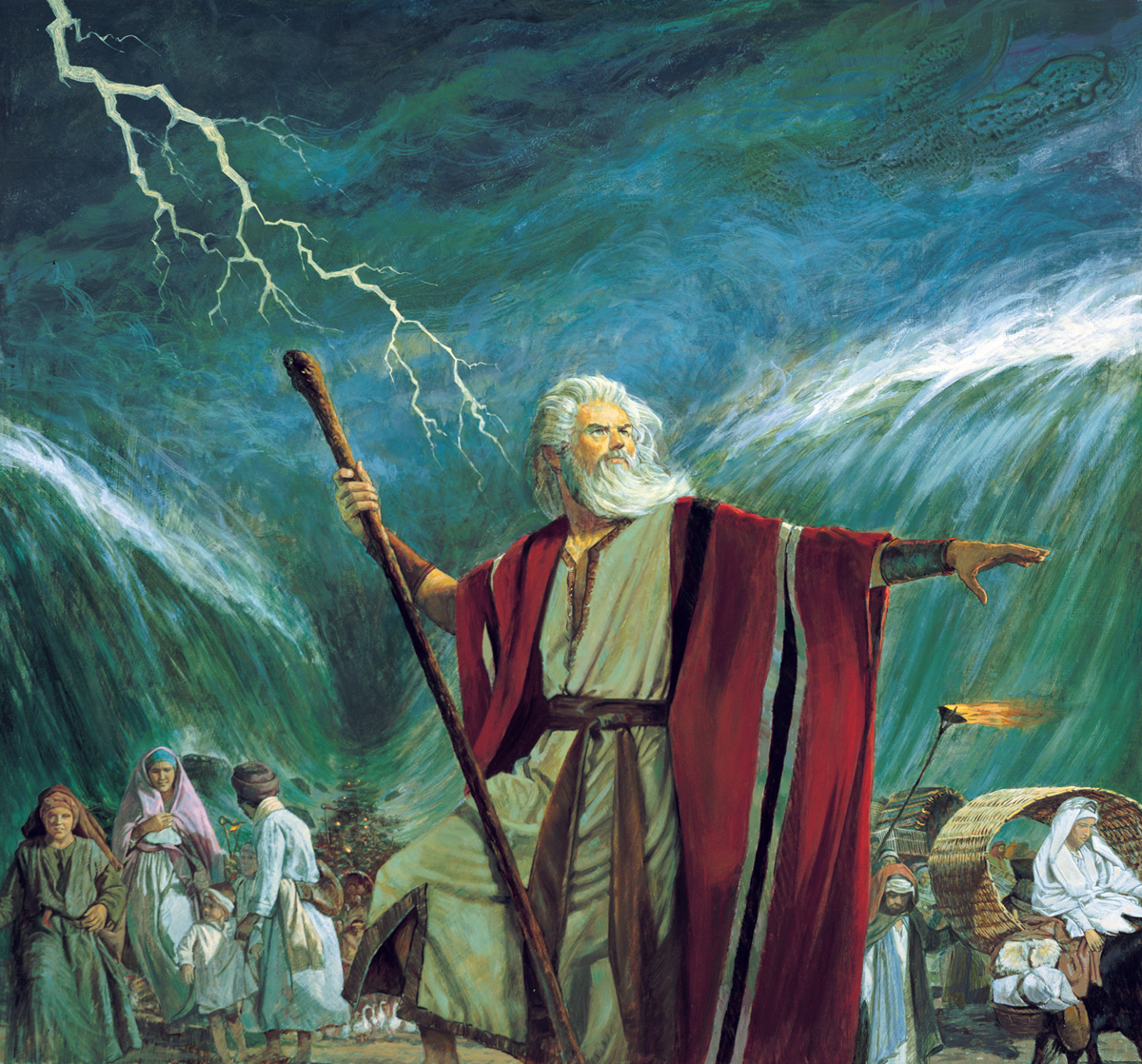
Exodus 14:5 And the heart of Pharaoh and of his servants was turned against the people
‘Alas, how soon the obduracy of this reprobate king reappears! He had been convinced, but not converted–overawed, but not sanctified by the appalling judgments of heaven. He bitterly repented of what he now thought a hasty concession. Pride and revenge, the honor of his kingdom, and the interests of his subjects, all prompted him to recall his permission to reclaim those runaway slaves and force them to their wonted labor. Strange that he should yet allow such considerations to obliterate or outweigh all his painful experience of the danger of oppressing that people.’ (Robert Jamieson, A. R. Fausset and David Brown, Commentary Critical and Explanatory on the Whole Bible)
Exodus 14:10-18 Israel goes out of Egypt
‘The Israelites were frightened by the threat and became sarcastic and critical. But Moses stood firm in faith to strengthen them. When man can of himself do nothing more, he must simply put his trust in God and ‘stand still and see the salvation of the Lord’ (v13)
Moses was in his extremity; he was backed up against the sea. He had to rely on the spirit of revelation to know how to fulfill the Lord’s intention that Israel be saved. The spirit of revelation involves having faith enough to take the next step into the unknown. Modern revelation provides important insight for all of on this principle: ‘Yea, behold, I will tell you in your mind and in your heart, by the Holy Ghost, which shall dwell in your heart. Now, behold, this is the spirit by which Moses brought the children of Israel through the Red Sea on dry land.’ (D&C 8:2-3)’ (Andrew C Skinner, D Kelly Ogden, Verse by Verse, The Old Testament).
Exodus 14:27 The Lord overthrew the Egyptians in the midst of the sea.
‘As soon, therefore, as ever the whole Egyptian army was within it, the sea flowed to its own place, and came down with a torrent raised by storms of wind, and encompassed the Egyptians. Showers of rain also came down from the sky, and dreadful thunders and lightning, with flashes of fire. Thunderbolts also were darted upon them. Nor was there any thing which used to be sent by God upon men, as indications of his wrath, which did not happen at this time, for a dark and dismal night oppressed them. And thus did all these men perish, so that there was not one man left to be a messenger of this calamity to the rest of the Egyptians.’ (Josephus, Antiquities of the Jews, Book II, 16:3)

