(Largely based on Grant Hardy’s Annotated Book of Mormon and David J Ridge’s The Book of Mormon Made Easier)
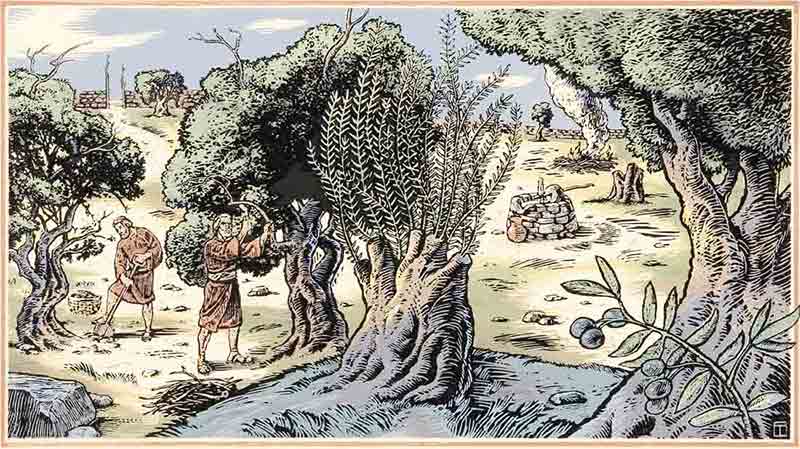
| Symbol | What It Might Represent |
| The vineyard | The world. “ The allegory of the olive tree could be called the allegory of the olive orchard. Sometimes olive orchards were called vineyards. In Hebrew there is only one word for ‘orchard’ and ‘vineyard’.” (John W Welch) |
| Master of the vineyard | Jesus Christ |
| Servants | The Lord’s prophets |
| Tame olive tree | The house of Israel, the Lord’s covenant people. Tame = domesticated or cultivated. “As Lehi himself taught, no symbol could serve more powerfully and profoundly of God’s expansive, constant, redeeming love—including especially the love represented in the gift of his Only Begotten Son—than does the olive tree” (Jeffrey R Holland, Christ and the New Covenant, 163–64). |
| Wild olive tree | Gentiles, or non-Israelites (later in the allegory the wild branches are apostate Israel) |
| Branches | Groups of people |
| The roots of the tame olive tree | The covenants the Lord makes with His children, a constant source of strength and life to the faithful |
| The fruit | The lives or works of men |
| Digging, pruning, fertilizing, nourishing | The work the Lord does for His children to help them be obedient and fruitful. NB The verb ‘nourish’ occurs 22 times in this chapter. |
| Transplanting the branches | Scattering groups of people throughout the world, or restoring them to where they came from |
| Grafting | The joining of one group of people to another; referring to scattered Israel, it also means to “come to the knowledge of the true Messiah” (see1 Nephi 10:14) |
| Decaying branches | People dying spiritually from sin and apostasy |
| Casting branches into the fire | God’s judgments |
“The allegory speaks mainly of one much-loved tree. But there are others – an entire orchard of trees – each of which is valued by the Lord. In the allegory he toils personally alongside his hardworking crew of devoted servants as they cut and prune and transplant and nourish the precious trees. The allegory can be understood locally, perhaps in the context of a northern Israelite prophet who is deeply disturbed by the wickedness and apostasy that he sees in his beloved Israel in its early monarchical period or slightly later. Or it may be understood cosmically, embracing the entire sweep of human history, or at least large portions of it.” (John A Tvedtnes, Vineyard or Olive Orchard).
- The first decay and remedy (Pruning, digging and nourishing) Jacob 5:1-6
“The first, incomplete recovery may correspond to reforms under Hezekiah or Josiah.” (Grant Hardy)
2. The second recovery (Wild branches grafted in, withered branches burned, young branches transplanted elsewhere) Jacob 5:7-14
“The wild branches are gentiles who will become Israelites (or later, Christians) by conversion and intermarriage. The young branches are Israelites who will be taken abroad, though they will retain their Israelite identity in foreign lands. The roots my be Israelite covenants or scriptures or nationhood.” (Grant Hardy)
3. General success (Additional time and care needed for the third transplant) Jacob 5:15-28
Verse 15 – events in the future for Jacob
Verse 16 – the main tree
Verses 17-18 – “When Paul uses the metaphor of wild branches being grafted into an olive tree, he is referring to Gentile converts to Christianity in the first century CE; this may be the time period indicated here as well. (Grant Hardy)
Verse 19 – the first transplant: possibly represents the 10 tribes led away by the Assyrians in 722 BC. The Book of Mormon assumes that they kept a separate identity at least for a time.
Verse 23 – the second transplant: possibly represents the Jews who were taken to Babylon in 586 BC.
Verse 24 – the third transplant: the Nephites transplanted to a good spot of ground (the New World).
4. The second decay (Jacob 5:29-48)
Verses 30-40 – “After several more centuries, there is general apostasy among the combined Israelites and Gentiles, though there is still value in the roots of the mother tree. Similarly, apostasy has overtaken each of the three transplants, including the third, where the Lamanites will overcome the Nephites in the 5th c CE” (Grant Hardy)
Verse 44 – the Jaredites
“There is much more here than simply the unraveling of convoluted Israelite history. Of greater significance in this allegory is the benevolent view of God that it provides. He is portrayed here as one who repeatedly, painstakingly, endlessly tries to save the work of His hands and in moments of greatest disappointment holds His head in His hands and weeps, ‘What could I have done more for my vineyard?’ (Jacob 5:41, 47, 49.) This allegory is a declaration of divine love, of God’s unceasing effort as a father laboring on behalf of His children. As one writer has noted, ‘Zenos’s allegory ought to take its place beside the parable of the prodigal son. Both stories make the Lord’s mercy so movingly memorable.’ (John S. Tanner, “Jacob and His Descendants as Authors,” in Rediscovering the Book of Mormon, ed. John L. Sorenson and Melvin J. Thorne [Provo: Foundation for Ancient Research and Mormon Studies; and Salt Lake City: Deseret Book, 1991], p. 61.)” (Jeffrey R Holland, Heroes from the Book of Mormon, p. 37)
5. Third remedy (Cross-grafting between the main trees and the transplants; the worst branches are burned) Jacob 5:49-59
“The Lord postpones judgement in order to give the trees one last chance to bear good fruit and proposes regrafting the scattered natural branches back into the mother tree, including a gathering of scattered Israel in the last days. In addition, some of the newer branches of the mother tree will be grafted into the far-off trees…Only a few branches, the most bitter will be destroyed at this point.” (Grant Hardy)
“This part of the allegory is concerned with the gathering of Israel. The allegory spoke off Old World branches that had been scattered, at least including the lost ten tribes. Those are to be gathered in and brought back to the house of Israel. The New World branches are to be gathered. They too are to be reunited. The allegory does not mention specific locations. And those natural branches in the poor soil are not specifically mentioned, although it is certain that they too are part of the gathering.” (Brant Gardner, Book of Mormon Minute)
6. A Plan for One Last Effort (Servants are called for additional grafting, pruning, digging, and nourishing; the bad branches are gradually removed.) Jacob 5:60-69
“This is the last time such effort will be expended before the Judgement.” (Grant Hardy)
Additional servants are enlisted to continue the ingathering of Israel.
“It is possible that this separation of the righteous from the wicked refers to the last days when Satan will be bound. The millennial state will be one where the wicked have been cast off, leaving only the righteous.” (Brant Gardner)
7. Success again (Jacob 5:70-74)
“Following the plan laid out in vv 60-69, the Lord and a few servants increase the yield of good fruits by nourishing the good branches and pruning away the bad.” (Grant Hardy)
8. A prophecy of a third decay and the end of the vineyard (Jason 5:75-77)
“After the Lord and his servants have rejuvenated and restored all the olive trees in the vineyard, they will enjoy a long harvest season, until bad fruit reappears. At that time, the good and bad will be separated.” (Grant Hardy)

