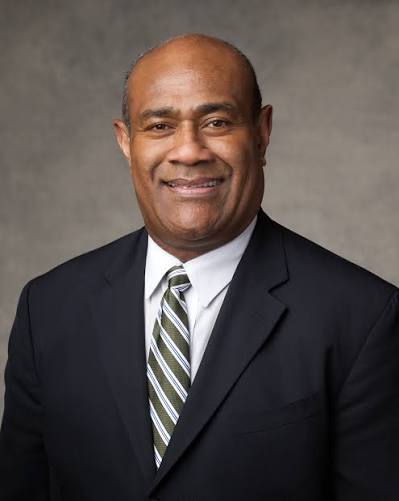
Biographical information from the Church website
Church Service
Elder Taniela B. Wakolo was sustained as a General Authority Seventy of The Church of Jesus Christ of Latter-day Saints on April 1, 2017. At the time of his call, he had been serving as president of the Arkansas Little Rock Mission. He is currently serving as a member of the Pacific Area Presidency.
Since joining the Church in 1994, Elder Wakolo has served in numerous callings, including seminary and institute teacher, branch president, high councilor, counselor in a bishopric, counselor in a stake presidency, stake president, president of the Arkansas Little Rock Mission, Area Seventy and president of the Philippines Area.
Professional Life
Elder Wakolo studied management and public administration at the University of the South Pacific. In 2007 he received a master’s degree in management from the University of Sunshine Coast, Australia.
Personal Life
Taniela Biu Wakolo was born in Lomaloma, Lau, Fiji, on June 25, 1967. He married Anita Herberta Moimoi in August 1987. They are the parents of two children.
Brief summary of talk
Elder Wakolo teaches that Heavenly Father’s plan is designed to unite individuals and families through Jesus Christ and the ordinances of the temple. He offers hope to those in part-member families, those waiting for loved ones to embrace the gospel, and those who long for eternal family blessings. Through personal experiences—including his own conversion and sealing to his wife, Anita—he testifies that God honours faithful patience, respects agency, and keeps His promises in His own time.
Key quotes and questions to discuss or ponder
‘…prophets, seers, and revelators testify of Jesus Christ and teach His doctrine so simply that it cannot be misunderstood. (Paragraph 2)
- Why is it important to teach the gospel simply?
’The temple stands as a symbol of hope, not pressure. The gospel of Jesus Christ is not a wedge to divide families but a bridge to unite them eternally. We must ensure that our discipleship reflects the Savior’s patience, His gentleness, and His perfect love.’ (Paragraph 14)
- In what ways can the gospel strengthen family relationships, even when family members have different beliefs?
- How can I ensure my discipleship draws my family closer together rather than creating distance?
- What lessons do you draw from the stories in paragraphs 17-21 and 23-25?
‘Sometimes the seed is planted long before it breaks the soil.’ (Paragraph 19)
‘Brothers and sisters, the Lord honors patient faith. And it is never too late for miracles.’ (Paragraph 22)
- Why is patience such an important attribute when helping others come unto Christ?
‘Brothers and sisters, God keeps His promises—but in His timing.’ (Paragraph 26)
- Where do I need greater trust in the Lord’s timing?
‘…conversion is personal. Timing is individual. Agency is sacred.’ (Paragraph 27)
‘The Savior never forces. He invites. He blesses. He fulfills promises according to faith and faithfulness.’ (Paragraph 33)
- What does it mean that “agency is sacred”?
‘To those who are waiting—do not give up.’ (Paragraph 29)
- How can we avoid becoming discouraged when loved ones make different choices?
Invitations and application
‘I invite you to make a commitment and choose to come unto Christ—together. Eternity shall be your reward.’ (Paragraph 34)
Elder Wakolo’s message is one of profound hope. Whether we are waiting for a spouse, a child, a parent, or another loved one to embrace the gospel, the Lord asks us to remain faithful, loving, and patient. The Saviour invites rather than compels, and as we follow His example, we become instruments in helping others come unto Him. God’s promises are certain, even if their fulfillment comes according to His perfect timing.
Additional thoughts
President Henry B. Eyring gave this assurance:
“My message ….to all of us trying to forge eternal families, is that there is joy guaranteed for the faithful. From before the world was, a loving Father in Heaven and His Beloved Son loved and worked with those who They knew would wander. God will love them forever.” (General Conference, October 2013.)
With a similar thought Elder Dieter F. Uchtdorf reframed the parable of the lost sheep as a testimony of God’s relentless love:
“Over the centuries, this parable has traditionally been interpreted as a call to action for us to bring back the lost sheep and to reach out to those who are lost. While this is certainly appropriate and good, I wonder if there is more to it. .. Is it possible that the Saviour’s message was that God is fully aware of those who are lost – and that He will find them, that He will reach out to them, and that He will rescue them?….To me, the parable of the lost sheep is one of the most hopeful passages in all scripture.” (General Conference, April 2016).
Elder Dallin H Oaks taught:
“We cannot have true faith in the Lord without also having complete trust in the Lord’s will and in the Lord’s timing.” (Timing, BYU Speeches, January 2002.)
President Gordon B. Hinckley gave an uplifting promise:
“I leave my blessing upon you. May there be . . . a sense of security and peace and love among your children, precious children every one of them, even those who may have strayed. I hope you don’t lose patience with them; I hope you go on praying for them, and I don’t hesitate to promise that if you do, the Lord will touch their hearts and bring them back to you with love and respect and appreciation.” (Remarks at a fireside in Crawley, England, reported in Church News 2 September 1995.)
You can watch Elder Wakolo’s talk here.
If you have found this post helpful, please subscribe or leave a ‘like’ or a comment. Thank you!

