The Gospel of Luke contains several parables that are sometimes called the “parables of mercy.” In this post I am going to focus on two of them: the parable of the Good Samaritan and the parable of the Lost Sheep.
Together they teach us not only what mercy looks like, but also how the Saviour extends mercy to each one of us, and by implication, how we should extend mercy to others.
The Good Samaritan (Luke 10:25-37).
In Luke chapter 10, a lawyer asks Jesus what he must do to inherit eternal life. As the conversation unfolds, he asks another question:
“Who is my neighbour?”
Jesus answers not with a definition, but, as He often did, with a story or parable.
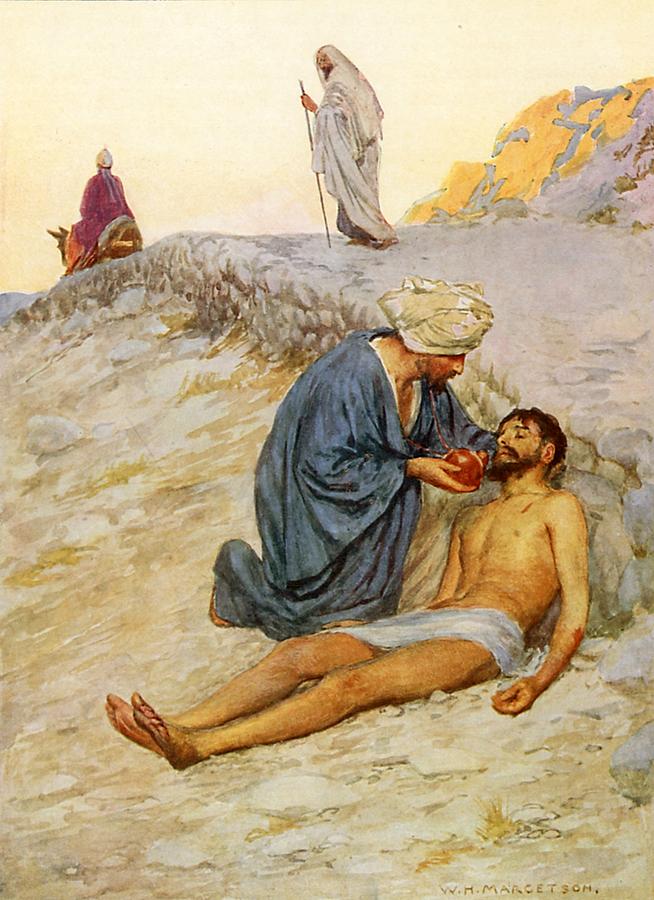
A traveller is attacked by thieves, robbed, beaten, and left half dead beside the road. A priest passes by and deliberately crosses to the other side. A Levite does the same. Finally, a Samaritan—a man whom the Jews would normally have despised—comes upon the injured traveller.
The Samaritan does four things.
First, he sees the wounded man.
Second, he draws near to him.
Third, he is moved with compassion.
Finally, he acts.
John W. Welch points out that the Greek word translated as compassion describes deep, inner sympathy and is used in the New Testament when writers wish to portray the divine compassion of God Himself.
That is significant. The Samaritan is not simply being polite or generous. He is demonstrating godly mercy.
Notice that the injured traveller has done nothing to earn this compassion. He is a complete stranger to the Samaritan. To Christ’s audience that day, the Samaritan represented a despised enemy.
The Samaritan asks no questions about who the traveller is, where he came from, or whether he deserves help.
This parable can also be seen as an allegory of our mortal journey and our relationship with Jesus Christ. Like the wounded traveller, each of us is on a dangerous journey and has been injured by sin, weakness, disappointment, and mortality. Left to ourselves, we cannot fully heal.
The Saviour comes to us. (He literally came into our mortal reality)
He sees us as individuals.
He draws near to us.
He is moved with perfect compassion.
Through His Atonement, He binds our wounds, carries us when we cannot walk, and pays the full price for our healing.
As we recognise ourselves in the wounded traveller, our gratitude for the Saviour’s mercy deepens.
But Jesus also invites us to become like the Samaritan.
The parable asks searching questions of each of us.
Who are the people I find difficult to love?
Who are the people I unconsciously avoid?
Have I become so busy, so comfortable, or so focused on my own plans that I pass by those who need my help?
The Samaritan did far more than feel sympathy. He sacrificed his own time, money, comfort, and energy to ensure that another person was cared for.
At the conclusion of the parable Jesus asks,
“Which now of these three, thinkest thou, was neighbour unto him that fell among the thieves?”
The answer comes in verses 36-37:
“He that shewed mercy on him.”
Jesus then gives one of His simplest and most challenging invitations:
“Go, and do thou likewise.”
President Thomas S. Monson beautifully applied this invitation:”Each of us, in the journey through mortality, will travel his own Jericho Road. What will be your experience? What will be mine?… Will I be one who sees, who hears, who pauses, and who helps?… Jesus provided our watchword, ‘Go, and do thou likewise.'”
Every day provides opportunities to notice someone who needs encouragement, friendship, forgiveness, or practical help. Sometimes mercy begins simply by seeing someone who feels invisible.
The Lost Sheep
Luke chapter 15 presents another beautiful picture of mercy. Jesus tells of a shepherd who has 100 sheep. When 1 wanders away, he leaves the 99 and goes in search of the 1 that is lost.
This sounds risky. If a risk assessment was carried out it would say ‘Stay with the 99’. 99 sheep in the fold are worth more than one in the wilderness. But this is the Good Shepherd who is full of mercy and compassion. For the One
The moment the Shepherd realises one sheep is missing, He acts.
The sheep may have wandered away, but it has never lost its worth.
The shepherd does not stand at the fold waiting for the sheep to find its own way home. He searches until he finds it.
When he finally finds the sheep, he does not scold it or punish it. Instead, he lifts it onto his shoulders and carries it home rejoicing.
This shepherd was able to rejoice with his friends and neighbours because his lost sheep was found. He was overjoyed with the rescue of this one, lost sheep. Jesus makes it clear that heaven gets excited about the salvation of just ONE lost soul.
This parable reminds us that each of us is, at times, the lost sheep.
Like sheep grazing, we often drift gradually rather than suddenly. Small distractions, small compromises, and small acts of neglect can slowly lead us away from the Shepherd.
And like the lost sheep we cannot save ourselves. We rely on the mercy of Jesus Christ’s atonement.
Thankfully, the Good Shepherd never stops looking for us. In Elder Kearon’s words, God is in relentless pursuit of us. He testified
” The Father’s design, His plan, His purpose, His intent, His wish, and His hope are all to heal you, all to give you peace, all to bring you, and those you love, home. “
He knows our names.
He knows where we are.
He knows how to reach us.
He rejoices when we return.
This is the heart of mercy.
The Tender Mercies of the Lord
The Hebrew word translated as mercy is often expressed in the plural—mercies—reminding us that God’s compassion comes to us in countless ways.
We experience His mercies as He forgives our sins through the Atonement of Jesus Christ.
We experience His mercies as He answers prayers.
We experience His mercies through the guidance of the Holy Ghost.
We experience His mercies through healing, comfort, strength, and quiet reassurance during difficult times.
Elder David A. Bednar described the tender mercies of the Lord as:
“The very personal and individualized blessings, strength, protection, assurances, guidance, loving-kindnesses, consolation, support, and spiritual gifts which we receive from and because of and through the Lord Jesus Christ.”
Further, he taught that “the tender mercies of the Lord are real and that they do not occur randomly or merely by coincidence. Often, the Lord’s timing of His tender mercies helps us to both discern and acknowledge them.”
Conclusion
The two parables we’ve considered today complement one another.
In the Good Samaritan, we learn how disciples of Christ should show mercy to others.
In the Lost Sheep, we learn how perfectly the Saviour shows mercy to us.
Sometimes we are called to become the Samaritan—to notice, to stop, and to help.
Sometimes we are the wounded traveller or the wandering sheep, desperately in need of the Saviour’s healing grace.
As we receive His mercy, our hearts should gradually become more merciful toward others. We should become more patient, more forgiving, more compassionate, and more willing to bear one another’s burdens.
Jesus Christ is the Good Shepherd. He is also the Good Samaritan. Because of His Atonement, no wound is beyond healing, no soul is beyond hope, and no one is ever beyond the reach of His redeeming love.
May we gratefully receive His mercy and faithfully extend that same mercy to everyone we meet.

